AI video technology is entering a new stage — and Mirage wants AI agents to do more than simply generate video clips.
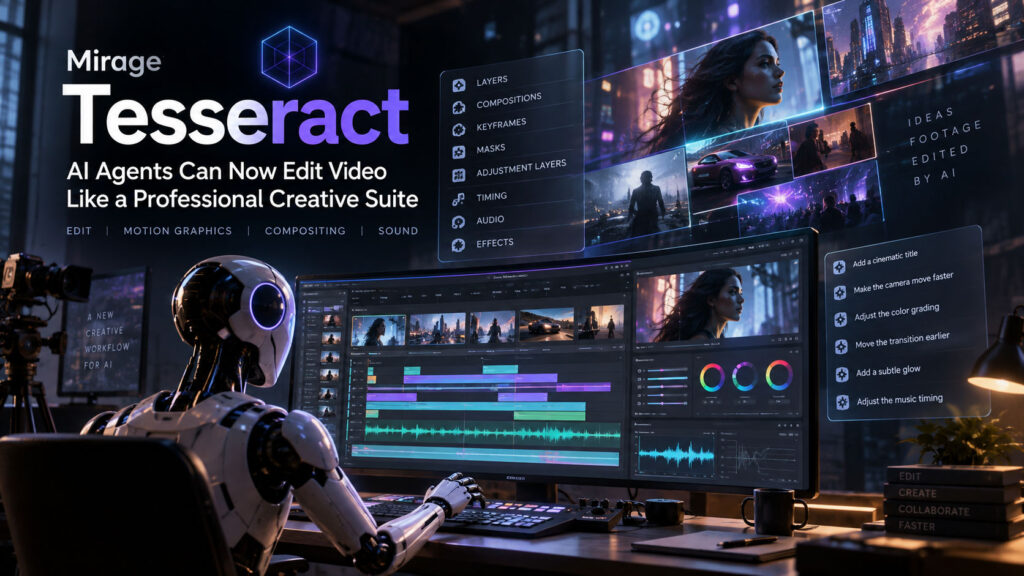
The company has introduced Tesseract, a video creative suite built specifically for AI agents. The system gives agents direct access to tools for video editing, motion graphics, compositing and sound, allowing them to create and modify editable video projects through natural-language instructions.
Mirage describes the concept as “Premiere and After Effects, rebuilt for agents.”
That positioning makes Tesseract particularly interesting for VFX, motion graphics and content-production professionals.
AI Agents Are Moving Into Professional Video Production
Traditional generative AI video tools generally focus on producing footage from prompts. Tesseract takes a different approach by giving an AI agent access to the underlying structure of an editable creative project.
From Prompt to Editable Video Project
Instead of asking an AI to simply generate a finished video, the agent can work with a structured creative project containing elements such as:
- Video layers
- Compositions
- Keyframes
- Masks
- Adjustment layers
- Timing
- Audio
- Motion graphics
The project remains editable, meaning creators can ask the agent to change specific elements without necessarily rebuilding the entire video.
For example, a creator could ask the agent to change the timing of a title, modify a keyframe, adjust a shot or rebalance the music.
AI Agents Work Directly With Video Concepts
One of the more significant technical ideas behind Tesseract is that the AI agent doesn’t need to operate a traditional editing interface by clicking through menus.
Instead, Mirage has built a creative engine around the underlying concepts of professional video production, including layers, compositions, animation timing, masks, effects and sound.
According to Mirage, this allows agents to work directly with video rather than attempting to represent a video project through technologies such as HTML or React.
A creator could potentially say:
“Move the title two seconds earlier and make the animation slower.”
The agent can then modify the appropriate elements within the editable project rather than generating an entirely new video.
Motion Graphics and Compositing Are Built In
Tesseract isn’t limited to cutting footage.
Its feature library includes tools for motion graphics, compositing, typography, effects and color, including keyframe animation, vector masks, adjustment layers, animated masks, track mattes, glow, blur, color correction and other effects.
It also supports techniques such as:
- Animated typography
- Screen replacement
- Parallax cards
- Neon text
- Motion paths
- Audio-reactive animation
- Procedural animation
- Time remapping
- Layer-based compositing
This puts Tesseract closer to a creative-production engine than a conventional text-to-video generator.
It Can Work With Existing Footage
Another important distinction is that Tesseract isn’t primarily a footage-generation system.
Creators can provide their own video footage, images, brand assets and audio, and the AI agent can use those materials to construct the project.
That opens up practical applications such as:
Social media production → Product videos → Motion graphics → Advertisements → Launch videos → Editorial videos → Short-form content
The system can also create original motion graphics around existing footage.
The Project Remains Editable
One of the biggest advantages of this approach is project continuity.
According to Mirage, an agent can create a project, preview it, receive feedback and make further changes while keeping the project editable.
That means the workflow can look more like:
Creative brief → AI builds project → Preview → Human feedback → AI revision → Preview → Final render
rather than:
Prompt → Generate clip → Start again → Generate another clip → Manually assemble everything
For professional creators, that difference could be significant.
Local Rendering Without a Traditional Editing Subscription
Mirage says the Tesseract creative engine runs locally and that its local preview, rendering and export are free. The user’s AI-agent subscription or model-usage costs are separate.
The current setup supports Mac and Windows, while the official documentation says Linux, WSL and cloud execution aren’t supported for the current local runtime.
The system also doesn’t require a Captions account, API key or Captions credits for the local engine, according to Mirage.
Tesseract and the Future of AI Video
The bigger story here isn’t simply another AI video tool.
It is the attempt to give AI agents an understanding of the structure of professional video production.
Today’s AI systems can generate impressive images and video. But professional production also involves:
Timing → layers → compositing → animation → sound → revisions → continuity → delivery
Tesseract is designed around those concepts.
Instead of treating video as a single generated object, the system treats it as an editable creative project that an AI agent can manipulate.
That could eventually change how creators interact with editing and motion-design software.
Human Direction Still Matters
Despite the automation, Mirage’s workflow still keeps the creator involved.
The user provides the creative brief, reviews the result and directs revisions. Mirage describes the process as giving the agent the technical tools while allowing the creator to remain responsible for the creative direction.
That distinction is important.
Tesseract isn’t replacing the need for a creative brief or artistic decisions. Instead, its goal is to let the creator communicate those decisions directly to an AI agent that can execute them inside an editable video environment.
Why This Matters for VFX and Motion Graphics
For the VFX and motion-graphics industry, this development is particularly interesting because it moves AI closer to the actual production pipeline.
Instead of AI being another separate tool used alongside Premiere, After Effects or other applications, the agent itself can potentially become the interface through which the creative workflow is controlled.
Imagine directing a sequence conversationally:
- “Make the camera move faster.”
- “Change the title animation.”
- “Add a glow to the graphics.”
- “Move this transition two frames earlier.”
- “Keep the footage unchanged but rebalance the music.”
The technology is designed to make this type of interaction possible while maintaining an editable project.
The Bigger Shift
Tesseract represents an interesting shift in AI video technology:
AI video generation
↓
AI-assisted editing
↓
AI-controlled creative workflows
The long-term question is whether AI agents can become reliable enough to handle increasingly complex professional production tasks while creators remain in control of the artistic decisions.
Mirage’s Tesseract is an early example of that direction — bringing editing, motion graphics, compositing and sound into an AI-agent workflow.
For creators, the most interesting part may not be that an AI can make a video.
It is that the AI can potentially understand and modify the video as a real production project.