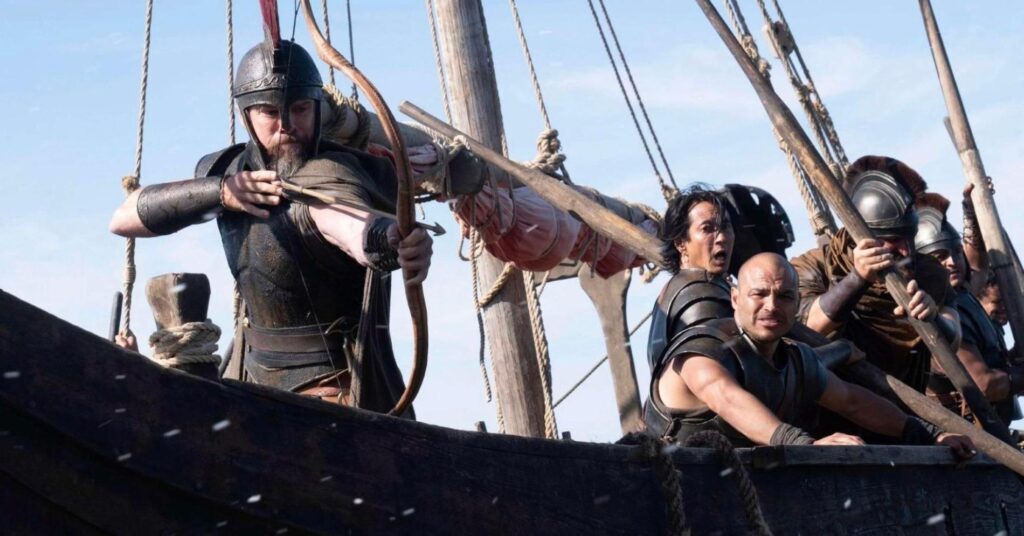
Christopher Nolan's The Odyssey brought ancient Greek mythology to the screen through an ambitious combination of practical filmmaking, large-scale creature effects and digital visual effects. In a production breakdown, the film's VFX supervisors describe how DNEG helped transform physical puppets, live-action performances and real locations into mythological sequences.
Published by Animation World Network on October 30, 2026, the behind-the-scenes feature explores the challenges faced by production VFX supervisor Andrew Jackson, DNEG supervisors Andy Lockley and Giacomo Mineo, and special effects supervisor Scott Fisher.
The production demonstrates how sophisticated digital techniques can enhance practical filmmaking without dominating the visual style.
Fewer Than 500 VFX Shots — But a Complex Production
Despite the film's mythological creatures, large-scale environments and dangerous sea voyages, The Odyssey reportedly contains fewer than 500 visual effects shots.
That number may appear modest compared with many modern effects-heavy blockbusters. However, the production required extensive digital work within individual sequences.
DNEG served as the film's sole visual effects vendor, working closely with Nolan's production team to preserve the director's preference for grounded, physically believable imagery.
Rather than designing every creature or environment entirely in computer graphics, the filmmakers frequently began with physical elements captured during principal photography.
These elements were then extended, modified or combined with digital performances in post-production.
The result illustrates an important distinction in contemporary visual effects: a relatively small shot count does not necessarily mean a simple production pipeline.
Building a 36-Foot Cyclops Puppet
One of the most technically demanding sequences involved the Cyclops, the giant creature encountered by Odysseus during his journey.
The production created a physical marionette approximately 36 feet tall and suspended it inside a real cave in Greece.
Using a large puppet gave the filmmakers a tangible reference for lighting, scale, interaction and camera movement.
However, the practical creature was only one component of the finished performance.
Actor Bill Irwin also portrayed the Cyclops in makeup on a separate set in Los Angeles.
DNEG's artists combined the large-scale puppet, Irwin's performance and fully computer-generated elements to construct the final creature.
The process required careful matching of perspective, anatomy, movement and lighting across footage captured in different environments.
Why the Cyclops Required 260,000 Frames of Digital Work
According to the production breakdown, the Cyclops sequence involved approximately 260,000 frames of footage requiring digital augmentation.
A particularly important challenge involved the creature's eye.
The filmmaking team needed the eye's movement and orientation adjusted before the editorial department could confidently select takes.
This meant that visual effects work had to begin unusually early in the editorial process.
DNEG used tracked three-dimensional information to support adjustments that could sometimes be completed using two-dimensional techniques.
That approach helped maintain the correct relationship between the eye, the creature's head and the camera angle.
The sequence is a useful example of how compositing and matchmoving can work together to preserve realism, even when the visible adjustment seems relatively small.
Combining Practical Performances With Full CGI
The Cyclops was not created through a single visual effects method.
Different shots required different combinations of puppet footage, actor performance and computer-generated imagery.
In some situations, the practical puppet provided the creature's body and scale, while digital effects completed missing anatomy or enhanced facial movement.
Other shots required a greater degree of CG reconstruction.
The challenge was especially significant when the creature appeared in brighter environments or interacted with water.
These situations exposed details that could remain hidden in a dark cave and required greater precision in the digital integration.
The artists had to preserve the weight and physical presence established by the practical footage while introducing movements that the original puppet could not perform.
Practical Effects Also Shaped the Sea Sequences
The production's emphasis on physical filmmaking extended beyond its mythological creatures.
Special effects teams used practical methods to create violent sea conditions, including fireboats and large quantities of water directed toward performers.
Other physical devices helped generate the basis for complex environmental effects.
Digital artists then enhanced or extended the photographed material where necessary.
This approach provided authentic water interaction, lighting and movement for the visual effects team to build upon.
It also reduced the need to simulate every environmental element from scratch.
However, blending practical water effects with digital imagery can still require demanding compositing, tracking and simulation work.
Nolan's Preference for Invisible Visual Effects
A central theme of the production is Nolan's preference for effects that feel integrated into the photographed world.
The VFX team emphasized restraint rather than spectacle for its own sake.
Effects that appeared too exaggerated could be reduced or revised to match the film's visual language.
This approach places considerable importance on lighting consistency, subtle animation, realistic textures and the interaction between physical and digital elements.
For audiences, the goal is to experience a believable cinematic environment rather than notice the techniques used to construct it.
For visual effects artists, achieving that result can require substantial technical work.
What VFX Artists Can Learn From The Odyssey
The production offers several valuable lessons for modern VFX pipelines.
First, practical elements can provide strong foundations for digital work, particularly when artists need accurate lighting and physical interaction.
Second, early collaboration between editorial and visual effects departments can become essential when unfinished effects influence shot selection.
Third, a hybrid production strategy can produce distinctive results when practical and digital departments work together from the beginning.
Finally, the project demonstrates that visual effects quality should not be judged simply by the number of CG shots.
A single complex sequence may involve extensive matchmoving, compositing, character work and environment reconstruction.
Final Thoughts
DNEG's work on The Odyssey highlights the continuing importance of combining traditional filmmaking techniques with advanced digital effects.
From a 36-foot Cyclops puppet to complex performance integration and digitally enhanced sea sequences, the production relied on practical foundations supported by sophisticated post-production work.
For filmmakers and VFX professionals, the project offers a compelling example of how CGI can expand the possibilities of physical filmmaking while maintaining a grounded visual style.