LAIKA is pushing stop-motion animation to an extraordinary level of physical detail with Wildwood, its upcoming fantasy feature arriving in theaters on October 23, 2026. One of the film’s most technically demanding characters is a giant golden eagle known as the General.
The eagle required a combination of traditional stop-motion craftsmanship, mechanical engineering, 3D printing and carefully designed puppet systems to create convincing movement frame by frame.
A Giant Stop-Motion Puppet
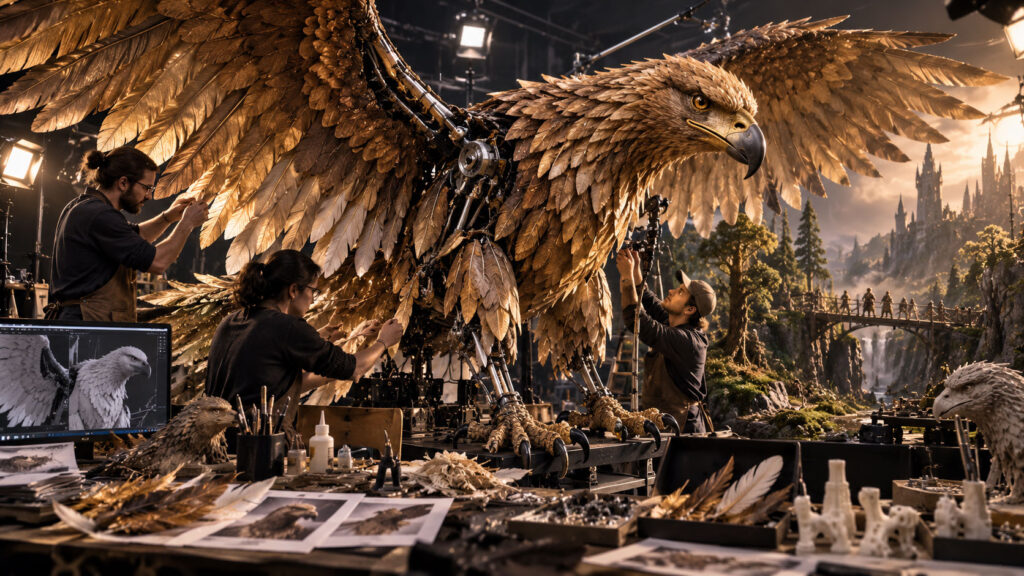
The General is considerably larger than a typical LAIKA puppet. The character measures about 2.5 feet tall with a wingspan of roughly five feet. LAIKA built three versions: two for flying sequences and another designed for scenes where the eagle’s wings are folded.
The scale created a major engineering challenge: the puppet needed to remain mechanically controllable while still behaving like a living bird.
Nearly 12,000 Feathers
One of the most remarkable aspects of the character is the feather work.
LAIKA’s fabricators cut between 3,700 and 4,000 feathers for each of the three General puppets, producing about 12,000 feathers in total. The feathers were made from laser-cut polyester satin, then dyed, embossed and individually attached by hand.
Selected feathers could also be manipulated by the animators. Wired feathers around the wing tips and neck helped create subtle changes that suggested wind resistance and movement.
3D Printing Meets Mechanical Engineering
The General’s neck presented another technical challenge. LAIKA created a 3D-printed, Slinky-like spiral structure that could stretch and bend while maintaining the silhouette of the neck.
An extendable barbell and rack-and-pinion mechanism, controlled through a bicycle-brake cable, gave the animator additional control for tighter bends.
The Puppet Can Breathe
LAIKA also incorporated a mechanical breathing system. A diaphragm inside the puppet allows the animator to create subtle expansion and contraction in the eagle’s chest.
The technique builds on LAIKA’s earlier experiments with mechanical “breathers” and gives the physical puppet a more organic presence.
Motorized Wings
The General’s large wings were another engineering problem. Because of their size and weight, LAIKA installed motors in the puppet’s shoulders.
The motors allowed very small adjustments to the wings while maintaining precise control over their position. The animation still happened one frame at a time; the technology gave the animator finer mechanical control rather than replacing the animator.
One Face for Every Frame
LAIKA’s facial animation combines physical fabrication with digital production tools. Actors recorded their dialogue before animation, and facial performances were planned using software including Autodesk Maya.
For the General, a different 3D-printed face was produced for individual frames of the performance. This allowed the animator to concentrate on eye direction, expression and emotional timing while replacing the face between frames.
Creating the Illusion of Flight
Making a five-foot-winged physical puppet appear to fly was one of the film’s most demanding animation challenges.
For the flying sequences, LAIKA used large mechanical systems including a hexapod, gimbal and track-based camera movement. The puppet could move through complex orientations while the camera moved around it, creating the impression of a much larger flying environment than the physical stage space.
According to The New York Times, animator Dobrin Yanev spent four years completing the flight sequence.
Stop Motion + Digital Effects
Although Wildwood is fundamentally a stop-motion production, the filmmaking process also uses digital visual effects to expand and enhance the physical world.
This combination preserves the tactile qualities of stop-motion while allowing filmmakers to extend environments and effects beyond what could be achieved entirely inside a miniature set.
For today’s VFX industry, the production is a useful example of how CGI and digital effects can complement practical filmmaking rather than simply replace it.
Why Wildwood Is Interesting for VFX Artists
The General demonstrates a production approach that combines:
- Traditional stop-motion
- Mechanical engineering
- 3D printing
- Digital animation tools
- Visual effects
The result is a character that retains the physical qualities of stop-motion while achieving movement and scale that would be extremely difficult with traditional puppetry alone.
Wildwood is scheduled for theatrical release on October 23, 2026.
Sources
Production details in this article are based primarily on The New York Times’ September 18, 2026 report on how LAIKA created the General, with additional cross-checking against recent production coverage.