
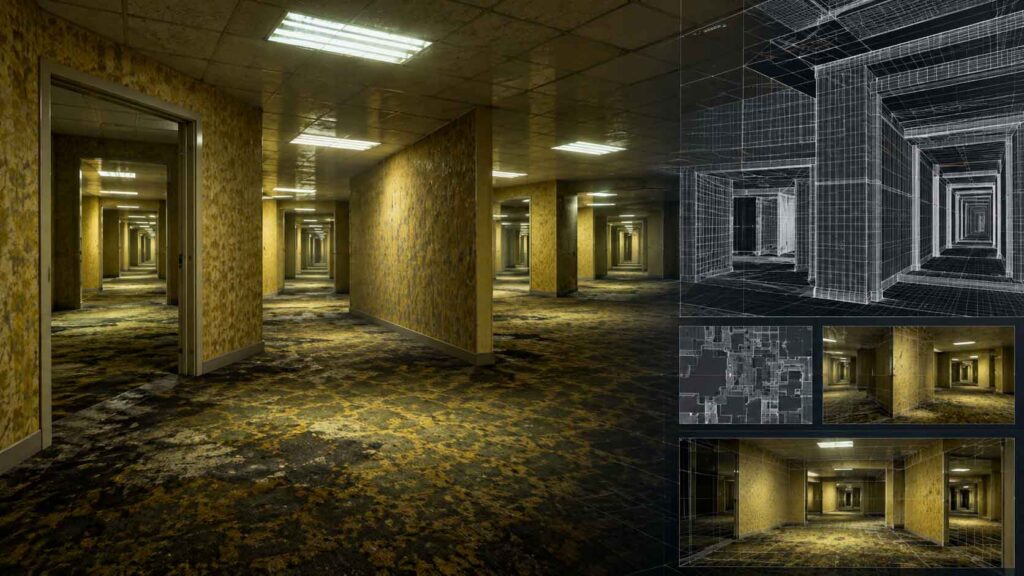
A new visual effects breakdown from Roxel Creative reveals how the team helped bring the unsettling world of Backrooms to the big screen, transforming digital mazes, familiar suburban streets and impossible rooms into convincing cinematic environments using Blender and visual effects.
What makes an ordinary room feel deeply unsettling? Sometimes, it is the sense that the space should continue forever — or that the world around you no longer follows the rules of reality.
That idea lies at the heart of Backrooms, A24’s psychological horror film directed by Kane Parsons. Originally inspired by Parsons’ viral online horror series, the film expands the strange, fluorescent-lit corridors and seemingly endless rooms into a feature-length cinematic experience.
On October 10, 2026, Roxel Creative released a new VFX breakdown showcasing its contribution to the film. Led by Calvin Romeyn, who served as an associate visual effects supervisor on Backrooms, the studio highlights work on the found-footage opening, a suburban street, an alleyway and the film’s disorienting Vertigo Room.
From Internet Horror to a Feature-Film World
The original Backrooms concept became popular through images and videos depicting empty, seemingly endless interiors. Its visual identity relies on ordinary spaces that feel subtly wrong: yellow wallpaper, patterned carpets, buzzing fluorescent lights and corridors that appear to have no logical end.
Recreating that atmosphere for a feature film presented a substantial production challenge.
The filmmakers needed environments that could support cinematic camera movements, character performances and increasingly complex sequences without losing the raw, unsettling quality of the original concept.
Blender played an important role in developing this world. Parsons had already used the software to construct environments for his earlier online videos, and those digital foundations became part of the feature film’s visual effects pipeline.
Rather than abandoning the original visual language, the production expanded it, combining practical sets with digital environments and carefully designed visual effects.
Blender at the Centre of the Digital Maze
One of the most interesting aspects of the production is its use of Blender for environment creation.
According to reporting on the film’s VFX pipeline, Parsons had digitally laid out approximately 100,000 square feet of Backrooms architecture. The physical production, meanwhile, constructed around 30,000 square feet of sets across four sound stages.
These figures illustrate how the production combined physical construction with a much larger digital world.
Practical sets provide real surfaces for actors, natural interactions with lighting and tangible details that are difficult to reproduce perfectly in CG. Digital extensions can then continue the architecture beyond the walls and ceilings visible on set.
This hybrid approach helps create an environment that feels physically present while suggesting a much larger, almost limitless structure beyond the camera.
It also allows filmmakers to control how spaces connect, how corridors extend and how the audience perceives the geography of the maze.
Making the Vertigo Room Feel Impossible
The Vertigo Room is one of the standout environments highlighted in the new Roxel Creative breakdown.
Rooms of this kind are particularly challenging because their unsettling effect depends on the viewer’s expectations about architecture and perspective.
A convincing result requires careful control of geometry, camera position, lighting and the relationship between the room’s surfaces. If those elements do not work together, the environment can look like a conventional digital set rather than a place that feels physically impossible.
For visual effects artists, this is an example of how geometry can become part of the storytelling.
The environment does not simply provide a location for the characters. It helps communicate the psychological unease that makes the Backrooms concept distinctive.
How Visual Effects Expand Practical Sets
The feature’s wider VFX pipeline demonstrates how digital techniques can make relatively limited physical locations appear much larger.
Visual effects teams can extend walls, continue corridors, replace sections of a set and create additional rooms that were never physically constructed. These changes need to match the photographed material in perspective, lighting and surface detail.
The production also used digital techniques to create the film’s signature “no-clipping” moments, in which characters appear to pass through solid surfaces.
Reporting on the film’s VFX work describes how artists used room geometry, actor scans and carefully matched movement to create these transitions. The challenge was not simply removing a wall; it was preserving the visual logic of a character moving through a surface that should be solid.
This is where modelling, matchmoving and compositing work together. Even a brief effect can require careful alignment between the actor, camera and digital environment to make the impossible action feel convincing.
A Major VFX Effort Behind the Horror
The film’s production relied extensively on visual effects. Reporting indicates that approximately 600 of its 830 shots contained VFX, demonstrating how deeply digital work was integrated into the finished movie.
That does not mean every shot was entirely computer-generated. Instead, the production combined practical sets, digital extensions and full-CG sequences according to what each shot required.
The distinction is important. Building every room physically would limit the scale and flexibility of the environment, while making everything digitally could remove the natural interactions that help performances feel grounded.
The hybrid pipeline offered a way to balance those competing needs.
For a horror film built around disorientation, the result also gives the filmmakers control over how much of the environment the audience sees — and how much remains mysterious.
What VFX Artists Can Learn From Backrooms
The project offers several useful lessons for environment artists, 3D generalists and compositors.
- Start with a strong visual concept. The Backrooms’ simple architectural language is a major part of its identity.
- Combine practical and digital environments strategically. Physical sets provide tangible detail, while CG creates scale and flexibility.
- Use geometry to support storytelling. Unusual room layouts and spatial transitions can make the environment itself a source of tension.
- Match the camera and lighting carefully. Digital extensions need to feel continuous with the photographed material.
- Keep the audience focused on the experience. The most effective effects support the atmosphere instead of distracting from it.
Perhaps the biggest lesson is that impressive VFX does not always require photorealistic destruction or enormous action sequences. Sometimes, a carefully constructed room and a convincing camera move can be just as effective.
Watch the Roxel Creative Breakdown
Roxel Creative’s newly released breakdown provides a closer look at the studio’s work on Backrooms, including the found-footage opening, suburban street, alleyway and Vertigo Room.
Watch the breakdown and examine how the production combines digital environments with practical filmmaking techniques.
- Read the original breakdown at befores & afters
- Read VFXwire’s report on Roxel Creative
- Explore the wider VFX pipeline in VFX Voice
Follow Zgian for more VFX breakdowns, Blender workflows, CG environment techniques and behind-the-scenes insights from film production.