
Apple has introduced a redesigned MacBook Pro featuring its new PROLED XDR display, touchscreen interaction and M5 Pro and M5 Max processors. Announced on October 28, 2026, the new 14-inch and 16-inch laptops introduce major changes aimed at professional creators, including VFX artists, video editors, 3D designers and virtual production teams.
The latest MacBook Pro introduces tandem OLED display technology, a wider color gamut, high brightness levels and expanded connectivity.
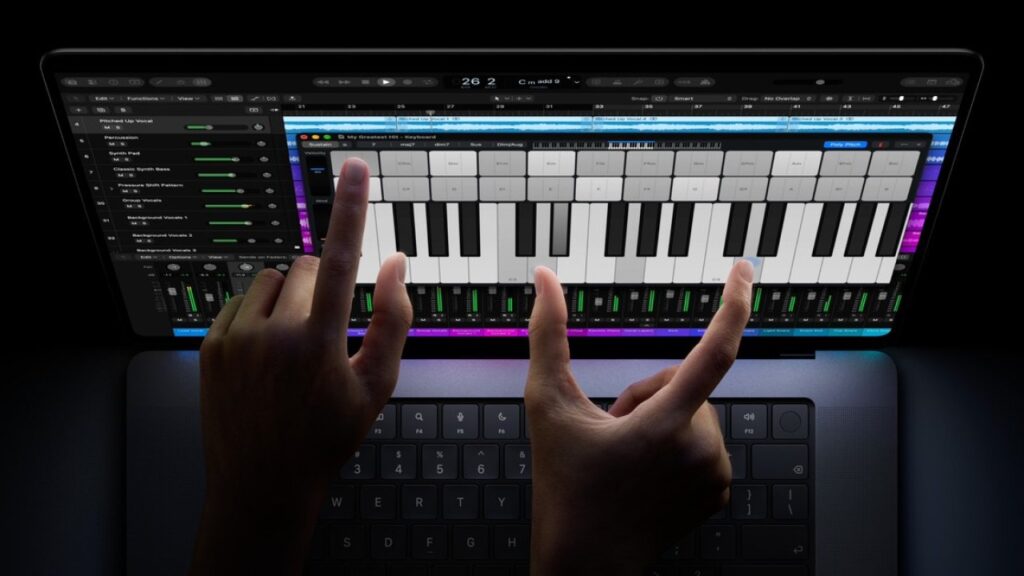
Apple has also added touchscreen interaction to the MacBook Pro for the first time, allowing creators to manipulate content directly on the display.
The new models are available for preorder, with retail availability beginning November 6, 2026.
PROLED XDR Introduces Tandem OLED Technology
One of the most significant changes is the introduction of Apple's PROLED XDR display.
The new panel uses tandem OLED technology, combining two self-illuminating pixel layers to improve brightness, contrast and image quality.
According to Apple, the display delivers up to 2,000 nits of peak HDR and SDR brightness, a claimed contrast ratio of 10,000,000:1 and a variable refresh rate of up to 120Hz.
It also supports both P3 and Adobe RGB color spaces, providing greater flexibility for color-critical creative work.
These capabilities are particularly relevant to professional photographers, colorists and visual effects artists who require accurate image reproduction.
Apple also highlights improved brightness uniformity, reduced reflections and precise factory calibration.
Touchscreen Interaction Arrives on MacBook Pro
For the first time, Apple's MacBook Pro supports direct touchscreen interaction.
Users can navigate applications, manipulate images and interact with creative software through gestures.
The touchscreen is integrated directly into the display rather than added as a separate external layer.
Apple says this approach helps reduce latency and improve responsiveness.
For creative professionals, touchscreen support introduces new possibilities for drawing, painting, editing and manipulating digital content.
Apple has demonstrated touchscreen functionality in applications including Pixelmator Pro, Final Cut Pro and Logic Pro.
Existing Mac applications can also interpret touch interactions through macOS compatibility features, although individual applications may require additional optimization to take full advantage of the technology.
M5 Pro and M5 Max Target Demanding Creative Workflows
The new MacBook Pro models are powered by Apple's M5 Pro and M5 Max processors.
Apple positions these chips for demanding professional workloads, including high-resolution video production, graphics processing and AI-assisted creative tasks.
The laptops support up to 128GB of unified memory and configurable storage of up to 16TB.
For VFX artists and 3D professionals, large memory configurations can be particularly useful when working with complex scenes, high-resolution textures and demanding compositing projects.
However, real-world performance will depend on software optimization, project complexity and hardware configuration.
Independent application-specific benchmarks will be important for evaluating the new processors against existing professional workstations.
Genlock Support Opens New Virtual Production Opportunities
Another important addition is genlock support.
Genlock allows compatible video systems to synchronize display refresh timing with camera capture.
This capability can help reduce visual artifacts such as tearing and synchronization problems during virtual production.
For filmmakers using LED walls and in-camera visual effects, synchronization between cameras and display systems is an essential technical requirement.
The addition of genlock makes the new MacBook Pro particularly interesting for mobile production teams and professionals exploring Apple-based virtual production workflows.
It does not eliminate the need for other specialized equipment, but it expands the laptop's potential role in production environments.
New Design and Professional Connectivity
Apple has redesigned the MacBook Pro to make it thinner and lighter.
The 14-inch model weighs approximately three pounds, while the 16-inch model weighs approximately four pounds.
Despite the slimmer design, the laptops retain professional connectivity options.
These include three Thunderbolt 5 ports, HDMI, an SDXC card slot, MagSafe charging and a headphone connection.
Wireless connectivity includes Wi-Fi 7 and Bluetooth 6.
The M5 Pro models support up to three external displays, while M5 Max configurations support up to four.
Apple also claims battery life of up to 24 hours, depending on usage.
Pricing and Availability
Apple announced the following US starting prices:
14-inch MacBook Pro with M5 Pro: $2,899. 16-inch MacBook Pro with M5 Pro: $3,399. 14-inch MacBook Pro with M5 Max: $4,499. 16-inch MacBook Pro with M5 Max: $4,799.
Preorders began October 28, 2026.
The new MacBook Pro is scheduled to become available through Apple Stores and authorized resellers on November 6.
Pricing and availability may vary by region.
What This Means for VFX and CGI Professionals
The combination of improved display technology, high-performance Apple silicon and touchscreen interaction could influence how creative professionals work on portable computers.
For compositors and colorists, the new display capabilities may improve the experience of reviewing HDR content and working across different color spaces.
For 3D artists, touchscreen interaction introduces additional possibilities for navigating and manipulating digital scenes, although software-specific support will determine how useful these features become.
For virtual production teams, genlock support is a notable addition that could help integrate portable Apple hardware into specialized filming environments.
The new hardware also provides a platform for future developments in AI-assisted creative applications.
Final Thoughts
Apple's 2026 MacBook Pro represents a significant redesign of its professional laptop lineup.
The introduction of touchscreen controls, tandem OLED display technology, M5 Pro and M5 Max processors, and genlock support broadens the device's potential applications across professional media production.
For filmmakers, editors, animators and VFX artists, the most important question will be how effectively these capabilities translate into faster and more flexible real-world workflows.