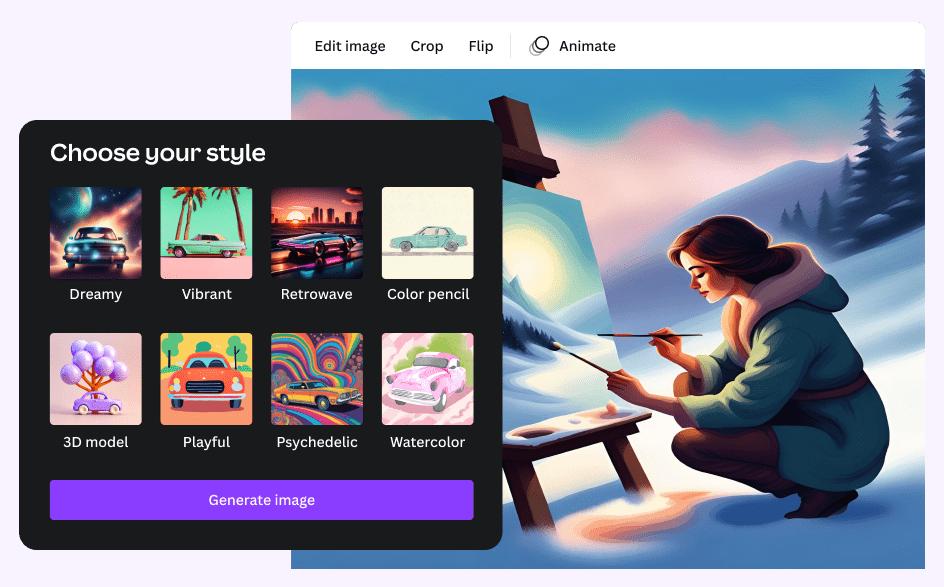
Canva has introduced Craft, its first image-generation foundation model developed and trained by its in-house Canva Research team. The new system separates image planning from rendering, an approach designed to improve control over composition, object placement and typography.
Announced on October 22, 2026, Canva Craft is available through Canva and its public API. The company says the model can produce images at up to 2K resolution and supports more than 30 aspect ratios, making it relevant to creators producing visual assets for different formats.
A Two-Stage Approach to AI Image Creation
Rather than generating the final image directly from a text prompt in a single stage, Craft first interprets the request and creates a plan. This planning stage accounts for the objects that should appear, their positions, relative sizes, visual hierarchy and any text that needs to be included.
A separate rendering model then turns that plan into the finished image. Canva argues that this architecture can improve the accuracy of complex compositions, particularly when an image needs several clearly arranged elements or readable typography.
These are Canva’s reported design goals and capabilities; independent production testing will be important to understand how consistently they translate into real-world creative work.
Why Editable Results Matter
For professional designers, generating an attractive first result is only part of the job. A client may ask to move a subject, adjust a headline or adapt the composition to a new aspect ratio without rebuilding everything from scratch.
Canva positions Craft around more precise editing and refinement, an important distinction from image-generation workflows where a small change can unpredictably alter the entire picture. The model’s design-focused architecture could make it useful for concept development, marketing visuals, social content and early-stage creative exploration.
Performance Claims and Future Versions
Canva says Craft achieved strong results in DesignArena evaluations, including high placements in people, landscape and other image categories. The company also describes improvements in generation efficiency and plans two additional variants, Craft-fast and Craft-ultrafast, aimed at reducing costs and improving throughput.
Those performance rankings and efficiency statements are company-reported. They should not be treated as a guarantee that Craft will outperform every competing model across all professional tasks.
What This Means for CGI and Digital Production
Although Craft is an image-generation model rather than a 3D modeling or AI video system, its planning-first approach is relevant to broader creative pipelines. Art directors and production artists increasingly need outputs that follow composition constraints and can be revised reliably, whether they are creating storyboards, style frames or presentation artwork.
The larger question is whether structured planning and editable outputs become standard expectations for generative creative tools. Canva Craft is a notable example of that direction, but its value will ultimately depend on how well it performs under real production demands.