
Digital Domain has revealed how it created visual effects for Steven Spielberg’s science-fiction thriller Disclosure Day, delivering 418 final VFX shots featuring digital environments, complex action, photorealistic creatures and a spectacular train chase.
The visual effects studio has released a breakdown showcasing its work on the film, offering a closer look at how computer-generated imagery, simulations and live-action photography were combined to build its cinematic world.
The project includes a 40-shot train chase, an enormous crop circle forming in a field, digitally created environments and alien creatures capable of disguising themselves as familiar animals. The work demonstrates the technical and artistic coordination required to make ambitious science-fiction sequences feel grounded in reality.
Reconstructing a Train Chase in CG
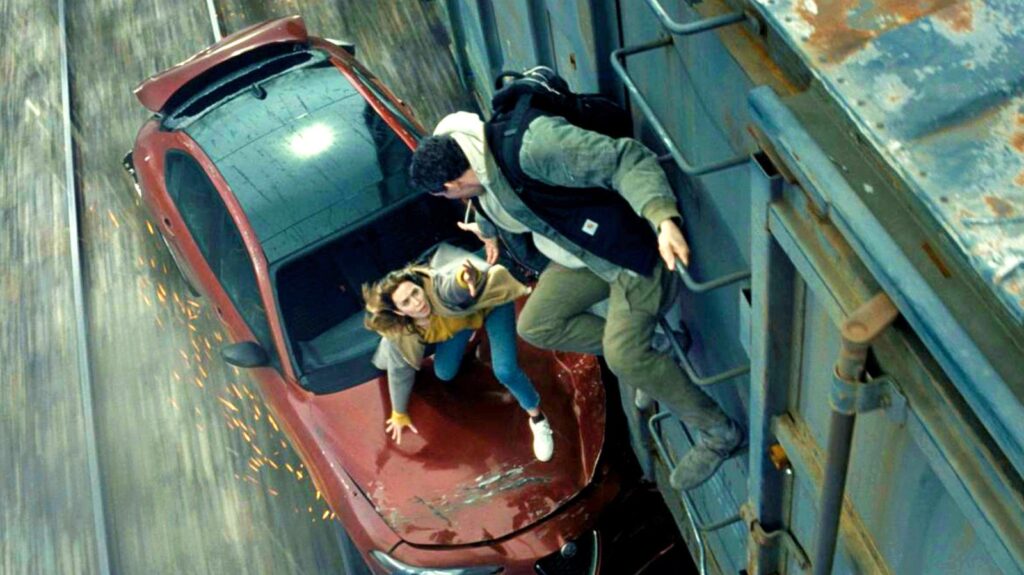
One of the major sequences involved a dramatic train chase comprising approximately 40 VFX shots.
To create the sequence, Digital Domain reconstructed a New Jersey location as a digital environment. The work combined CG surroundings, train enhancements, rig removal and face replacements to integrate the visual effects with the original footage.
The studio also developed a modular destruction system that allowed the train and surrounding vehicles to react convincingly to collisions. Flying debris and shattered glass helped communicate the physical impact of the action.
Sequences like this require more than detailed 3D models. Artists must coordinate camera movement, perspective, environmental detail, lighting, destruction and the timing of individual effects so that every shot feels like part of the same continuous event.
The result is a combination of practical photography and digital work designed to preserve the immediacy of the action while giving filmmakers greater control over what appears on screen.
Creating an Alien World Through Digital Environments
Digital Domain’s contribution also extended to environments that would have been difficult to capture practically.
In one sequence, bluescreen footage was transformed into a snow-covered forest. The digital environment featured frozen trees, detailed footprints and snow simulations that helped establish the atmosphere and physical character of the setting.
Another striking effect involved a crop circle forming across a field. The studio generated millions of digital grass blades and used carefully controlled animation and wind effects to create the large-scale pattern.
Such shots require close attention to environmental interaction. The movement of grass, the direction of the wind, lighting and the overall progression of the effect must work together to make a digitally constructed event feel believable.
Digital environments are particularly valuable in science-fiction filmmaking because they allow artists to create locations and events that would be impractical, expensive or impossible to reproduce in the real world.
Building Photorealistic Aliens and Animal Disguises
Creature work was another major part of the production.
The VFX breakdown features CG aliens alongside animal forms used as disguises, including a deer and a red cardinal. These creatures needed to integrate naturally into the film’s live-action environments while maintaining the visual credibility expected of high-end cinematic effects.
For the project, Digital Domain developed a new three-tier Creature Muscle system.
This system uses different levels of detail depending on the requirements of each asset:
- High-detail tier: Designed for hero creatures that require the greatest level of visual fidelity.
- Mid-detail tier: Provides an intermediate level of detail for shots with less demanding requirements.
- Automated low-detail tier: Supports faster production for assets that do not need the highest level of muscle detail.
This tiered approach allows artists to allocate technical resources according to the needs of individual shots, balancing visual quality with production efficiency.
Muscle systems are important in creature production because the way a character’s body moves and deforms contributes significantly to its perceived weight, anatomy and realism. The challenge becomes even greater when a digital creature must perform convincingly alongside real actors and animals.
Combining Technical Innovation With Cinematic Storytelling
The Disclosure Day project illustrates how modern VFX pipelines bring together several specialist disciplines.
Environment artists reconstruct locations and build digital worlds. Creature teams develop believable anatomy and movement. FX artists simulate destruction, snow and environmental effects, while compositors integrate these elements with the original photography.
Each discipline must work within the requirements of the final shot, including camera perspective, lighting, performance and editorial continuity.
The new Creature Muscle system is one example of how a studio can adapt its technology to the specific demands of a production. Rather than applying the same level of complexity to every asset, a tiered workflow can help direct detailed simulation and deformation work where it matters most.
For VFX artists and technical directors, the breakdown offers an opportunity to examine how large-scale action, creature effects and digital environments can be managed within one feature-film production.
Watch the Disclosure Day VFX Breakdown
Digital Domain’s breakdown showcases the train chase, alien creatures, crop-circle sequence and other visual effects created for the film.
Watch the breakdown and explore the production details:
- CG Channel: Check out Digital Domain’s VFX breakdown for Disclosure Day
- The Art of VFX: Digital Domain creates aliens, epic action and CG environments
Source: CG Channel and The Art of VFX, published October 19, 2026.
Zgian covers visual effects, CGI, animation, AI video and the production technology shaping film and digital entertainment.