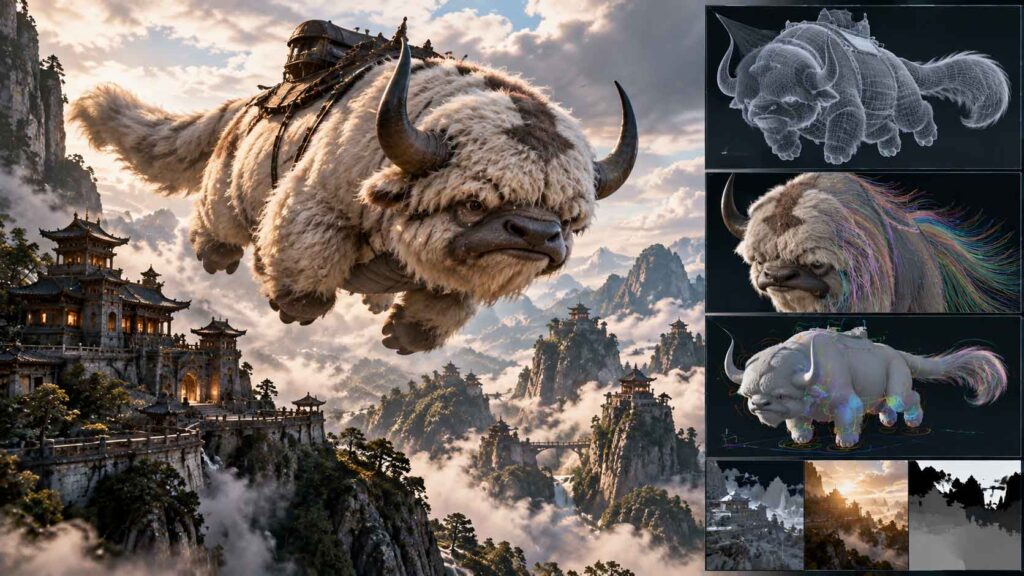
Framestore has revealed how its artists expanded the world of Netflix’s live-action Avatar: The Last Airbender for Season 2, creating the beloved flying sky bison Appa, introducing his younger family members and delivering emotionally demanding creature animation alongside large-scale fantasy environments.
Bringing a familiar animated creature into live action is about much more than making a convincing digital animal. The character must feel physically believable, communicate emotion and retain the personality that audiences remember from the original series.
That was the challenge facing Framestore’s London team as it returned to Appa for Season 2 of Avatar: The Last Airbender.
The new visual effects breakdown, published on October 15, 2026, highlights the studio’s work on Appa and other creatures, alongside the expanding environments and elemental effects featured in the season.
The project builds on Framestore’s work from Season 1, but the new season introduces a more demanding emotional journey for the flying bison. Appa faces capture and imprisonment, requiring the artists to communicate fear, anger and vulnerability while preserving the creature’s familiar design.
Turning an Animated Icon Into a Believable Creature
Appa presents an unusual character-design challenge. He is recognisably a bison, but he must also fly, express emotion and interact convincingly with human characters.
Framestore VFX supervisor Ross Wilkinson studied the original animated series and its concept material to understand the character’s proportions, movement and personality. The team looked at real animals to help establish a believable physical foundation for the digital creature.
The references included bison, manatees and hippos.
These animals offered different qualities that could inform Appa’s design. Bison provided the underlying identity and body shape, while manatees and hippos helped inform his mass, movement and other anatomical characteristics. His tail, in particular, drew inspiration from a manatee.
The challenge was combining these references without making Appa look like an ordinary animal with an unusual body.
A successful fantasy creature needs to feel as though its anatomy belongs to a coherent living being, even when its abilities are impossible in the real world.
Fur Grooming and Digital Detail
Appa’s thick coat is central to his appearance. Fur helps establish his enormous size, soft character and recognisable silhouette, but it also introduces technical complexity.
A creature of this scale requires careful grooming, shading and lighting so that its coat responds convincingly as it moves through different environments.
The groom needs to work in close shots as well as wide shots, where the overall shape and movement of the fur contribute to the character’s silhouette.
Framestore’s artists also had to ensure that Appa’s fur remained consistent during action sequences, including scenes in which the creature is restrained and struggles against his captors.
Small details matter in these moments. The way ropes press into the coat, how the fur shifts during movement and how the character’s body responds to force all help make the interaction feel physical rather than purely digital.
The result needs to support the performance without drawing attention away from the character’s emotions.
Baby Appa, His Mother and His Siblings
Season 2 expands Appa’s story by introducing baby Appa, his mother and his siblings.
Creating younger versions of a familiar creature is not simply a matter of reducing the size of the original model. Younger animals have different proportions, movement patterns and expressions.
Their bodies may appear rounder, their movements less coordinated and their behaviour more curious. These differences help communicate age and personality.
Framestore needed to preserve the visual relationship between the younger creatures and adult Appa while giving them their own identities.
The production VFX team specifically highlighted the challenge of capturing baby Appa’s childlike wonder.
This is an important aspect of creature animation: a convincing design establishes what a character looks like, but animation establishes who the character is.
The Emotional Challenge of Appa’s Capture
One of the season’s major sequences involves Appa being captured by the Dai Li.
The scene required more than a technically convincing creature animation. Appa needed to appear frightened and distressed while actively fighting against the people attempting to restrain him.
The sequence draws on the original animated series, including the use of darts and ropes to bring the enormous creature down.
Framestore and the production team needed to get several details right: the scale of the darts, how deeply they penetrate the fur, how the ropes wrap around Appa and how his body reacts as he struggles to escape.
These interactions involve several connected elements. The ropes must follow the creature’s movement, the fur must respond to contact, and the animation must communicate the force of Appa’s struggle.
The performance also needs to remain readable. Viewers must understand that Appa is resisting capture, not simply moving through an action sequence.
By building on the original character’s behaviour while adapting it to live action, the team could preserve the emotional meaning of the scene.
Giving Appa an Airbending Defence
Appa’s capture sequence also includes an important display of his airbending abilities.
The challenge was to make his defensive response feel powerful enough to repel attackers without suggesting that he had entered the Avatar State.
VFX supervisor Ross Wilkinson described the intended effect as more organic and primal than a fully controlled display of elemental power.
This distinction matters because elemental effects in Avatar: The Last Airbender are closely tied to character and storytelling.
The movement needs to feel connected to the creature’s physical actions rather than appearing as an unrelated visual effect layered onto the scene.
For VFX artists, this is a useful example of how creature animation and simulation work must be coordinated. The creature’s body movement, the timing of the effect and the reactions of surrounding characters all contribute to whether the moment feels convincing.
Building a More Practical Foundation for Season 2
Framestore’s work on Appa formed part of a wider production strategy for the new season.
Production VFX supervisor Marion Spates and production VFX producer Adam Chazen explained that the team aimed to build as much of the physical environment as possible before using bluescreens and digital extensions to complete the world.
This approach provides artists with real-world information about geometry, lighting, texture and depth.
A practical set gives the camera and performers tangible surfaces to interact with. Digital extensions can then expand the location beyond the physical construction.
For fantasy productions, that foundation can be particularly useful because the final environments often combine practical architecture, digital landscapes, elemental effects and computer-generated creatures.
The production also placed greater emphasis on earthbending and choreographed action in Season 2, requiring coordination between the stunt team, previs artists, directors and VFX departments.
What Creature Artists Can Learn From Appa
Framestore’s work illustrates several important principles for creating believable digital characters.
- Study real anatomy. Animal references help establish believable proportions, weight and movement.
- Design for emotion. Facial expressions and body language must communicate a character’s state of mind.
- Make interactions physical. Fur, ropes and other objects need to respond convincingly when they come into contact.
- Coordinate animation and FX. Elemental powers should feel connected to the creature’s actions and the surrounding scene.
- Respect the source material. Live-action adaptations can reinterpret animated designs while preserving the personality that makes the characters memorable.
The most important lesson is that a successful digital creature is not defined by detail alone. Its movement, expressions and interactions must work together to create a character the audience can believe in.
Watch the Framestore VFX Breakdown
Framestore’s new breakdown offers a closer look at its work on Avatar: The Last Airbender Season 2, including Appa, his younger family members and the fantasy environments surrounding the story.
The studio’s work demonstrates how creature design, animation, fur grooming and elemental effects can combine to bring an iconic animated character into live action.
Sources and further reading:
- Framestore — Avatar: The Last Airbender Season 2 VFX
- What’s on Netflix — Inside the Season 2 VFX
- The Art of VFX — Season 2 production VFX interview
- befores & afters — VFX breakdown coverage
Follow Zgian for more creature animation, CGI, VFX breakdowns and behind-the-scenes insights from film and television production.