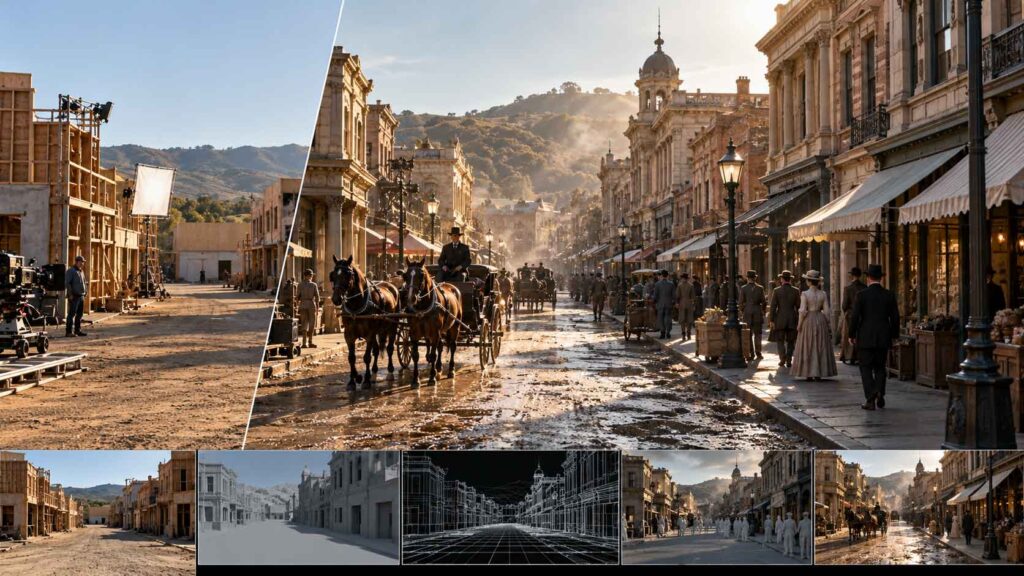
Framestore has revealed how it used extensive CG environments, digital set extensions and invisible visual effects to recreate early-20th-century California for Netflix’s adaptation of John Steinbeck’s East of Eden. The breakdown showcases how digital environments helped transform practical filming locations into historically convincing American settings.
Published on October 21, 2026, the new VFX breakdown offers a closer look at the work behind the period drama, including the recreation of residential streets, San Francisco’s Chinatown and a dramatic house fire. The project demonstrates how environment design, compositing and detailed effects work can expand the possibilities of location-based filmmaking.
Rebuilding California Through Digital Environments
Set in the early 20th century, East of Eden follows a multigenerational family saga against the backdrop of California’s Salinas Valley. Recreating the period required more than costumes and physical sets: the streets, buildings and surrounding environments also needed to reflect the era.
Framestore built extensive CG environments that could be integrated with the production’s practical locations. Its work included individual houses, an area known as Brothel Row and the streets of San Francisco’s Chinatown.
Digital environment work allows filmmakers to extend real locations beyond their physical boundaries. A street filmed on a limited set can become a larger neighbourhood, while additional buildings and architectural details can establish a convincing sense of place.
The challenge is making these additions feel as though they were captured by the same camera under the same conditions as the original footage. Artists must carefully match perspective, lighting, colour, atmospheric depth and image detail.
For a period drama, the smallest inconsistencies can weaken the illusion. Modern buildings, contemporary objects or incorrect architectural details can undermine the historical setting, making accurate environment design essential to the final result.
From Production References to Final CG Shots
The breakdown follows several environments from their original production references through to their final rendered appearance. This before-and-after approach illustrates how digital work can substantially change what audiences see without drawing attention to the visual effects themselves.
The process typically involves several connected disciplines:
- Environment modelling: Building digital architecture and surrounding structures.
- Texturing and look development: Creating convincing surfaces, materials and signs of age.
- Lighting: Matching the CG environment to the live-action plate.
- Compositing: Combining practical photography and digital elements into a coherent final image.
When these stages work together, the result can appear to be a real location captured during filming rather than a digitally reconstructed environment.
This approach is particularly valuable for historical productions, where finding a complete, untouched period location can be difficult or impractical.
Creating a Dramatic House Fire
Not every effect in the production was designed to remain invisible.
One of the more dramatic sequences involved a fire consuming the Ames House, an effect that played out across four shots. Framestore’s contribution demonstrates the contrast between its extensive environment work and more immediately noticeable effects.
Fire effects require careful integration with the surrounding scene. Flame movement, brightness, smoke, changing illumination and the interaction between the fire and the building all influence how convincing the sequence feels.
The visual effects team must also maintain continuity from shot to shot. The progression of the fire, the appearance of the structure and the lighting on nearby objects must remain consistent as the sequence unfolds.
In a production that relies on realistic historical environments, a dramatic event such as a house fire must feel as though it belongs to the same physical world established by the quieter scenes.
The Importance of Invisible VFX
The breakdown also highlights smaller effects that audiences may never consciously notice. These included an animated deer reacting to a hunter’s rifle blast, blood effects, muzzle flashes, and cleanup work involving wigs and prosthetics.
Such details are an important part of modern visual effects production. Not every shot requires a spectacular digital creature or a completely computer-generated world. Sometimes, the most effective work is a subtle adjustment that preserves the performance while removing a technical distraction.
Invisible VFX can help maintain continuity, enhance an action or make a practical element fit more naturally into the final image. When executed well, these changes support the story without taking the audience out of the scene.
Why Framestore’s East of Eden Breakdown Matters
Framestore’s work on East of Eden demonstrates how contemporary VFX pipelines support period filmmaking through a combination of extensive CG environments and targeted shot-level effects.
The project also highlights the range of skills required in episodic visual effects. Environment artists, modelers, texture artists, lighting specialists and compositors must collaborate to ensure that digital locations and practical photography remain visually consistent.
For artists working in CGI, compositing and digital matte painting, the breakdown provides a useful look at how real-world production references can be developed into convincing final environments.
Ultimately, the goal is not simply to create detailed CG buildings. It is to establish a believable sense of time and place, allowing viewers to become immersed in the story without questioning how the world was constructed.
Watch the VFX Breakdown
Framestore’s breakdown shows how its artists transformed production references into the final environments and effects for Netflix’s East of Eden.
- befores & afters: Watch Framestore’s VFX breakdown for East of Eden
- CG Channel: Watch Framestore’s VFX breakdown for period drama East of Eden
- Framestore: Explore Framestore’s episodic VFX work
Sources: befores & afters, CG Channel and Framestore.
Zgian covers visual effects, CGI, animation, AI video and the production technology behind film and television.