An abandoned environment project became a striking cinematic water scene after artist Mario Sánchez Aguado rebuilt his workflow around Houdini Solaris and Karma XPU. The project demonstrates how a more efficient scene-assembly and rendering pipeline can help artists focus on lighting, look development, effects and compositing.
From an abandoned project to a cinematic scene
The project originally began in Maya and Arnold. However, the modeling workflow proved frustrating, and the artist set the scene aside for approximately a year. After developing his skills in USD and Houdini Solaris, Aguado returned to the project with a different approach. Solaris provided a USD-based environment for scene layout, look development and lighting, while Karma XPU became the main rendering solution.
Building convincing ocean effects
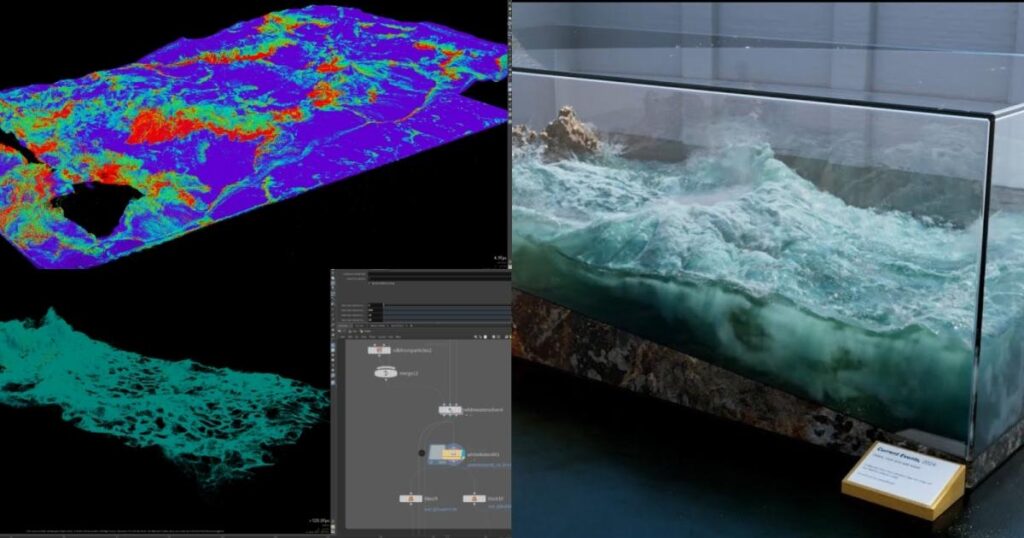
Water was one of the most important technical decisions. Rather than creating an extremely dense ocean mesh with multiple layers of displacement, Aguado used Houdini’s Ocean Procedural to generate the surface. This approach provided the large-scale movement and surface detail he needed while avoiding excessive geometry and longer render times.
The underwater appearance also depended on carefully controlled transmission and lighting. Turquoise illumination scattered across coral and fish created the bioluminescent look, while the ocean’s depth helped establish the atmosphere.
Finishing the shots in Nuke
The final images were completed in Nuke, where the artist added camera shake, lens effects and caustic effects to enhance the cinematic result. The project illustrates how a successful VFX scene is rarely about a single application: Houdini handled procedural and water workflows, Solaris organized the scene, Karma XPU rendered the imagery, and Nuke provided compositing.
Lessons for VFX artists
The key takeaway is the value of choosing tools around the needs of a shot. A complex simulation is not always necessary when a procedural surface can deliver the required result more efficiently. For cinematic environments, procedural workflows, reusable assets, thoughtful lighting and compositing can be more valuable than adding complexity at every stage.
Original source: 80 Level — This Dreamy Wooden Cabin Scene with Glowing Water FX Was Made with Houdini