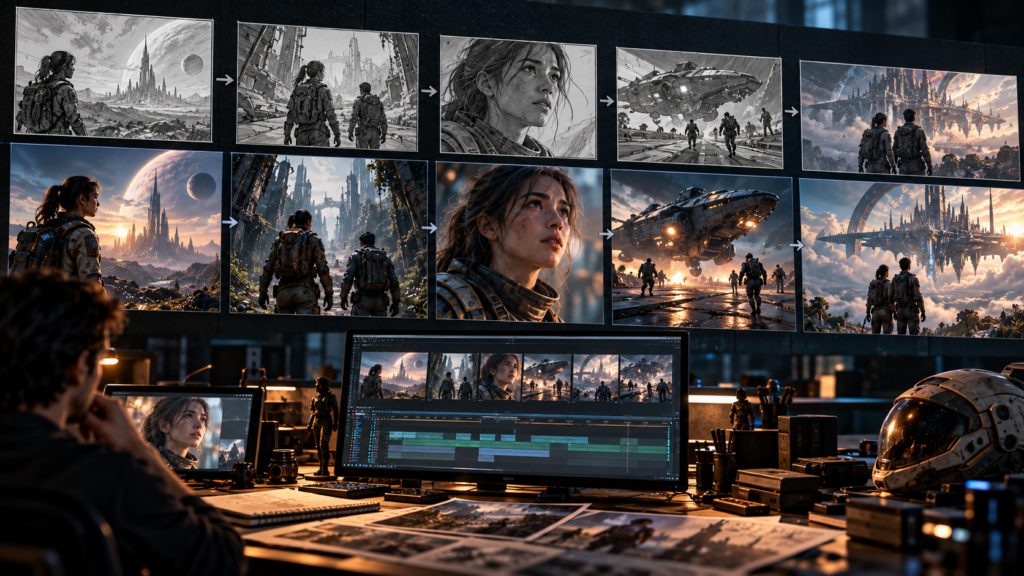
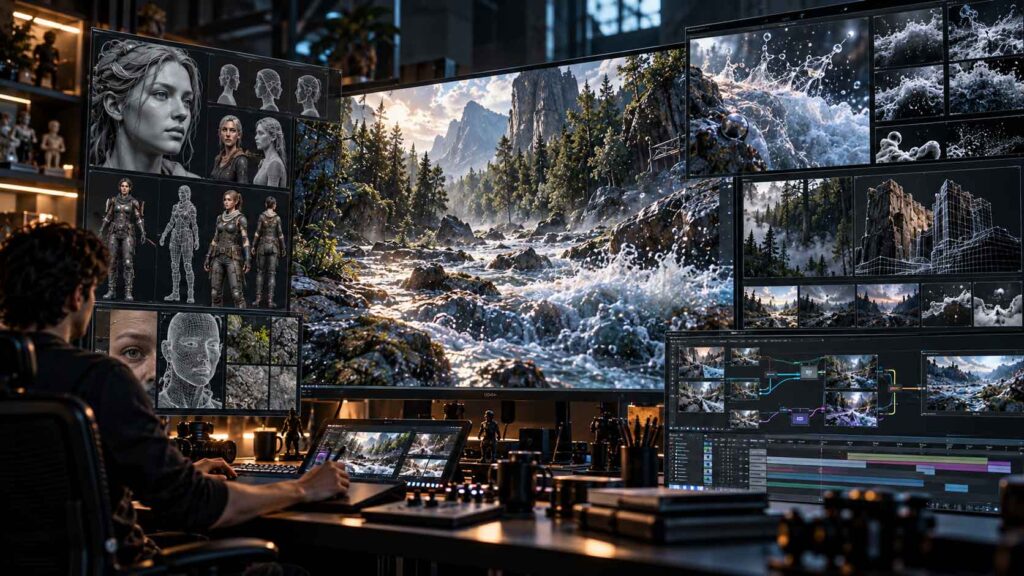
Maxon has announced its Fall 2026 software release, introducing version 2027.0 updates across Cinema 4D, ZBrush, Redshift, Red Giant and Autograph. The release focuses on procedural 3D environments, liquid simulations, integrated sculpting workflows, faster rendering feedback and new ways to connect AI assistants with creative applications.
3D artists and visual effects professionals are getting a broad set of workflow improvements with Maxon’s latest software release. Rather than focusing on a single headline feature, the update improves several stages of production — from building complex environments and sculpting characters to rendering scenes and compositing final shots.
Announced on October 14, 2026, the release introduces new capabilities across Maxon’s creative software ecosystem.
For artists working in CGI, animation, motion graphics and VFX, some of the most interesting changes are the new Scatter and Liquid FX systems in Cinema 4D, the integrated UV Editor in ZBrush, and AI-agent connectivity in Autograph.
Cinema 4D 2027: A New Procedural Scatter System
One of the biggest additions to Cinema 4D 2027 is a new procedural Scatter System.
Environment artists frequently need to populate scenes with large numbers of objects, including trees, rocks, vegetation, debris and other environmental details. Building and positioning these elements individually can become time-consuming, particularly when creating expansive landscapes or cinematic environments.
The new Scatter Generator and Scatter Tag provide controls for object distribution, filtering, clustering and transformation. Integration with Cinema 4D’s MoGraph tools also allows artists to use Fields and Effectors to influence how scattered objects are arranged and animated.
This gives artists a more direct way to build dense environments while retaining control over the final composition.
For example, an artist creating a forest could use procedural scattering to distribute trees across a terrain, control where they appear, create clusters and adjust their placement without manually positioning every asset.
The same general workflow can be useful for rocky landscapes, abandoned buildings, rubble, set dressing and other scenes that require large amounts of environmental detail.
The important benefit is not simply generating more objects. It is making large-scale scene construction easier to art-direct and revise.
Liquid FX Adds Foam, Spray and Bubbles
Cinema 4D’s unified simulation system also gains Liquid FX, which adds automatically generated secondary effects to liquid simulations.
The new system can produce foam, spray and bubbles that respond to the underlying liquid behaviour. These details help make simulated fluids appear more convincing without requiring artists to construct every secondary effect as a separate simulation.
This is relevant to a wide range of visual effects and motion-design work.
A pouring liquid, for example, can require splashes and bubbles around the point of impact. Waterfalls may need spray and foam, while fast-moving liquids can benefit from additional surface details.
By connecting these secondary effects to the main simulation, Liquid FX aims to reduce some of the extra work involved in building a finished fluid shot.
For artists producing product animations, motion graphics or cinematic simulations, this could help streamline the process of moving from a basic fluid effect to a more polished result.
ZBrush 2027 Introduces an Integrated UV Editor
ZBrush 2027 brings another important workflow improvement: artists can now create and edit UVs directly inside ZBrush.
UV mapping determines how a 2D texture is placed onto a 3D model. It is a critical stage of character creation, creature modelling, props and other assets that need to be textured for production.
Previously, artists might need to move between sculpting software and a separate UV application to complete this stage of the pipeline.
The new UV Editor supports professional workflows including UDIMs and texel-density controls, allowing artists to work on UVs without leaving the ZBrush environment.
UDIM workflows are particularly useful for detailed characters and complex assets that require multiple texture tiles to maintain sufficient resolution.
Keeping UV editing closer to the sculpting workflow can reduce application switching and make it easier to prepare models for texturing and downstream production.
Selection Sets for More Flexible Sculpting
ZBrush 2027 also introduces Selection Sets, allowing artists to save and recall selections and configurations involving elements such as Polygroups, masks, Polypaint, morph targets and UVs.
This is useful when working on complex models that require repeated changes or multiple creative variations.
Instead of rebuilding selections manually each time, artists can return to saved configurations and continue working from a known state.
For character artists and 3D generalists, this type of improvement can reduce repetitive work during iterative sculpting and asset preparation.
Redshift 2027: Faster Feedback While Working
Rendering performance is another major focus of the update.
Maxon says Redshift 2027 improves memory utilisation and interactive performance, helping artists see the effects of changes to lighting, materials and scene elements more quickly.
Faster feedback can make a significant difference during look development.
Artists often make repeated adjustments to materials, lights, camera settings and rendering parameters before arriving at the desired image. When feedback is slow, each iteration interrupts the creative process.
The update also improves the integration between Cinema 4D and Redshift, including easier access to Cinema 4D objects and systems within material workflows.
A further addition is procedural generation of fur, fibres, textiles and knitted materials at render time. These capabilities can help artists create detailed surface appearances without having to model every strand or fibre individually.
For digital artists working on characters, fabrics and product visualisation, procedural materials can provide another way to achieve detailed results while retaining control over the final look.
Red Giant Adds AI-Powered, Depth-Aware Relighting
Red Giant 2027 introduces Scene Light, an AI-powered, depth-aware relighting tool designed to work with live-action footage and CG imagery inside Adobe After Effects.
The feature allows artists to place lights into existing footage and adjust how those lights affect the image. Potential applications include adding illumination from a muzzle flash or explosion, enhancing environmental light, and creating day-for-night treatments.
Relighting photographed footage can be difficult because the original scene’s lighting is already baked into the image.
Traditional workflows may require extensive masking, rotoscoping and colour adjustments to achieve the desired effect.
Scene Light aims to make this process more direct by using depth-aware technology to help artists control the lighting effect.
It does not remove the need for judgement and refinement. Artists still need to evaluate whether the new lighting matches the scene, whether the subject integrates naturally and whether the result supports the shot.
However, an interactive relighting workflow could make experimentation more efficient for compositors and motion designers.
Red Giant 2027 also brings Maxon Noise into Universe, adding procedural noise tools for textures, animated maps, transitions and abstract effects. Custom Schmutz and expanded light-source options in Real Lens Flares provide additional control over lens effects.
Autograph 2027 Connects Creative Workflows With AI Agents
Perhaps the most forward-looking addition is the introduction of an MCP server in Autograph 2027.
MCP, or Model Context Protocol, provides a way for compatible AI clients to communicate with supported applications and tools. In this release, Autograph can expose its capabilities to compatible AI assistants, allowing them to help with application tasks, answer workflow questions and automate selected operations.
The practical significance is that AI can potentially become part of the production workflow rather than being limited to generating images or text outside the creative application.
Depending on the supported tools and permissions, an artist may be able to use natural-language instructions to assist with repetitive tasks or navigate aspects of a project.
Maxon has also introduced a direct connection between Cinema 4D and Autograph, allowing compatible 3D elements — including animated objects, cameras, lights and nulls — to be copied between the applications.
This can help reduce the need to rebuild scene elements when moving between 3D production and compositing.
For studios exploring AI-assisted workflows, the combination of application connectivity and automation is an important development. The key question will be how reliably these integrations perform on real production projects and how much control artists retain over each operation.
What the Update Means for 3D and VFX Artists
Maxon’s Fall 2026 release covers several stages of the creative pipeline.
- Environment artists: The new Scatter System offers more procedural control over dense scenes.
- FX artists: Liquid FX adds automatically generated foam, spray and bubbles to liquid simulations.
- Character artists: The integrated UV Editor and Selection Sets can simplify asset preparation and iteration.
- Look-development artists: Redshift improvements aim to provide faster interactive feedback and additional procedural material options.
- Compositors: Scene Light offers a new approach to relighting footage, while other Red Giant additions expand the available creative effects.
- Technical artists: Autograph’s MCP support opens new possibilities for AI-assisted tasks and application workflows.
Not every feature will affect every artist equally. The value depends on the software already used, the requirements of the production and whether the new capabilities improve an existing workflow.
Nevertheless, the release demonstrates a clear direction: reducing friction between the different stages of digital content creation while giving artists more direct control over complex scenes and effects.
Availability
Maxon announced the 2027.0 releases of Cinema 4D, ZBrush, Redshift, Red Giant and Autograph for October 14, 2026. The official announcement provides the overview of the new features and availability.
Read the full announcement on Maxon’s official website.
Follow Zgian for the latest developments in CGI, VFX, 3D animation, motion graphics and AI-assisted creative production.