One of the most technically interesting visual effects in Superman is the holographic message left by Superman’s Kryptonian parents.
Rather than creating the characters entirely as conventional CG digital doubles, Framestore used 4D Gaussian Splatting to capture real actor performances as volumetric data, creating what the studio describes as a form of “living photography.”
Framestore is presenting the technology in a dedicated September 22, 2026 session led by CG Supervisor Kevin Sears, providing a closer look at how the technique was adapted for feature-film production.
What Is 4D Gaussian Splatting?
Gaussian Splatting is a relatively new approach to representing a 3D scene.
Instead of constructing a traditional polygonal model with conventional textures, the technique represents a scene using millions of small anisotropic Gaussian shapes that encode information about light and volume.
The addition of the fourth dimension — time — allows the technique to represent moving subjects.
For Superman, Framestore integrated 4D Gaussian Splatting into its VFX pipeline to capture and reproduce moving actor performances. The studio says the system was trained at a rate of 4,600 images per second during the process.
Capturing the Kryptonian Performances
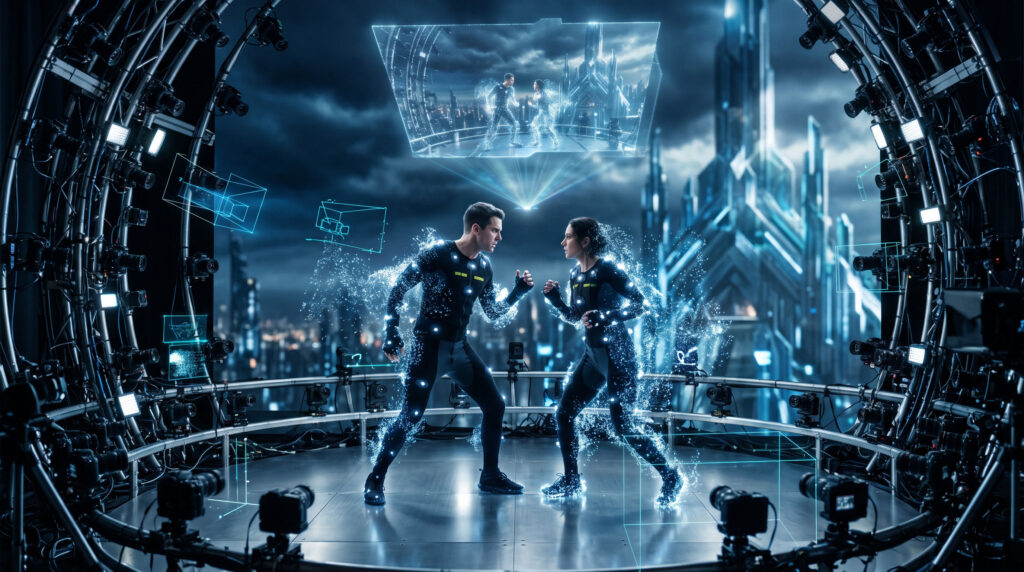
Framestore worked with Infinite Realities to capture the performances volumetrically.
According to Framestore, the system used nearly 200 cameras simultaneously, capturing the actors from multiple angles.
Rather than recording only a conventional 2D image, the process captured detailed information about the performers from different viewpoints and generated a high-precision moving volumetric representation.
This gave the VFX team something particularly valuable: the ability to manipulate the captured performance in post-production.
Re-Filming the Performance in Post
One of the major advantages of the technique was creative flexibility.
Traditional volumetric or motion-control approaches can require many decisions about cameras and movement to be made during the shoot.
With the captured volumetric performance, Framestore could effectively change the virtual camera after the performance had already been recorded.
Framestore’s Kevin Sears explained that the approach allowed the team to “re-film” the performance in post-production from different creative angles.
That could be particularly valuable for directors and VFX supervisors because camera decisions don’t have to be completely locked during capture.
Creating the Unstable Hologram
The technology also served an important storytelling purpose.
Superman’s Kryptonian parents appear as an unstable recorded holographic message.
Framestore was able to manipulate sections of the volumetric performance in 3D space, making parts of the hologram rotate, turn away, glitch and break apart while retaining the captured appearance of the actors.
This is an important distinction from simply adding a 2D glitch effect over a conventional image.
The captured performance itself could be manipulated as volumetric data, allowing the instability of the hologram to become part of the 3D visual effect.
Preserving Real Human Performance
Another advantage was performance fidelity.
Because the holographic characters were based on captured actors, Framestore could preserve details of their real performances rather than building every element from scratch using keyframe animation or conventional digital doubles.
The studio describes the result as “living photography” — a volumetric representation that retains the photographic qualities of the original performance.
For emotionally important scenes, this can be particularly useful. The technology provides a way to combine the authenticity of a real performance with the flexibility normally associated with a fully digital character.
A Different Kind of VFX Pipeline
The Superman hologram demonstrates how Gaussian Splatting could fit into a professional VFX pipeline.
The process can be broadly understood as:
Actor Performance → Volumetric Capture → 4D Gaussian Splatting → Virtual Camera → Digital Manipulation → Compositing → Final Hologram
This is different from a traditional CG workflow where artists might build a digital character, create a rig, animate it and then render the result.
It is also different from conventional live-action photography because the captured performance can be repositioned and viewed from different virtual camera perspectives after capture.
Why This Matters for VFX Artists
Gaussian Splatting has attracted significant attention across VFX, virtual production, games, digital humans and immersive media.
The Superman example is particularly interesting because it demonstrates the technology being integrated into a major feature-film production rather than remaining purely a research or demonstration technique. Framestore describes it as the first integration of 4D Gaussian Splatting in a feature film.
The technology doesn’t necessarily replace traditional CG. Instead, it adds another way to capture, represent and manipulate real-world performances.
- Digital humans
- Holographic characters
- Virtual production
- Volumetric filmmaking
- Interactive experiences
- Virtual reality
- Game cinematics
- VFX character work
The Future of Volumetric VFX
The most interesting part of Framestore’s work may be the creative control it provides.
A captured performance no longer has to be treated as a fixed camera recording.
Instead, artists can potentially treat it as a 3D performance that can be revisited and reshaped during post-production.
For filmmakers, that opens up an interesting possibility: capture the performance once, then explore camera angles, composition and visual treatment later.
For VFX artists, it introduces another tool between traditional photography and fully computer-generated imagery.
Final Thoughts
Framestore’s work on Superman shows how quickly the boundaries between photography, volumetric capture, machine learning and traditional VFX are evolving.
The Kryptonian hologram wasn’t simply created by putting a digital distortion over a filmed performance. The underlying performance itself became a manipulable volumetric representation.
And as 4D Gaussian Splatting continues to develop, this kind of workflow could become an increasingly interesting part of future VFX and digital-human production.
The next generation of visual effects may not be about choosing between real photography and CGI — but about turning real performances into flexible 3D data that artists can reshape long after the cameras stop rolling.
Sources
Information in this article is based on Framestore’s published production information and its September 22, 2026 presentation about the technology.
Framestore — Official Website
Infinite Realities — Official Website