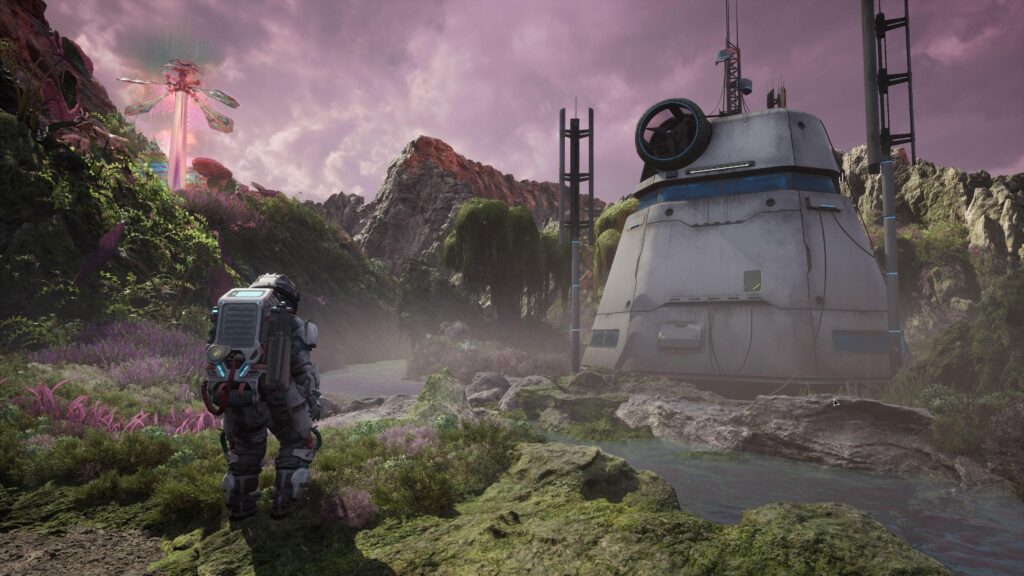
A terraforming environment must do more than look convincing. It must support changing world states, dense vegetation and stable real-time performance. A production breakdown of The Alters: Last Variable explores these environment-art challenges.
A breakdown published by 80 Level describes work by 11 bit studios senior environment artist Artem Ostapchuk, covering a workflow that combines Blender, ZBrush and Unreal Engine 5.
Designing alien vegetation
Alien flora needs to feel unfamiliar while maintaining visual coherence. Artists develop distinctive silhouettes, surface patterns and growth structures, then prepare assets for texturing and use in the game engine. A consistent visual language helps repeated assets create varied, believable environments.
Managing vegetation in Unreal Engine 5
Large environments can contain thousands of plants, rocks and repeated objects. Procedural content generation and instanced meshes help distribute assets efficiently. The breakdown discusses Nanite-compatible foliage geometry, procedural scattering and hierarchical instanced static meshes to support dense scenes and practical asset management.
Supporting different world states
Terraforming creates a further challenge: the environment must remain coherent as its appearance changes. A barren planet and its terraformed version may need different vegetation distributions, colours, silhouettes and visual landmarks. The pipeline must support these differences without compromising composition or gameplay readability.
Lessons for environment artists
The workflow illustrates how environment art combines traditional modelling, procedural tools and engine-level optimisation. Efficient scattering and instancing help deliver scale, but artistic direction remains essential to making an alien world distinctive.
Source: 80 Level production breakdown