
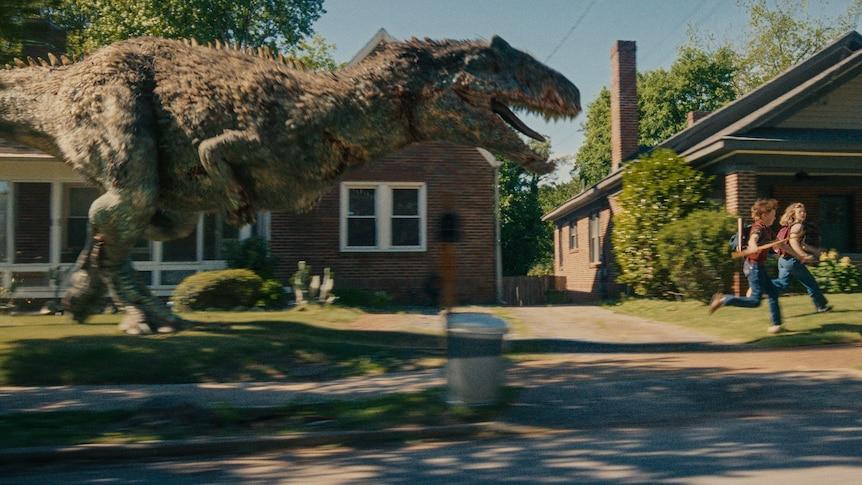
Industrial Light & Magic has revealed how its artists created approximately 700 visual effects shots for The End of Oak Street, transforming an ordinary 1980s American neighborhood into a prehistoric world filled with dinosaurs, swamps, forests and enormous digital environments.
Building a Prehistoric Neighborhood
The production filmed houses and streets at different real-world locations. ILM combined these environments digitally to create the illusion of a connected neighborhood surrounded by prehistoric terrain. The team extended streets, added houses, adjusted hills and constructed expansive views that could not have been captured practically. Period-appropriate details, including backyard pools, fences and residential architecture, preserved the look of the film's 1982 setting.
Creating Forests, Swamps and a Prehistoric Cliff
ILM developed prehistoric forests, a swamp, a massive cliff edge and a distant volcano. The abrupt boundary between the suburb and its prehistoric surroundings needed to appear unnaturally sharp, reflecting the mysterious event that transported the neighborhood. Artists studied geological references such as sinkholes and fractured cliffs, while adapting them to the story. The distant volcano was created using matte-painting techniques.
Designing 12 Prehistoric Species
The creature work involved approximately 12 prehistoric species, including Allosaurus, Coelophysis, Camarasaurus and a giant Titanoboa. Artists moved from 2D concepts to detailed digital models and surface treatments. Scars, damaged skin and other imperfections helped the animals feel dangerous rather than pristine. Bird movement informed the Coelophysis animation, with deliberately irregular timing used to increase tension.
Why ILM Used Hand Animation
ILM chose hand animation for the dinosaur stampede to retain direct control over creature performances and environmental interactions. In one sequence, an Allosaurus picks up and throws Ewan McGregor's character. The shot combined creature animation, a digital double, simulated clothing, digital ground replacement, flying dirt and compositing to maintain a convincing sense of weight.
Houdini and 3ds Max in the VFX Pipeline
Houdini was used extensively for creature-related work, including feathers and hair. The environment team used Autodesk 3ds Max to construct digital locations. ILM's Sydney, San Francisco and Vancouver facilities contributed to environments, creatures, previs and postvis, illustrating the coordination required across modeling, animation, simulation, lighting and compositing.
Balancing Horror, Realism and the Film's Rating
The team explored how far dinosaur attacks could go while preserving the intended PG-13 rating. Some shots required alternative versions of blood effects so filmmakers could adjust their intensity. The result combined horror-inspired creature animation with detailed digital environments.
A Major Showcase for Modern Creature VFX
The End of Oak Street shows how digital environments and character animation can transform a familiar suburban setting into an entirely different world. Its approximately 700 VFX shots offer insight into creature performance, environment integration, digital doubles and storytelling-driven effects design.