
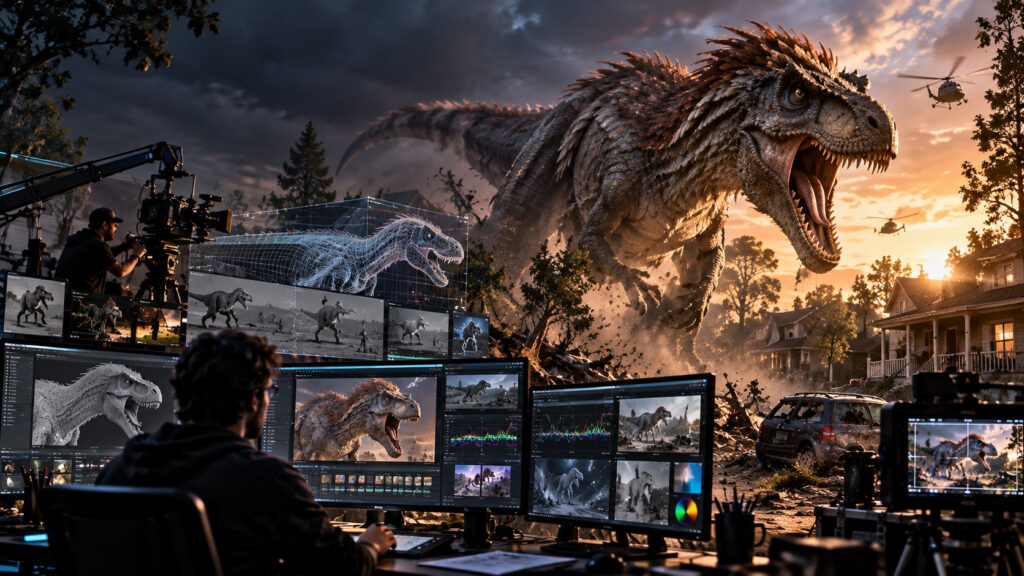
Industrial Light & Magic is giving audiences a closer look at the visual-effects work behind The End of Oak Street, David Robert Mitchell’s dinosaur-filled science-fiction film.
A new featurette goes behind the scenes of ILM’s work on the movie’s digital creatures. The production VFX team was led by ILM production VFX supervisor Jay Cooper. ILM’s official production page confirms Cooper’s role, alongside executive visual-effects producer Katherine Bluff and visual-effects producer Keith Anthony-Brown.
The film follows the Platt family after a mysterious cosmic event tears their suburban neighborhood away from the outside world and transports it into an unfamiliar environment populated by prehistoric creatures.
For ILM, that created a very different challenge from simply recreating familiar dinosaurs.
The team wanted creatures that felt like living animals within the film’s world.
Creating Dinosaurs That Feel Lived-In
According to Cooper, director David Robert Mitchell wanted the dinosaurs to look mangy, dirty and wounded, rather than perfectly clean creatures.
The visual-effects team explored different combinations of feathers, plumage, beaks, crocodilian skin and other characteristics inspired by the natural world.
The goal was not to reproduce the appearance of dinosaurs from previous movies. Instead, ILM developed its own visual language for the creatures.
The team looked at modern animals including elephants, crocodiles, alligators, cassowaries, emus, ostriches and snakes for behavioral and visual references. Animators could then use interesting or unsettling movements from those animals as inspiration for their dinosaur performances.
Giving Different Dinosaurs Different Personalities
Creature animation wasn’t treated as a one-size-fits-all process.
ILM’s animation team used horror references and observations from real animals to develop distinct personalities and movement patterns for different dinosaur species.
Cooper explained that the team wanted the creatures to have recognizable behavioral characteristics rather than simply moving like generic digital dinosaurs.
One example was the Titanoboa, whose relentless pursuit behavior was influenced by the unsettling quality of the character Bob from Twin Peaks, according to Cooper.
This kind of reference-based animation helps digital creatures feel like characters with their own behavior rather than animated visual-effects assets.
The Challenge of Feathered Dinosaurs
Feathers created another major technical challenge.
Cooper explained that working with feathers is difficult both from a shading and movement perspective.
For The End of Oak Street, ILM wanted its feathered creatures to occupy a visual space between the prehistoric world and modern birds.
The team therefore developed proto-feathers that incorporated elements audiences associate with modern feathers while still feeling primitive and appropriate to the film’s prehistoric creatures.
This required attention not only to how feathers looked but also to how they behaved during animation and lighting.
Building a Prehistoric World Around a Suburban Neighborhood
The dinosaurs weren’t the only major VFX challenge.
ILM also had to transform the suburban environment surrounding Oak Street.
Associate VFX supervisor Gabriel Reichle led the effort in Sydney to build and extend the world, including streets, hills and environmental elements that connected multiple locations into one believable setting.
The filmmakers wanted a clear visual contrast between the familiar modern neighborhood and the prehistoric world surrounding it.
The team explored concepts involving sinkholes, cliffs, trees and vegetation to create a boundary between those two environments.
One important visual distinction involved vegetation: prehistoric-looking trees and flora were contrasted against the more familiar trees of the suburban world.
Making Digital Dinosaurs Work With Real Actors
One of the biggest challenges with digital creatures is getting actors to interact convincingly with something that isn’t physically present.
ILM used several practical on-set references to solve this problem.
- Stunt performers wearing dinosaur heads
- Foam dinosaur cutouts
- Tennis balls mounted on sticks
- Physical references for eyelines and framing
For a sequence involving Denise, the children and ornithosuchuses, stunt performers wore dinosaur heads while the actors performed the scene.
This gave the actors something physical to respond to and provided the VFX team with useful references for positioning and composition.
Cooper emphasized the importance of having a physical counterpart rather than asking actors to simply imagine the creature.
Lighting the Dinosaurs Like Digital Performers
Lighting was another critical part of making the creatures believable.
ILM’s data-gathering team recorded lighting information, LiDAR data and measurements from the sets, allowing the artists to reconstruct the environments during post-production.
But the process wasn’t simply about reproducing the lighting exactly.
Cooper explained that CG creatures were treated similarly to actors being photographed by a cinematographer. Once the captured lighting became the starting point, artists could use techniques such as:
- Eye lights
- Bounce lighting
- Negative fill
- Additional shaping light
The objective was to make the digital creature work photographically within the shot while still preserving the intended cinematic appearance.
A Large-Scale Creature VFX Production
Cooper described the production as involving approximately 600 VFX shots. Work began in 2024, with the project going through a long post-production process with periods of work and breaks.
The production was described by Cooper as being largely an all-ILM show, with some additional fix-it and age-modification work handled by Lola.
ILM’s official credits list Cooper as production VFX supervisor, with Katherine Bluff as executive visual-effects producer and Keith Anthony-Brown as visual-effects producer.
Why the VFX Approach Is Interesting
The impressive part of The End of Oak Street isn’t simply the number of dinosaurs on screen.
The production demonstrates how modern creature VFX combines several disciplines:
Concept Art → Creature Design → Animation & Performance → Environment Creation → Lighting & Rendering → Compositing → Final Cinematic Image
The process also shows how much information can come from the physical production itself.
Stunt performers, practical references, LiDAR, lighting measurements and on-set data can all become part of the digital-creature pipeline.
ILM’s Dinosaurs Aren’t Just Digital Effects
With its combination of creature design, animation, environment work and compositing, The End of Oak Street demonstrates how modern VFX teams approach digital animals as performers within a scene.
The dinosaurs have to react to their surroundings, interact with actors, respond to lighting and occupy the same physical space as the rest of the movie.
That makes creature VFX much more than simply creating a convincing 3D model.
It is about creating a believable performance.
And that is where animation, cinematography, VFX and filmmaking come together.
Watch the Behind-the-Scenes Breakdown
ILM’s official production page provides the film’s VFX credits and teaser.
ILM — The End of Oak Street
The End of Oak Street — Official Movie Site