
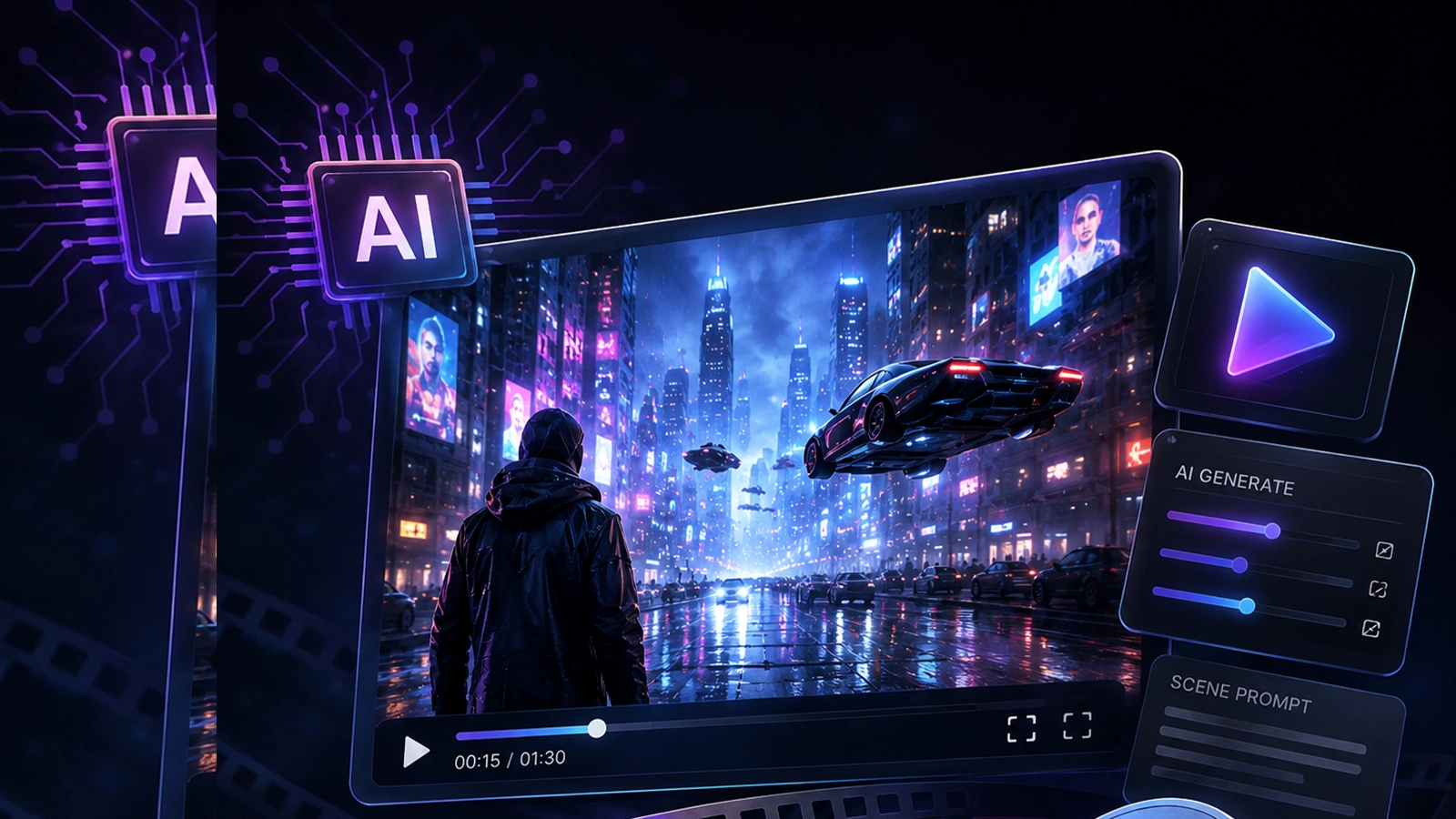
AI is moving beyond 2D image generation into editable 3D assets, automatic rigging, animation, scene assembly and VFX production. The most useful tools are the ones that keep artists in control after generation.
What is AI 3D?
AI 3D refers to systems that generate or modify three-dimensional assets and scenes from text, images, video or other references. Instead of beginning with polygon modeling from scratch, an artist can generate a starting asset and then refine it inside a normal 3D pipeline.
The category includes text-to-3D, image-to-3D, AI texturing, automatic rigging, motion generation, scene reconstruction and AI-assisted VFX.
The important question is not “Can AI make a 3D model?” It is “Can I take the model into my actual VFX pipeline and still control it?”
Best AI 3D tools for VFX: quick comparison
| Tool / workflow | Best for | Current strength | Best fit |
|---|---|---|---|
| Autodesk Flow Studio | AI-native VFX scenes | Text/image-to-3D, AI rigging, animation, scene assembly, camera control and editable exports | VFX creators, previs and virtual production |
| Meshy | AI 3D asset creation | Text-to-3D, image-to-3D, multi-image, texturing and animation | Artists, game creators and rapid prototyping |
| Traditional DCC + AI | Final production | AI-generated starting assets refined in Maya, Blender, Houdini, Unreal or other DCCs | Professional VFX pipelines |
| AI 3D research / custom workflows | Specialized production | Custom generation, reconstruction and automation | Technical artists and R&D teams |
Autodesk Flow Studio: the most complete AI-VFX direction
Autodesk’s 2026 Flow Studio updates show how quickly AI 3D is moving toward complete scene workflows. Wonder 3D introduced text-to-3D and image-to-3D generation for editable characters and props, while later updates added AI Rigging and Neural Layer.
In August 2026, Autodesk launched 3D Editor + Canvas, allowing characters, environments, animations and cameras to be assembled in a controllable 3D scene before AI rendering and refinement.
Flow Studio also supports exports such as mocap, camera tracking and clean plates for downstream tools including Maya, Blender, Unreal and 3ds Max.
Best for: AI-assisted VFX, previs, character replacement, virtual production and creators who want generation plus scene direction in one environment.
Meshy: fast AI asset generation
Meshy is an AI 3D modeling platform focused on generating production-ready assets from text and images. Its current workspace includes 3D Model, Animate, Scene and Video modules, and its documentation lists Text-to-3D, Image-to-3D, AI Texturing and animation capabilities.
Meshy has also expanded its image-to-3D workflows to support multiple reference images and 8K base-color textures in 2026.
Best for: rapid asset creation, concept development, game assets, visualization and starting models for further artist cleanup.
AI modeling: text-to-3D vs image-to-3D
| Method | Best use | Main advantage | Main challenge |
|---|---|---|---|
| Text-to-3D | Concept exploration | Very fast from an idea | Exact shape and topology control can be limited |
| Image-to-3D | Reference-based assets | Closer to a known visual design | Hidden/back-side geometry must be inferred |
| Multi-image-to-3D | Known object / product | More reference information | Requires consistent images |
| Traditional modeling | Final hero assets | Maximum topology and design control | Slower from scratch |
For VFX, a useful workflow is to use AI for blockout and asset discovery, then decide whether the generated mesh is good enough for the shot or needs retopology and traditional modeling.
AI texturing
AI texturing can generate materials, colors and surface details from text or image references. This can be valuable when a model exists but the look-development stage is slowing the project down.
Meshy currently includes Text-to-Texture, while its 2026 API updates added higher-resolution base-color texture support.
For professional VFX, treat AI texture generation as a look-development accelerator. Check UVs, texture resolution, material response and consistency before using the result in a close-up.
AI rigging and animation
Generating a character is only the first half of the problem. The character must move. Autodesk’s Flow Studio introduced AI Rigging so generated characters can be automatically rigged and animated, while Neural Layer can help refine cinematic results.
Meshy also includes animation features for generated characters and quadrupeds.
Best practice: use AI rigging for speed, then inspect joints, deformation, foot contact, facial motion and silhouette before final production.
AI 3D scene building
The newest direction is more important than simple model generation: scene-level control.
↓
AI CHARACTER / PROP
↓
AI ENVIRONMENT
↓
3D SCENE
↓
CAMERA + BLOCKING
↓
ANIMATION
↓
AI RENDER / VIDEO
↓
VFX COMPOSITING
Flow Studio’s new 3D Editor + Canvas is an example of this direction. Autodesk describes it as a workflow where creators assemble editable scenes, control camera movement and then use AI models for final visual generation and refinement.
Professional AI 3D workflow for VFX
Step 1 — Concept
Use AI image generation to explore shapes, costumes, environments and visual direction before committing to 3D production.
Step 2 — Generate the asset
Use text-to-3D or image-to-3D. For known designs, multiple reference images can improve the result.
Step 3 — Clean the mesh
Check topology, intersections, normals, scale and hidden geometry. AI-generated does not automatically mean production-ready.
Step 4 — Texture
Generate materials quickly, then verify UVs, resolution and physical plausibility.
Step 5 — Rig
Auto-rig where useful, but test deformation at extreme poses.
Step 6 — Animate
Use AI motion generation or mocap as a starting point. Polish timing and contact points manually.
Step 7 — Build the scene
Control camera, lighting, blocking and scale before final rendering.
Step 8 — Composite
Bring the result into the larger VFX pipeline for tracking, roto, relighting, paint and final compositing.
What AI 3D still struggles with
| Problem | Why it matters in VFX | Artist response |
|---|---|---|
| Topology | Bad edge flow can break deformation. | Retopologize or rebuild important areas. |
| Exact proportions | Hero assets need design accuracy. | Use reference images and manual modeling. |
| Hidden geometry | Single-image generation must guess unseen areas. | Use multi-view references. |
| Texture consistency | Generated textures may swim or repeat. | UV-check and manually refine. |
| Rig deformation | Automatic rigs can fail at extreme poses. | Correct weights and joint setup. |
| Exact camera/scene continuity | Film shots require repeatable spatial relationships. | Use editable 3D scenes and tracked cameras. |
AI 3D is most valuable when it reduces the starting cost of an asset while leaving the artist enough control to make the final asset production-ready.
AI 3D vs traditional 3D
| AI 3D | Traditional 3D |
|---|---|
| Fast concept-to-asset | Slower initial creation |
| Excellent for variations | Excellent for exact design control |
| Topology may need cleanup | Topology can be designed for purpose |
| Useful for background/secondary assets | Strong for hero assets |
| Great for previs and exploration | Strong for final production |
How should you choose an AI 3D tool?
- Choose Flow Studio if you want AI generation connected to VFX scene assembly, animation and controllable shots.
- Choose Meshy if your priority is quickly generating 3D assets from text/images and experimenting with textures and animation.
- Use traditional DCC tools for final hero assets, complex topology, precise rigging and advanced look development.
- Combine them when speed and production control are both important.
Where AI 3D fits in the Zgian roadmap
This is an important expansion of Zgian because it connects our AI video articles with the site’s original CGI & 3D focus.
Frequently asked questions
What is the best AI 3D tool for VFX in 2026?
For an AI-native VFX workflow, Autodesk Flow Studio is one of the most complete current options, combining 3D generation, AI rigging, animation and controllable scene building. Meshy is a strong choice for rapid asset generation.
Can AI generate 3D models from images?
Yes. Both Flow Studio’s Wonder 3D and Meshy support image-to-3D workflows.
Can AI 3D models be used in professional VFX?
Yes, particularly as starting assets, previs elements, background assets and concept-development tools. Important hero assets may still require traditional modeling and cleanup.
Can AI rig a 3D character?
Yes. Autodesk Flow Studio currently provides AI Rigging for generated characters, while Meshy also provides animation capabilities.
Will AI replace 3D artists?
AI is reducing some repetitive asset-production work, but artists remain important for design decisions, topology, deformation, look development, camera, lighting and final quality.
3D Generalist & VFX Professional · About the author →