China Is Building an AI Filmmaking Industry
Artificial intelligence is moving beyond experimental video generation in China.
According to a Reuters report published September 25, 2026, Chinese filmmakers, studios and local governments are increasingly treating AI-generated video as an emerging production industry rather than simply another creative tool. citeturn0search0turn0search1
Shenzhen has become one of the important centers of this development. AI filmmaker Zhu Zhili, who runs the AIGC department at China Wit Media, told Reuters that he has been approached by officials from cities and industrial parks across China interested in attracting AI film businesses. citeturn0search0
The push includes incentives such as subsidized offices, housing assistance and computing resources aimed at attracting AI filmmakers and startups. citeturn0search1
From AI Video Tools to Production Studios
The significance of the current movement is that AI video is increasingly being organized around production companies, studios and distribution platforms.
China’s local governments are developing technology clusters designed to attract AI filmmakers, while companies are experimenting with AI-generated short dramas, animation and feature-length productions. citeturn0search1
Shanghai has introduced measures supporting AI-powered micro-drama production and overseas distribution. Beijing’s Huairou district also offers support intended to reduce computing costs for AI short-drama producers, while Shenzhen is providing technical support for video production, visual effects and content generation. citeturn0search1
This creates an ecosystem where the cost of computation, access to AI models and production infrastructure become part of the filmmaking equation.
AI Is Dramatically Reducing Production Costs
One of the biggest reasons filmmakers are experimenting with AI is economics.
Reuters reported that the cost of producing AI short dramas in China fell from approximately 5,000 yuan per minute to a few hundred yuan per minute during the first half of 2026, according to China’s state broadcaster CCTV. citeturn0search1
For independent filmmakers, the difference can be substantial.
- Cast and crew
- Physical locations
- Sets and props
- Cameras and lighting
- VFX teams
- Post-production
- Rendering and finishing
AI-generated production can shift a significant portion of that work toward computing resources, AI models and digital workflows.
This doesn’t eliminate production expertise, but it changes where the costs and skills are concentrated.
The Micro-Drama Is Becoming a Major Testing Ground
Short-form storytelling is particularly important to China’s AI video ecosystem.
Reuters reported that 221,900 new AI shows were launched on Douyin during the first half of 2026. However, only 1,055 of those titles exceeded 100 million views, according to DataEye. citeturn0search1
That enormous difference between production volume and audience success highlights an important issue for AI filmmaking:
Generating video is becoming easier. Creating something audiences actually want to watch remains difficult.
AI can reduce the technical barrier to producing content, but it doesn’t automatically solve storytelling, originality, directing or audience engagement.
AI Models Are Becoming Part of the Production Infrastructure
China’s AI filmmaking ecosystem is also being supported by increasingly capable video-generation models.
Models such as Kling and Seedance are being used by creators and are part of the growing technical infrastructure around AI-generated video. Reuters reported that Chinese filmmakers see these models as important components of the country’s emerging AI film ecosystem. citeturn0search3
The result is a new production stack:
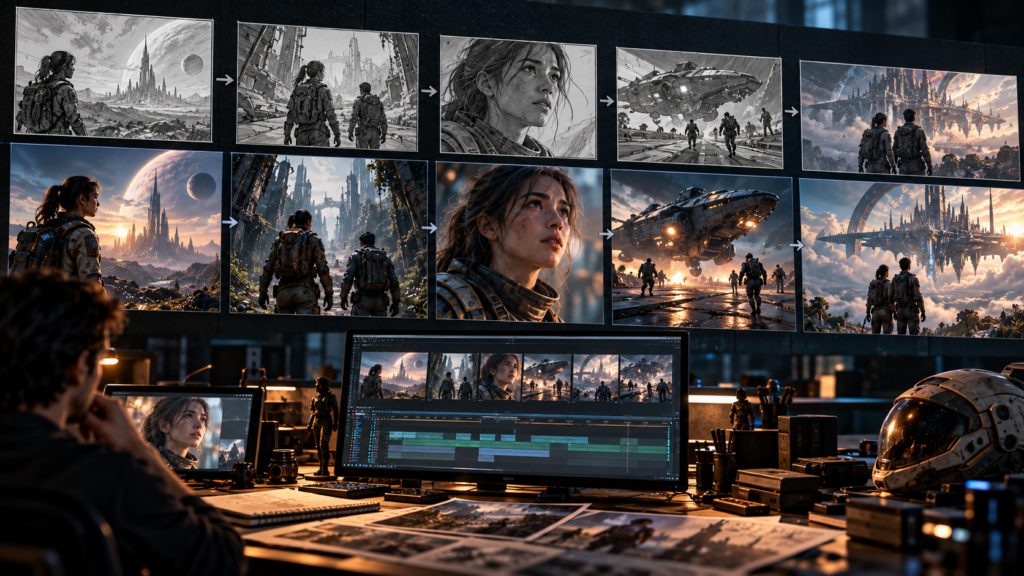
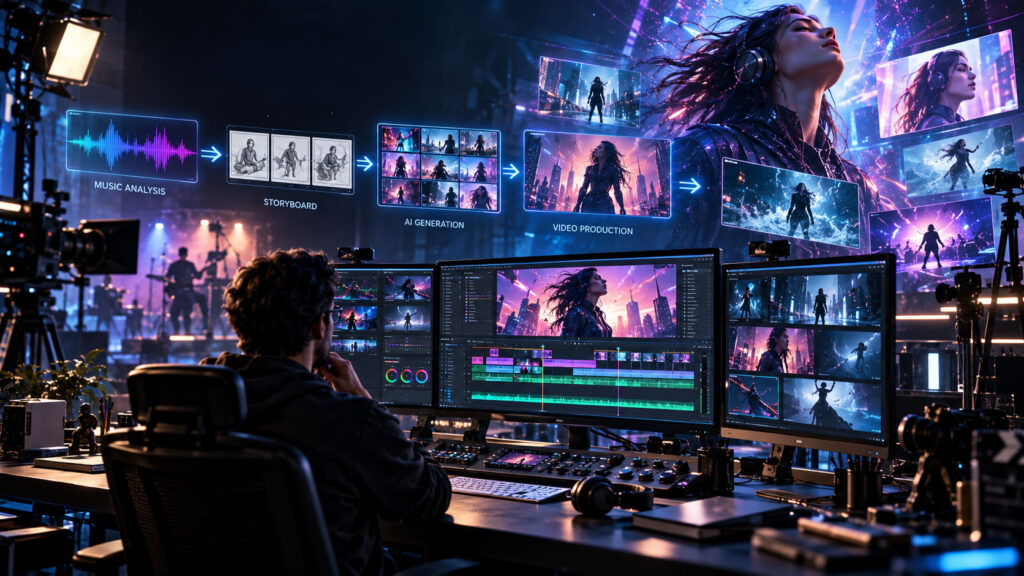
Story → Script → AI Characters → Environment → Video Generation → Editing → VFX → Sound → Distribution
Instead of AI being used for one isolated task, filmmakers are experimenting with connecting multiple stages of production.
China’s First AI Feature Films Are Moving Toward Cinemas
The development is also reaching feature-length filmmaking.
Reuters reported that China’s National Film Administration has granted a public-screening licence to Sanxingdui: Future Memories, a 90-minute science-fiction film produced by major Chinese studio Bona Film Group. It is scheduled for release in China later in 2026. citeturn0search1
This is significant because theatrical distribution introduces requirements that short social-media videos don’t necessarily face.
- Narrative consistency
- Character continuity
- Visual consistency
- Long-form editing
- Sound design
- Quality control
- Audience engagement
- Distribution and regulatory compliance
AI filmmaking therefore has to operate as a complete production pipeline rather than simply generating impressive individual shots.
The Industry Is Also Facing an AI Content Overflow Problem
Rapid production creates another challenge: too much content.
The Reuters data on Douyin illustrates the problem. Hundreds of thousands of AI shows can be created, but only a small fraction achieve very large audiences. citeturn0search1
This suggests that AI’s biggest impact may not simply be making production cheaper.
It could fundamentally change the ratio between content creation and content consumption.
When producing a video becomes dramatically easier, the competitive advantage can move toward:
- Storytelling
- Original characters
- Directorial vision
- Editing
- Visual identity
- Audience understanding
- Marketing
- Distribution
In other words, AI may make the production bottleneck smaller while making the creative and audience bottleneck larger.
Copyright and Performer Rights Remain Major Questions
The rapid expansion of AI filmmaking has also generated concerns around copyright, performers’ likenesses and employment.
Reuters reported concerns from Chinese actors about the use of their likenesses in AI films, while consumers have also raised concerns about plagiarism and originality. China requires explicit labeling for AI-generated content, but Reuters reported that clear copyright rules for AI-generated material have not yet been established. citeturn0search1
These issues could become increasingly important as AI-generated films move from experimental platforms into mainstream distribution.
What This Means for VFX and Animation
For the VFX industry, China’s AI video expansion is particularly interesting because it demonstrates how generative technology can become part of a broader production pipeline.
Traditional filmmaking separates many tasks into specialized departments:
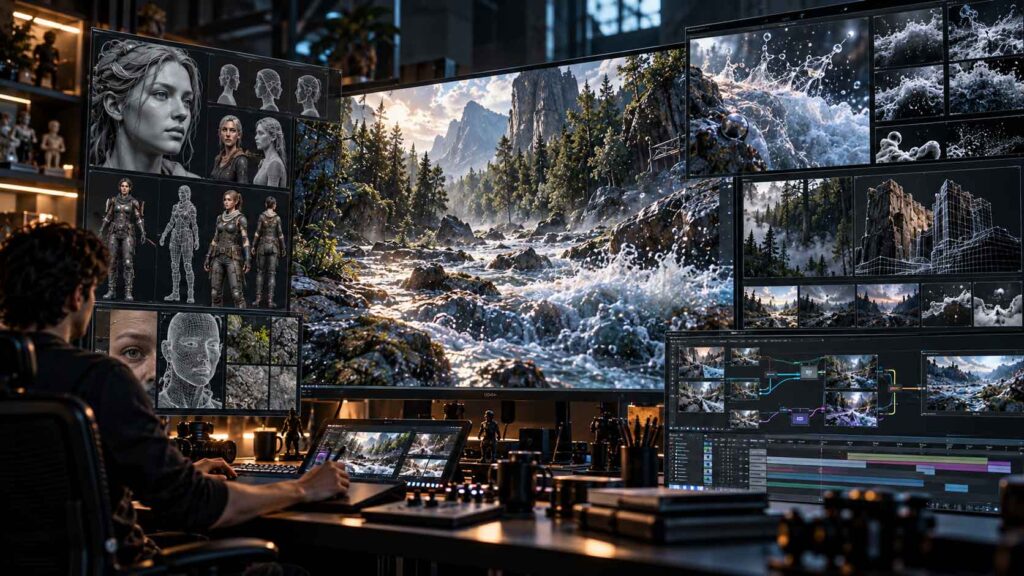
Concept Art → Modeling → Texturing → Rigging → Animation → Lighting → Rendering → Compositing
AI can potentially accelerate several of these stages, while also creating new workflows for generating characters, environments and shots.
But professional production still requires continuity, art direction, shot matching, compositing, editing and quality control.
That means the emerging AI filmmaking workflow may look less like replacing an entire VFX pipeline and more like adding increasingly capable generative systems throughout it.
The Bigger Shift: AI as Production Infrastructure
China’s current AI filmmaking expansion points toward a broader change in how video may be produced.
The important development isn’t simply that AI can generate a short video from a prompt.
It is that studios, governments, streaming platforms and filmmakers are beginning to build production ecosystems around the technology.
The next stage could involve AI being integrated into:
- Pre-production
- Script development
- Storyboarding
- Character creation
- Animation
- Virtual production
- VFX
- Editing
- Localization
- Distribution
That could turn AI video from an experimental creative technology into another layer of the professional filmmaking infrastructure.
For VFX and CGI artists, that makes the development worth watching closely.
The Future of AI Filmmaking Is Still Being Written
China’s rapid expansion of AI-generated video demonstrates both the possibilities and the challenges of the technology.
Production costs are falling, AI studios are emerging, governments are investing in infrastructure and feature-length AI productions are moving toward theatrical release. At the same time, content overload, originality, copyright and performer rights remain unresolved issues. citeturn0search1
The result is an industry still in its early stages.
The technology can increasingly generate images and video.
The bigger question is whether filmmakers can use it to consistently create stories that audiences want to watch.
And that may ultimately determine whether today’s AI video boom becomes a lasting filmmaking industry.
Sources
- Reuters reporting, September 25, 2026, on China’s AI video industry and emerging production ecosystem.
- Reuters video report on China’s AI film and video industry.
- Los Angeles Times reporting on China’s AI-driven film and micro-drama ecosystem.