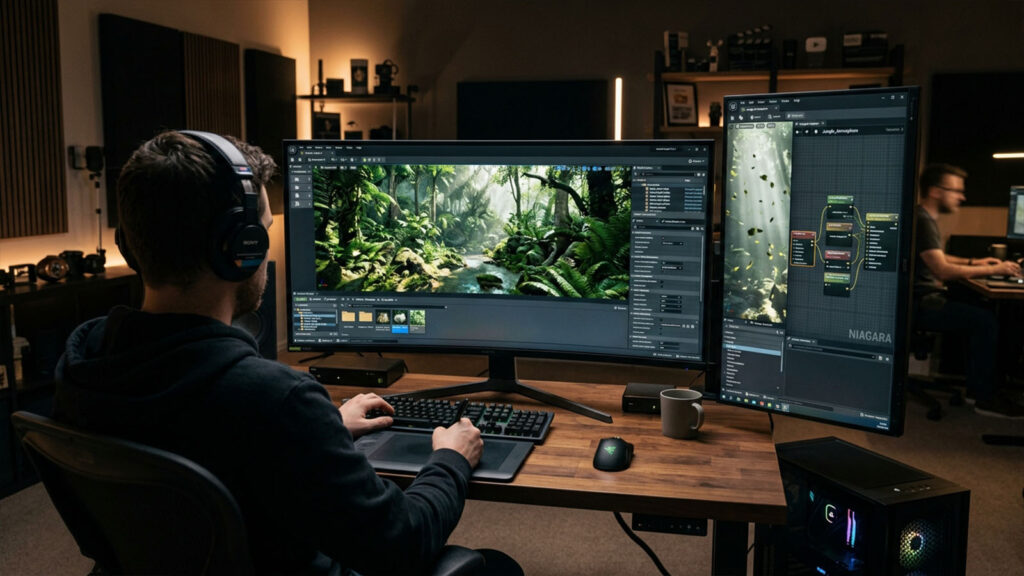
Unreal Engine’s recent rendering developments continue to place real-time graphics at the centre of both games and cinematic production. Epic’s MegaLights technology is designed to let artists work with large numbers of dynamic, shadow-casting lights, illustrating the broader push toward richer real-time scenes.
Game engines are increasingly being used for cinematics, previs, virtual production and interactive storytelling. As rendering capability improves, the distinction between a game-engine workflow and a cinematic workflow becomes less rigid.
Beyond a new engine version
The more important trend is the convergence of production disciplines. Artists may need to move assets, lighting decisions, environments and effects between real-time and offline stages while maintaining visual consistency and performance.
- Dynamic lighting: More complex lighting setups can be evaluated in real time.
- Cinematics: Engine technology is increasingly used beyond interactive gameplay.
- Production efficiency: Real-time feedback can accelerate iteration, but performance remains a practical constraint.
Zgian takeaway: The important story is not just another engine feature. It is the growing convergence of game rendering, VFX, animation and virtual production.