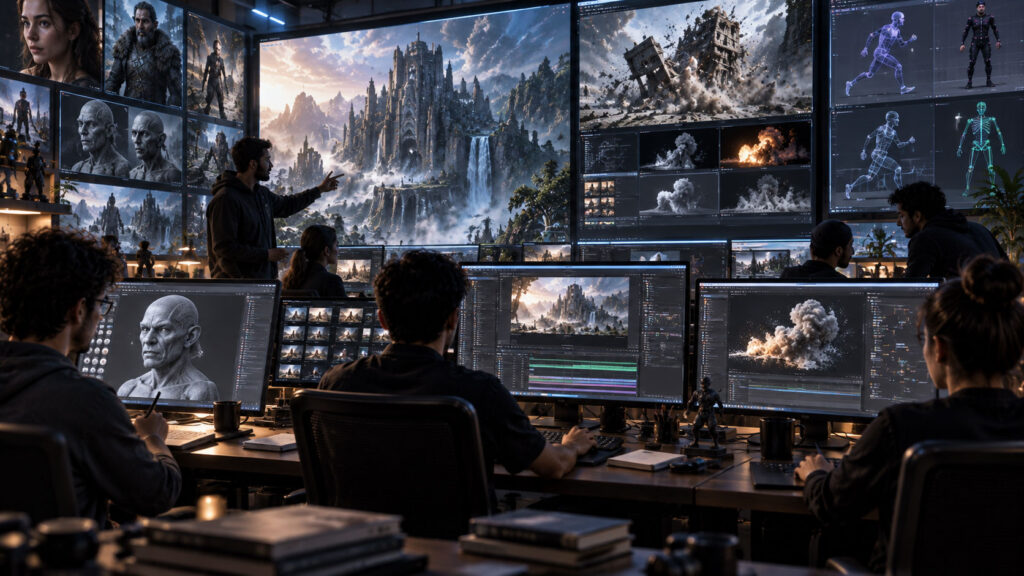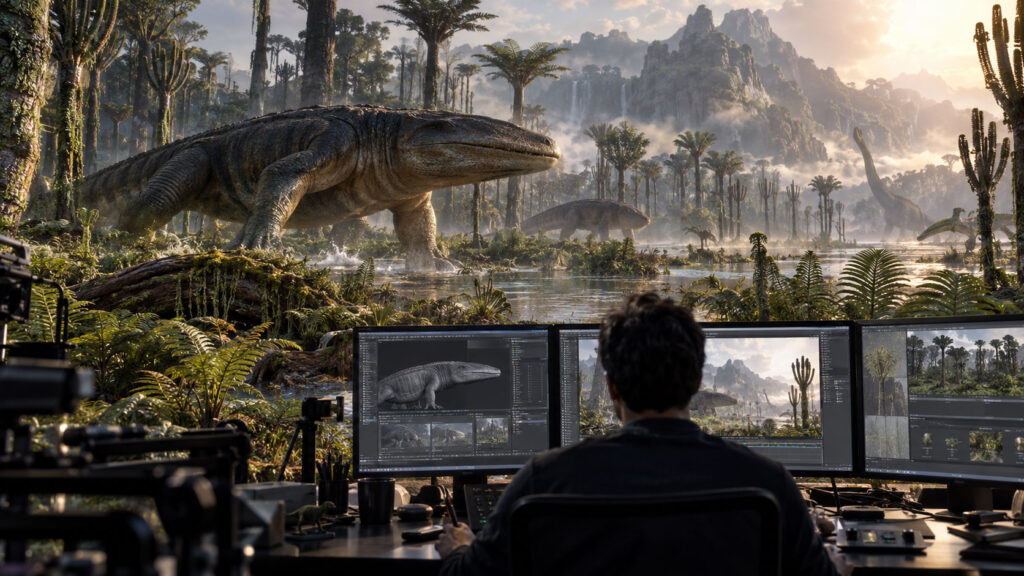
The boundary between the physical and digital worlds is becoming increasingly difficult to see.
At IBC 2026 in Amsterdam, spatial-intelligence company XGRIDS is demonstrating a workflow that turns real-world locations into photorealistic digital environments using 3D Gaussian Splatting, then brings those environments directly into Unreal Engine for media production.
The technology could have significant implications for virtual production, VFX, XR and real-time filmmaking.
From Real Location to Digital Environment
Traditionally, recreating a real location digitally can require extensive modelling, texturing and reconstruction.
3D Gaussian Splatting offers a different approach.
Instead of rebuilding every surface manually, a physical environment can be captured using specialized cameras and scanners and reconstructed as a highly detailed 3D scene.
XGRIDS says its Lixel K2 spatial scanner and PortalCam spatial camera can capture spatial and visual information from real locations. The data can then be processed using Lixel CyberColor, producing 3DGS environments that can be brought into Unreal Engine.
Bringing Gaussian Splats Into Unreal Engine
The next step is particularly relevant to VFX artists.
XGRIDS’ LCC Plugin for Unreal Engine allows 3D Gaussian Splatting scenes to be imported, rendered and interacted with inside Unreal Engine 5.
The current plugin supports multiple 3DGS formats and includes features such as depth rendering, scene lighting interaction, color adjustment, nDisplay and VR support.
This creates a direct path from a physical location to a real-time digital environment.
Physical location → spatial capture → 3DGS reconstruction → Unreal Engine → virtual production
Real Locations Can Become Virtual Production Assets
XGRIDS says the captured environments can be used for scene composition, camera blocking, XR and in-camera visual effects.
That means a location does not necessarily have to remain a one-time physical shooting location.
Once captured, it can become a reusable digital production asset.
A production team could potentially revisit the environment later, change the camera position, combine it with CG elements or use it as part of a virtual production setup.
A New Approach to Virtual Production
Virtual production has traditionally relied on several different techniques.
These include LED volumes, traditional 3D environments, photogrammetry, LiDAR scans and real-time game-engine rendering.
Gaussian Splatting adds another option.
Because the captured environment retains detailed visual information from the original location, it can provide a highly realistic starting point for digital production.
XGRIDS says its workflow supports major production platforms including Pixotope, Aximmetry, Disguise and nDisplay.
Why 3DGS Is Interesting for VFX
For VFX artists, one of the most important advantages of 3DGS is the speed at which real-world environments can be represented digitally.
Traditional environment reconstruction can require extensive modelling and texturing.
Gaussian Splatting can instead reconstruct the appearance of an environment from captured data.
The result can then be viewed and manipulated in a real-time engine.
This does not eliminate traditional 3D modelling.
Instead, it provides another type of digital representation that can be combined with conventional CG assets.
Combining Gaussian Splats With CG
XGRIDS’ Unreal workflow is designed to combine captured Gaussian scenes with other digital assets.
That opens interesting possibilities for filmmakers.
A captured building could become the background for a CG creature.
A real location could be extended with digital architecture.
A scanned environment could be used for previs before a shoot.
An entire real-world location could potentially become a virtual set.
The ability to combine real-world captures with conventional Unreal assets makes the workflow particularly interesting for hybrid VFX production.
From Previs to Final Production
Real-time environments can also be useful before the final shot is created.
Directors and cinematographers can use a captured environment to experiment with:
- Camera positions
- Lens choices
- Blocking
- Lighting
- Composition
- Virtual set extensions
- CG integration
This can move location visualization earlier in the production process.
Instead of waiting until final VFX to discover how a digital environment works, filmmakers can explore it during previs and virtual production.
3DGS Is Moving Beyond Demonstrations
XGRIDS says its technology is already being used in media and entertainment workflows.
The company points to South Korean broadcaster SBS, which has integrated 3DGS and XR into live news using the LCC plugin for Unreal Engine and Pixotope.
That is significant because it demonstrates that Gaussian Splatting is moving beyond experimental research and into real production environments.
Gaussian Splatting and Real-Time Rendering
The technology also fits naturally into the growing real-time rendering ecosystem.
XGRIDS’ Unreal plugin supports large-scale 3DGS scenes and features such as streaming level of detail, depth rendering and NVIDIA DLSS.
Its documentation also lists support for Unreal Engine versions extending through UE 5.8, along with nDisplay, VR and other virtual-production capabilities.
These capabilities are important because large captured environments can contain enormous amounts of visual data.
Efficient streaming and rendering therefore become critical when these scenes are used interactively.
The Role of AI and Spatial Intelligence
Although Gaussian Splatting itself is not simply a generative-AI technology, it sits within a broader movement toward AI-assisted spatial computing.
The objective is to make computers understand and represent physical environments in increasingly detailed ways.
Once a real location becomes a digital spatial asset, it can potentially be used for:
- Virtual production
- Digital twins
- Simulation
- Games
- XR
- Training
- Visualization
This makes spatial capture an important technology to watch alongside AI, real-time rendering and virtual production.
What This Could Mean for Filmmaking
The long-term possibilities are significant.
Imagine a production capturing a historic location once and then using that digital environment across multiple projects.
A studio could build a library of real-world locations.
VFX artists could combine those environments with CG characters.
Virtual production teams could use them on LED stages.
Editors and directors could explore locations digitally before filming.
And XR teams could turn the same assets into interactive experiences.
The physical location effectively becomes a reusable digital production asset.
A Hybrid Future for VFX
3D Gaussian Splatting is unlikely to replace traditional modelling, photogrammetry or conventional VFX techniques.
Instead, the industry may increasingly combine them.
A production could use Gaussian Splats for a captured environment, traditional geometry for hero objects, procedural systems for extensions and Unreal Engine for real-time rendering.
That hybrid approach could give artists more options while reducing the amount of work required to recreate certain real-world environments.
What’s Next for 3D Gaussian Splatting?
The technology is developing rapidly.
As capture hardware improves and real-time rendering becomes more capable, 3DGS could become increasingly useful across film, television, games and immersive media.
The important development is not simply that real locations can now be scanned.
It is that those scans can increasingly become editable production assets inside the same real-time environments used to create digital content.
Final Thoughts
XGRIDS’ IBC 2026 demonstration highlights an important direction for the future of digital production.
A physical location can be captured, reconstructed as a 3D Gaussian Splatting environment and brought into Unreal Engine for virtual production, VFX, XR and real-time workflows.
For filmmakers and VFX artists, this could make real-world environments easier to reuse, modify and integrate into digital productions.
As the boundary between real-world capture and computer-generated environments continues to disappear, technologies such as 3DGS could become an increasingly important part of the modern VFX pipeline.
Related Zgian Articles
- Unreal Engine for VFX and Virtual Production
- Real-Time 3D Rendering: The Future of Visual Effects
- How AI Is Changing the VFX Pipeline
- AI Agents and Unreal Engine
- What Is Virtual Production?
- The Future of 3D Scanning in Filmmaking
- Gaussian Splatting Explained
- Photogrammetry vs Gaussian Splatting