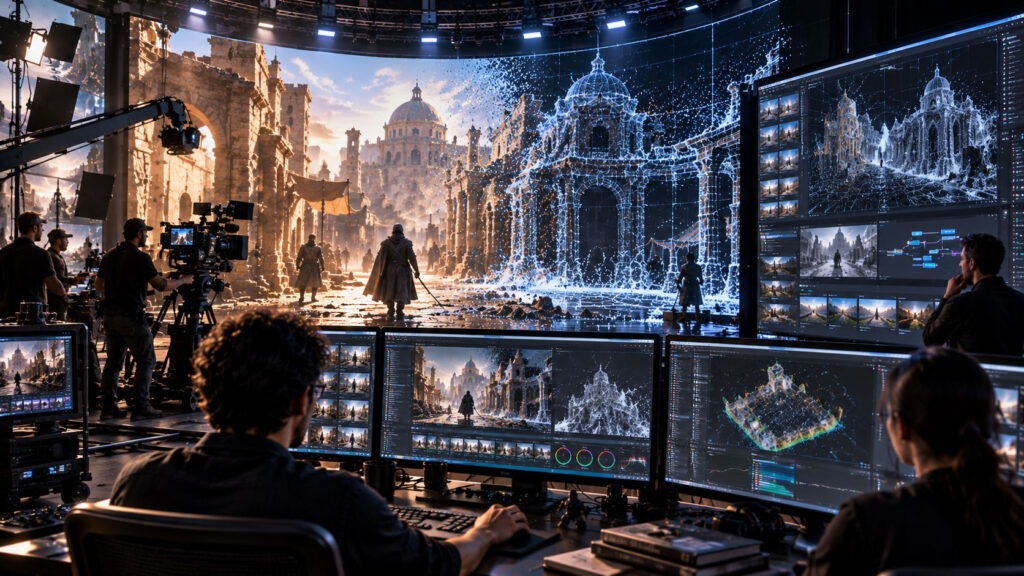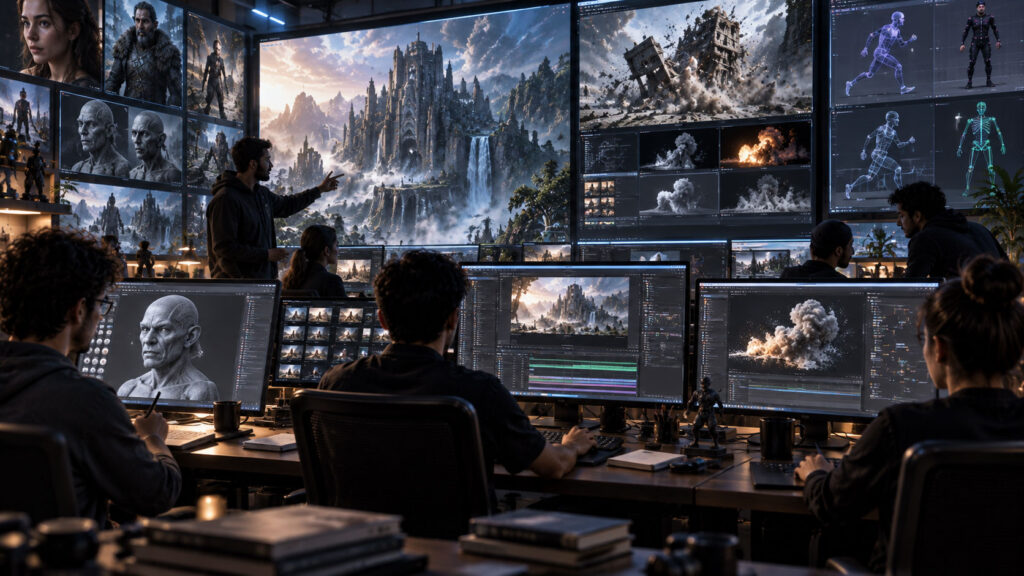
Creating believable prehistoric environments is one of the most demanding challenges in visual effects.
There are no modern locations where artists can simply film a Carboniferous forest or an ancient seafloor. Everything has to be reconstructed from scientific research, reference material and digital imagination.
For Surviving Earth, Milk VFX tackled that challenge with a production pipeline that combined traditional VFX tools with Unreal Engine, Houdini, USD and real-time workflows.
The result was more than 1,000 VFX shots featuring prehistoric creatures and environments across Earth’s history. Milk created 73 hero creature assets and more than 100 environments for the production. citeturn0search0
Unreal Engine Was Used From Previs to Post
One of the most interesting aspects of Milk’s approach was the role of Unreal Engine.
Rather than using Unreal only for early visualization, the studio incorporated it much further into the production pipeline.
Milk used Unreal Engine for previs, environment development, virtual production and post-production workflows. Key sequences were previsualized in Unreal to plan shots and on-set camera moves, with some assets refined for final shots. citeturn0search0
This demonstrates an increasingly important role for game engines in modern VFX.
Unreal Engine is no longer simply a tool for creating real-time graphics. It can become a production environment connecting creative departments throughout an entire project.
Building Worlds That No Longer Exist
One of the biggest challenges on Surviving Earth was recreating environments that disappeared millions of years ago.
Milk transformed terrain data and photography gathered in locations including Malta, New Caledonia and Iceland into prehistoric environments ranging from ancient seafloors to towering Prototaxites forests. citeturn0search0
Milk also developed a custom procedural landscape generator inside Unreal Engine, allowing artists to create expansive environments quickly while maintaining creative control.
This creates a valuable connection between virtual production and traditional filmmaking. Instead of designing the physical world and digital world separately, both can evolve together.
From Unreal Engine to Houdini and USD
Unreal Engine was only one part of the pipeline.
Milk also relied on Houdini and structured production workflows to manage complex scenes, assets and effects. The broader pipeline combined real-time and traditional VFX approaches so departments could work in parallel while maintaining flexibility.
This kind of connected workflow is particularly useful on large VFX productions where modelling, animation, FX, lighting and layout need to progress simultaneously.
More Than 100 Environments
Milk created more than 100 environments for Surviving Earth, including 13 real-time environments built in Unreal Engine. citeturn0search0
The environments included prehistoric landscapes, ancient seafloors, forests and other lost worlds. Procedural techniques were especially valuable for generating large environments containing repeated natural elements such as vegetation, rocks and terrain.
Creature Animation Was Another Major Challenge
The environments were only half of the problem.
The production also required a large number of prehistoric animals. Milk delivered 73 hero creature assets, with work spanning modelling, rigging, texturing, grooming, animation and creature FX. Scientific research informed anatomy, movement and surface detail. citeturn0search0
Some sequences also required crowd simulation and creature FX. A major stampede sequence featuring Edmontosaurus and Nanuqsaurus required complex animation, crowd simulation and detailed creature effects to convey scale and urgency. citeturn0search0
A Hybrid Real-Time and Traditional VFX Pipeline
Perhaps the most important lesson from Surviving Earth is that real-time rendering did not replace traditional VFX. Instead, Milk combined the strengths of multiple technologies.
- Unreal Engine: rapid visualization, real-time worldbuilding and virtual production workflows.
- Houdini: procedural effects and simulation workflows.
- USD and structured scene data: support for complex production assets and cross-department workflows.
- Traditional VFX tools: modelling, animation, simulation, rendering and compositing where they remained the best fit.
This hybrid approach allowed artists to choose the right technology for each part of the production.
Why This Matters for Future VFX Pipelines
The Surviving Earth workflow demonstrates how the boundaries between film production, VFX and game-engine technology continue to disappear.
A modern VFX pipeline can move through several connected stages:
Script → Previs → Unreal Engine → Virtual Production → Traditional VFX → Simulation → Lighting → Compositing → Final Delivery
The advantage is not simply speed. A connected pipeline can allow directors, production designers, VFX artists and technical teams to see the same digital world much earlier in production, helping creative decisions happen before expensive final shots are produced.
Unreal Engine Is Becoming a VFX Production Tool
The most interesting aspect of Milk’s work is that Unreal Engine was used beyond traditional previs. Milk described the project as an expansion of its Unreal pipeline, with the engine playing a central role from previs through post-production. citeturn0search0
That points toward an important direction for the industry: real-time engines are increasingly becoming part of image-production pipelines rather than simply tools for previews.
For VFX artists, this means understanding Unreal Engine can become increasingly valuable alongside traditional tools such as Houdini, Maya and compositing software.
The Future of VFX May Be Hybrid
The future of visual effects is unlikely to belong exclusively to either offline rendering or real-time rendering.
Instead, productions will increasingly combine both. Artists may use Unreal Engine for rapid worldbuilding and visualization, Houdini for procedural effects, traditional renderers for specific hero assets, and compositing software for final image integration.
Surviving Earth is a strong example of this direction. It shows how real-time technology can help VFX teams build ambitious worlds within the practical constraints of television production.
Related Zgian Guides
- Real-Time VFX: Unreal Engine, Niagara, Lumen & Nanite
- AI Virtual Production: LED Volumes, Virtual Sets & ICVFX
- Real-Time Compositing: LED, Green Screen & VFX Workflow
- AI VFX Environment Generation: Procedural Worlds & Digital Landscapes
Source
Production details are based on Milk VFX’s official Surviving Earth VFX production breakdown.