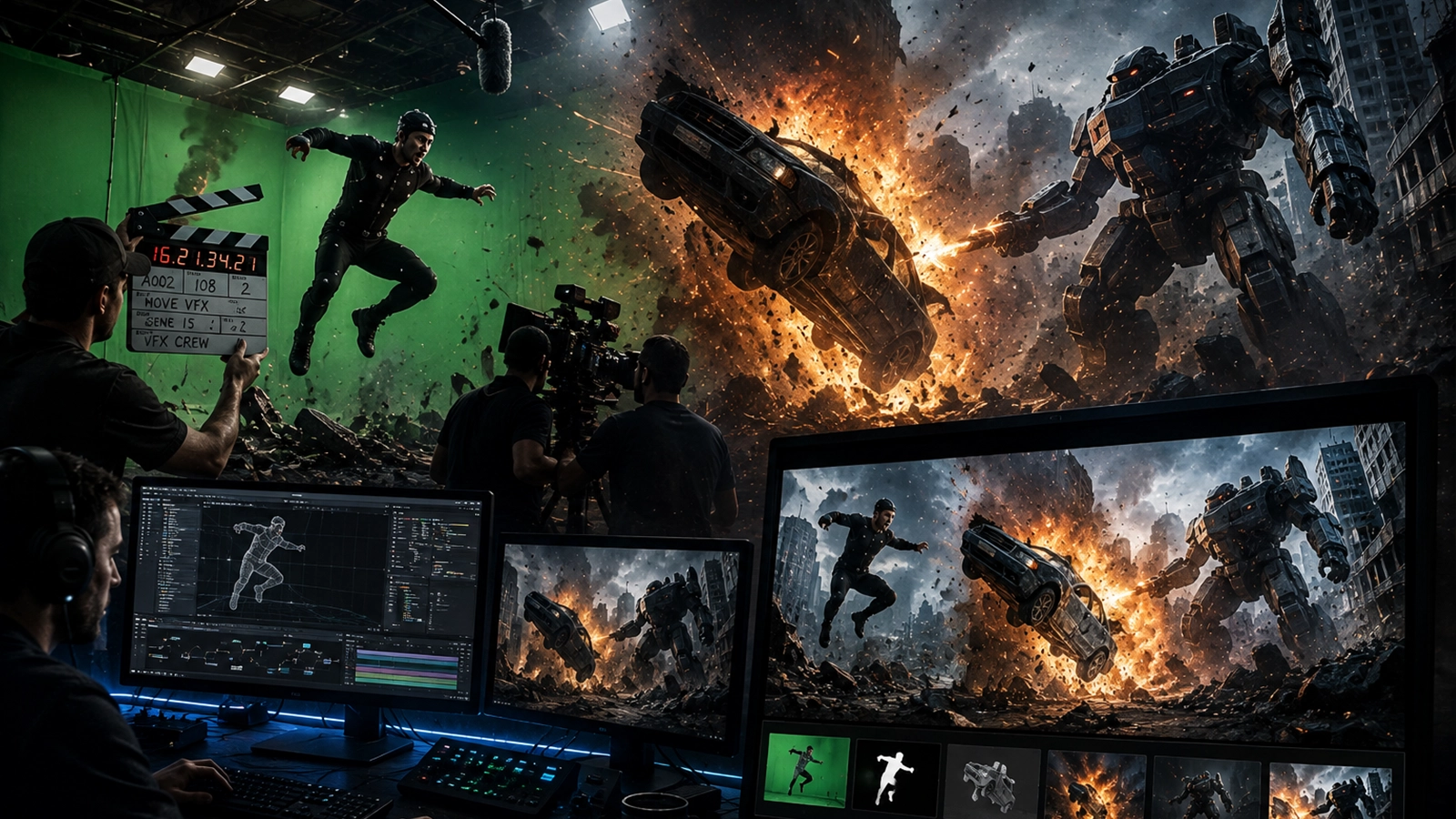
Creature animation combines anatomy, locomotion, performance and visual effects. AI can accelerate motion generation and transfer, but believable creatures still need intentional weight, contact, anatomy and character-specific movement.
1. What creature animation requires
A believable creature needs a consistent relationship between anatomy, movement, weight and personality. Even imaginary creatures should appear to obey their own internal physical rules.
→ ANATOMY
→ RIG
→ LOCOMOTION
→ PERFORMANCE
→ FUR / SKIN
→ CREATURE FX
→ LIGHTING / COMP
AI is most useful when it accelerates repetitive work while the artist controls the creature’s behavior and storytelling.
2. Creature design and anatomy
Start with the creature’s anatomy before choosing animation technology. Define its spine, limbs, joints, center of mass, range of motion and contact points.
| Creature type | Key anatomical concern |
|---|---|
| Quadruped | Four-limb coordination and spine motion. |
| Bird-like | Wings, balance and center of mass. |
| Insectoid | Many limbs and gait coordination. |
| Humanoid monster | Human-like balance with altered proportions. |
| Fantasy hybrid | Consistent rules for combined anatomy. |
3. Creature rigging
Creature rigs should expose the controls needed for locomotion, body weight and performance. AI auto-rigging can provide a starting hierarchy, but unusual anatomy often requires custom controls.
| Rig component | Purpose |
|---|---|
| Root / COG | Controls balance and body mass. |
| Spine | Shapes body flex and locomotion. |
| Limbs | Drive contact and movement. |
| Tail | Provides secondary motion and balance. |
| Neck / head | Controls attention and expression. |
| Wings / appendages | Supports specialized creature motion. |
For general rigging principles, see AI Character Rigging 2.0.
4. Quadruped locomotion
Quadruped movement is not simply human walking copied onto four legs. Each gait has a characteristic sequence of contacts, weight transfers and spine motion.
| Gait | Typical use |
|---|---|
| Walk | Controlled movement with clear contact. |
| Trot | Efficient moderate-speed movement. |
| Canter | Faster asymmetric gait. |
| Gallop | High-speed locomotion with airborne phases. |
| Creature-specific gait | Designed around fictional anatomy. |
5. AI motion transfer
Human performance can provide useful timing and acting references, but direct retargeting is rarely enough for a creature. The motion must be adapted to the creature’s proportions and locomotion logic.
↓
MOTION ANALYSIS
↓
ANATOMICAL MAPPING
↓
CREATURE RETARGET
↓
CONTACT / WEIGHT CORRECTION
↓
CREATURE PERFORMANCE
For the broader human motion workflow, see AI Motion Capture & Character Animation.
6. Gait and weight
Weight is communicated through acceleration, deceleration, contact timing and body overlap. A heavy creature should not move exactly like a lightweight animal.
| Movement signal | Weight cue |
|---|---|
| Foot impact | Contact timing and compression. |
| Body lag | Secondary movement after acceleration. |
| Head motion | Inertia and stabilization. |
| Spine compression | Force through the body. |
| Tail motion | Balance and momentum. |
7. Creature facial animation
Creature faces can use human facial principles, animal reference or custom expression systems. The design should reflect the creature’s anatomy rather than forcing a human face onto it.
| Creature feature | Possible control |
|---|---|
| Muzzle | Speech, sniffing and expression. |
| Ears | Attention and emotional reaction. |
| Eyes | Gaze, focus and expression. |
| Jaw | Bite, speech or roar. |
| Brows / plates | Creature-specific expression. |
For human-style facial performance, see AI Facial Animation & Lip Sync 2.0.
8. Fur, skin and grooming
Creature appearance depends strongly on surface response. Fur, scales, feathers and skin each require different grooming and shading strategies.
| Surface | Key considerations |
|---|---|
| Fur | Direction, density, clumping and breakup. |
| Scales | Pattern, roughness and directional layering. |
| Feathers | Layering, orientation and silhouette. |
| Reptile skin | Micro detail and roughness variation. |
| Wet creature | Specular response and dripping effects. |
9. Creature FX
Creature shots often require additional effects that sell interaction with the environment.
| FX | Purpose |
|---|---|
| Dust | Ground contact and movement. |
| Footprints | Weight and environmental interaction. |
| Water | Wet movement and splashes. |
| Debris | Impact and destruction. |
| Breath | Cold-weather or stylized atmosphere. |
| Blood / wounds | Story-driven creature damage. |
10. Monsters and fantasy characters
Monster animation benefits from clear behavioral rules. Decide whether the creature is animalistic, human-like, supernatural or mechanical before designing its motion language.
| Character type | Motion language |
|---|---|
| Predator | Focused, efficient and reactive. |
| Giant | Slow acceleration and heavy impacts. |
| Alien | Unfamiliar timing or locomotion. |
| Undead | Restricted, broken or unnatural movement. |
| Fantasy beast | Animal reference plus designed traits. |
11. Where AI helps
AI can assist with motion generation, reference analysis, pose estimation, retargeting, animation variations, cleanup and some creature design tasks.
| AI-assisted task | Benefit | Watch for |
|---|---|---|
| Pose estimation | Fast reference extraction. | Unusual anatomy. |
| Motion transfer | Rapid performance blocking. | Wrong joint behavior. |
| Motion variation | Create alternative performances. | Loss of character intent. |
| Animation cleanup | Reduce repetitive correction. | Over-smoothing. |
| Reference analysis | Study real animal movement. | Oversimplification. |
12. Common mistakes
| Mistake | Why it fails | Better approach |
|---|---|---|
| Human motion copied directly | Creature anatomy does not support it. | Adapt motion to anatomy. |
| No weight definition | Creature looks weightless. | Design acceleration and impact cues. |
| Ignoring foot contacts | Creature slides over the ground. | Use contact constraints and cleanup. |
| Perfectly symmetrical movement | Looks mechanical. | Add controlled asymmetry. |
| Too much random motion | Character becomes noisy. | Use purposeful secondary movement. |
13. Complete Zgian AI Creature workflow
↓
ANATOMY + REFERENCE
↓
RIG / SKELETON
↓
AI MOTION GENERATION / TRANSFER
↓
GAIT + CONTACT CLEANUP
↓
FACIAL PERFORMANCE
↓
FUR / SKIN / GROOMING
↓
CREATURE FX
↓
LIGHTING + COMP
↓
FINAL CREATURE QC
- Define anatomy, mass and movement rules.
- Build and validate the creature rig.
- Collect real-world or designed movement references.
- Generate or transfer an initial motion pass.
- Correct gait, contacts, weight and balance.
- Add facial and secondary performance.
- Build fur, skin or other creature surfaces.
- Add environmental creature FX.
- Integrate with the live-action or CG environment.
14. Final creature QC
- Check anatomy and silhouette.
- Check gait and foot contacts.
- Check weight and acceleration.
- Check spine and secondary motion.
- Check facial performance.
- Check fur, skin or feathers.
- Check environmental interaction.
- Check shadows and contact.
- Check motion blur and temporal consistency.
- Review the complete shot at normal playback speed.
How this fits the Zgian VFX + AI pipeline
AI MOTION CAPTURE → Motion Capture & Character Animation
AI FACIAL → Facial Animation & Lip Sync 2.0
CREATURE ANIMATION → this guide
DIGITAL HUMANS → Digital Humans 2.0
AI TRACKING → 3D & Object Tracking
Frequently asked questions
Can AI turn human motion into creature animation?
Yes, as a starting point. The motion must be adapted to the creature’s anatomy, proportions, gait and center of mass.
How do I animate a quadruped realistically?
Study gait cycles, foot contacts, spine movement, head stabilization, weight transfer and species-specific locomotion.
What makes a monster look heavy?
Acceleration, contact timing, body lag, compression, impacts and environmental interaction all contribute to perceived weight.
Can AI generate creature locomotion automatically?
AI can generate or assist with motion, but production shots benefit from constraints, cleanup and animator-driven performance choices.
Should creature animation be based on real animals?
Real references are useful for believable mechanics, while fantasy creatures can intentionally depart from them once their internal movement rules are established.
Continue the Zgian VFX + AI series
3D Generalist & VFX Professional · About the author →