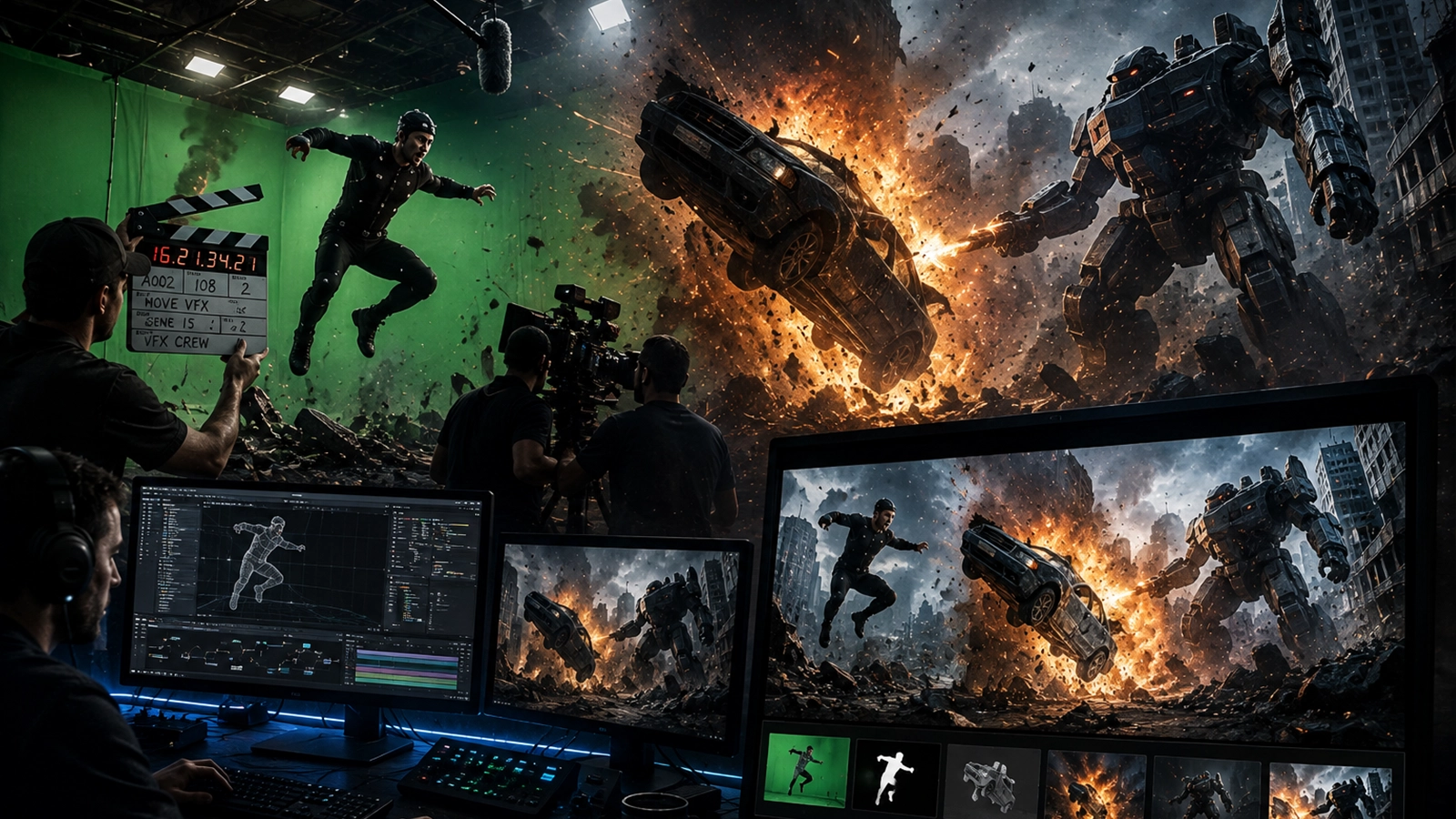
AI motion capture can turn live performance into animation data for digital characters. The professional challenge is not only capturing motion, but cleaning, retargeting and refining it so the character feels intentional.
1. What AI motion capture does
AI motion capture estimates human movement from visual input and converts it into animation-friendly data such as poses, joints, facial landmarks or performance controls.
→ BODY / FACE / HAND ESTIMATION
→ MOTION DATA
→ CLEANUP
→ RETARGET
→ CHARACTER RIG
→ ANIMATION REFINEMENT
→ FINAL SHOT
Unlike traditional marker-based capture, AI systems can sometimes work from ordinary camera footage, making performance capture more accessible. The quality still depends on camera angle, visibility, motion and the target character.
2. Body capture
Body capture estimates the positions and rotations of major joints. It is useful for locomotion, acting, choreography and blocking character animation.
| Motion | Typical challenge |
|---|---|
| Walking / running | Foot contact and ground alignment. |
| Turning | Hip and torso orientation. |
| Jumping | Airborne timing and landing contact. |
| Fast action | Occlusion and motion blur. |
| Seated performance | Hidden lower-body joints. |
3. Facial capture
Facial AI can estimate landmarks, expressions or control signals for a character face. Good facial animation depends on timing as much as shape.
| Facial area | Useful data |
|---|---|
| Eyes | Direction, blink and gaze timing. |
| Mouth | Lip shape and speech movement. |
| Brows | Expression and emphasis. |
| Jaw | Speech and emotional movement. |
For deeper tracking concepts, see AI Face, Body & Hand Tracking.
4. Hand and finger capture
Hands are among the hardest regions to capture because fingers overlap and contain many small joints. AI hand tracking can provide useful starting data, but interaction shots often require cleanup.
| Problem | Typical response |
|---|---|
| Finger overlap | Use temporal smoothing and manual correction. |
| Fast hand motion | Review blur-heavy frames and interpolation. |
| Object interaction | Constrain fingers to the prop. |
| Hidden hand | Use keyframes or alternate reference. |
5. Full-performance capture
Full-performance animation combines body, face and hands so the character communicates as one performance. The challenge is synchronization.
+
FACE
+
HANDS
+
VOICE / TIMING
↓
FULL PERFORMANCE
↓
CHARACTER RIG
↓
ANIMATION REFINEMENT
Body movement can influence facial timing, and hand actions can affect posture. Review the performance as a whole rather than evaluating each track independently.
6. Motion cleanup
Raw capture often contains jitter, foot sliding, unwanted rotations and noisy finger motion. Cleanup turns estimated data into intentional animation.
| Issue | Cleanup goal |
|---|---|
| Jitter | Smooth without destroying important accents. |
| Foot sliding | Restore believable ground contact. |
| Floating hands | Constrain to props or body contacts. |
| Noise | Filter unnecessary high-frequency motion. |
| Bad occlusion solve | Replace with keyframed motion. |
7. Retargeting
Retargeting transfers motion from the captured performer to a different character skeleton. Differences in height, proportions and joint orientation must be handled carefully.
→ JOINT MAPPING
→ SCALE / PROPORTION ADAPTATION
→ TARGET RIG
→ CONSTRAINTS
→ RETARGETED ANIMATION
| Retarget concern | Solution |
|---|---|
| Different proportions | Use normalized or proportion-aware mapping. |
| Different rest pose | Correct the bind/reference pose. |
| Different joint hierarchy | Map equivalent controls. |
| Character style | Add secondary animation after retargeting. |
8. Rigging and constraints
A good rig helps convert raw motion into believable character behavior. Constraints are especially useful for contacts, props and physically important relationships.
| Constraint | Use |
|---|---|
| Foot lock | Keep feet planted. |
| Hand-to-prop | Maintain grip and contact. |
| Look-at | Control gaze targets. |
| IK | Maintain end-effector placement. |
| Space switching | Change parent relationships during performance. |
9. Animation refinement
Motion capture is not the final animation. Refine timing, arcs, anticipation, follow-through, weight and character-specific style.
| Refinement | Purpose |
|---|---|
| Timing | Improve performance rhythm. |
| Arcs | Make movement readable and natural. |
| Anticipation | Clarify major actions. |
| Follow-through | Give body parts believable continuation. |
| Secondary motion | Add character-specific detail. |
Capture provides performance evidence; animation refinement gives that performance character, clarity and intent.
10. VFX integration
AI-driven character animation can feed many VFX workflows: digital doubles, creatures, crowd characters, virtual production, previs and full CG shots.
| Use | Pipeline connection |
|---|---|
| Digital double | Performance capture + facial animation. |
| Creature | Human motion retargeted to a custom rig. |
| Crowd | Capture clips converted into animation libraries. |
| Virtual production | Live performance driving digital characters. |
| Previsualization | Rapid blocking from recorded performance. |
11. Common mistakes
| Mistake | Why it fails | Better approach |
|---|---|---|
| Using raw capture as final animation | Noise and tracking errors remain. | Always clean and refine. |
| Ignoring foot contact | Character appears to slide or float. | Use foot locks and ground constraints. |
| Poor joint mapping | Limbs rotate incorrectly. | Validate skeleton mapping before retargeting. |
| Ignoring character proportions | Motion looks distorted. | Adapt source motion to target proportions. |
| Over-smoothing | Performance loses personality. | Preserve meaningful accents. |
| Separate review of body and face | Performance becomes disconnected. | Review the full performance together. |
12. Complete Zgian AI Motion Capture workflow
↓
BODY / FACE / HAND SOLVE
↓
DATA QC
↓
MOTION CLEANUP
↓
SKELETON MAPPING
↓
RETARGET
↓
IK / CONTACT CONSTRAINTS
↓
FACIAL + BODY SYNC
↓
ANIMATION REFINEMENT
↓
VFX / LIGHTING / COMP
↓
FINAL QC
- Capture the performance with suitable visibility and framing.
- Generate body, face and hand motion data.
- Remove tracking errors and jitter.
- Map the motion to the target character.
- Fix contacts, feet, hands and prop interactions.
- Synchronize facial and body performance.
- Refine timing, arcs and secondary motion.
- Integrate the character into the VFX scene.
- Review the complete performance before final delivery.
13. Final animation QC
- Check body stability.
- Check foot and hand contacts.
- Check facial timing.
- Check finger deformation.
- Check retargeting proportions.
- Check character balance and weight.
- Check intersections and clipping.
- Check motion arcs and timing.
- Check secondary motion.
- Review the final character in the actual shot.
How this fits the Zgian VFX + AI pipeline
AI CAMERA → Camera Tracking & Matchmoving 2.0
AI PERFORMANCE → this guide
AI ROTO → AI Rotoscoping 2.0
AI TEMPORAL → Motion & Frame Interpolation
AI COMP → AI Compositing
Frequently asked questions
What is AI motion capture?
It is the use of computer vision and AI techniques to estimate human movement from visual input and convert it into animation data.
Can AI capture hands and fingers?
Modern systems can estimate hand and finger movement, but occlusion and fast motion can require manual cleanup.
Is motion capture the same as final animation?
No. Capture provides performance data. Cleanup, retargeting, constraints and artistic refinement are still important.
What is retargeting?
Retargeting transfers motion from a source skeleton or performer to the skeleton and proportions of a target character.
How do I avoid foot sliding?
Use reliable contact detection, IK or foot locks, then refine the timing and ground relationship manually.
Continue the Zgian VFX + AI series
3D Generalist & VFX Professional · About the author →