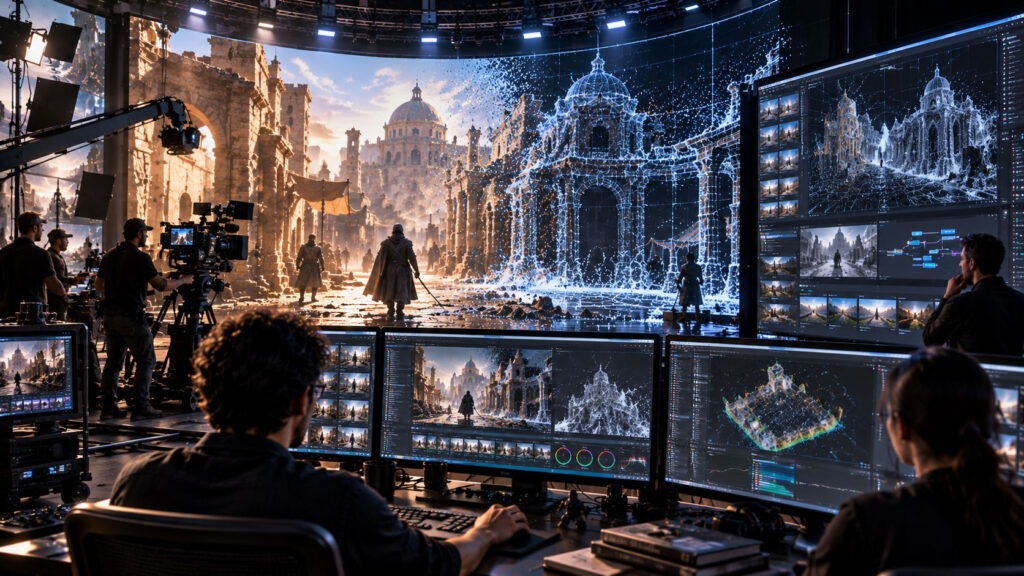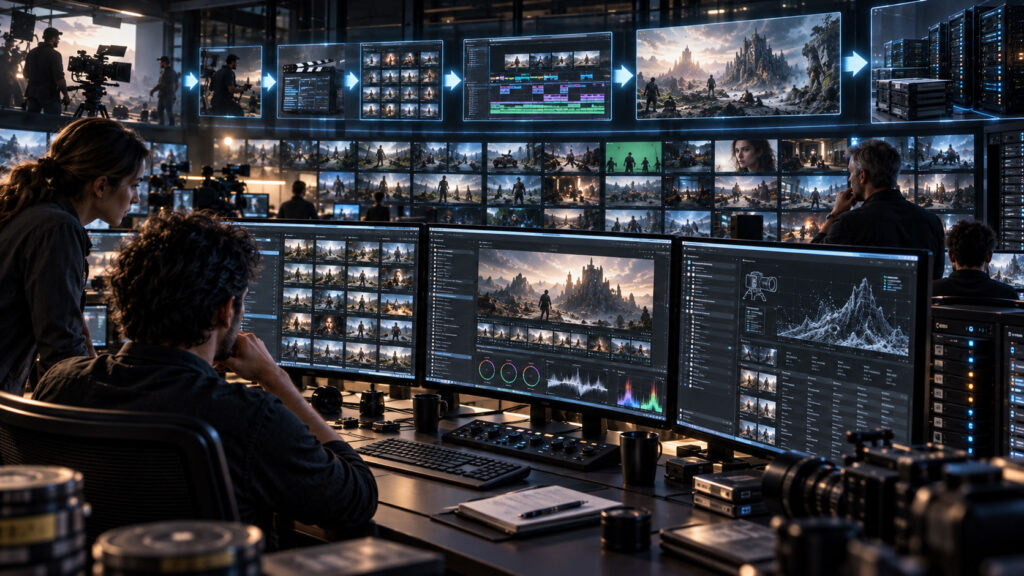
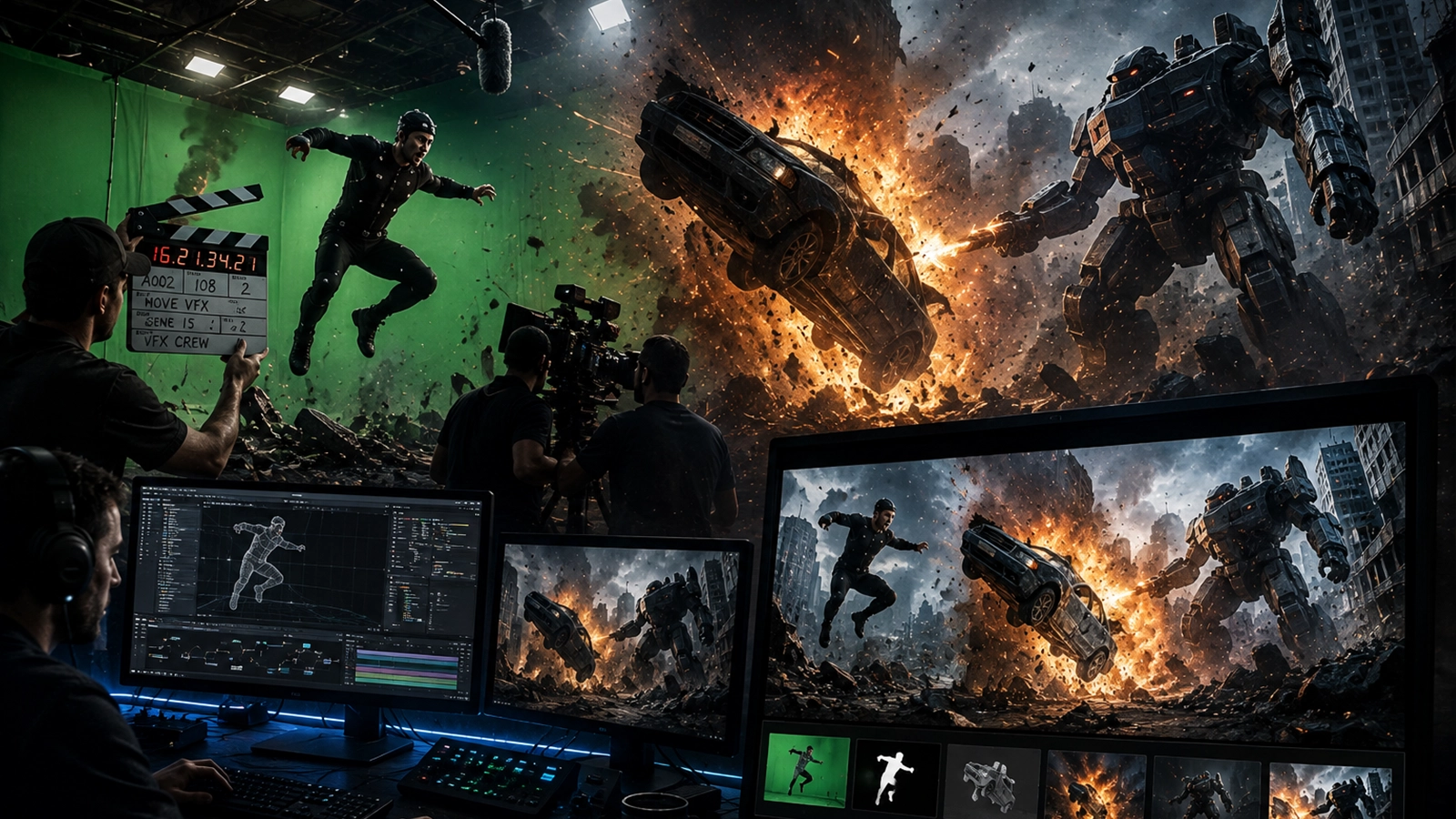
Virtual cinematography turns the real-time environment into a camera laboratory. Directors and cinematographers can explore lens choices, blocking, movement, lighting and composition before or during production, while AI can accelerate alternative shot exploration without replacing human creative judgment.
- What virtual cinematography changes
- Story and shot objective
- Virtual cameras
- Digital lenses
- Real-time camera movement
- Previs
- Techvis
- Shot design
- Virtual lighting
- AI camera direction
- Virtual directors
- Real-time editing
- Cinematic composition
- Continuity
- Optimization
- Common mistakes
- Complete workflow
- Final camera QC
- FAQ
1. What virtual cinematography changes
Virtual cinematography allows camera decisions to be explored inside the digital scene before expensive physical production. Camera, lens, actor blocking, lighting and environment can be tested together.
+
BLOCKING
+
CAMERA
+
LENS
+
LIGHT
+
ENVIRONMENT
↓
REAL-TIME SHOT
↓
PREVIS → TECHVIS → PRODUCTION
2. Story and shot objective
Every camera decision should support the story. Define what the audience needs to see, whose perspective matters and how the camera should guide attention before choosing technical settings.
| Story objective | Possible camera strategy |
|---|---|
| Reveal information | Controlled push, pan or reveal. |
| Build tension | Constrained movement and selective framing. |
| Show scale | Wide lens, height or deliberate movement. |
| Intimacy | Closer framing and controlled depth of field. |
| Action | Clear movement axis and readable staging. |
3. Virtual cameras
A virtual camera reproduces the essential behavior of a physical camera inside the real-time scene. It should be driven by real camera measurements when the result must translate to production.
| Parameter | Visual effect |
|---|---|
| Height | Changes perceived character power and perspective. |
| Position | Controls framing and spatial relationship. |
| Rotation | Defines screen direction and subject emphasis. |
| Sensor | Influences field of view and framing. |
| Shutter | Relates to motion-blur behavior. |
4. Digital lenses
Lens selection affects perspective, compression, depth of field and the emotional feel of a shot. Virtual production makes it possible to compare lens choices rapidly.
| Lens choice | Typical visual effect |
|---|---|
| Wide | Expanded space and stronger foreground perspective. |
| Normal | Balanced spatial relationships. |
| Long | Compressed space and stronger background isolation. |
| Anamorphic-style | Distinctive framing, flare and depth characteristics when accurately simulated. |
5. Real-time camera movement
Camera movement should have a purpose. Real-time tools make it easy to explore cranes, dollies, tracking shots, handheld motion and virtual drone-like movement before committing to a physical setup.
↓
MOVEMENT PATH
↓
SUBJECT BLOCKING
↓
LENS / FOCUS
↓
END FRAME
↓
SHOT REVIEW
| Movement | Use |
|---|---|
| Dolly | Controlled spatial change. |
| Tracking | Follow subject motion. |
| Crane | Reveal vertical scale. |
| Orbit | Expose spatial relationships. |
| Handheld | Add human instability and urgency. |
6. Previs
Previsualization turns a script or storyboard into rough animated shots. The goal is not final image quality; it is to solve storytelling, blocking, timing and camera language early.
| Previs check | Question |
|---|---|
| Blocking | Can the audience understand the action? |
| Framing | Is attention directed correctly? |
| Timing | Does the scene breathe at the intended pace? |
| Coverage | Are important moments captured? |
7. Techvis
Techvis translates the creative plan into physical requirements. It can identify camera positions, lens choices, crane or dolly paths, stage needs, LED coverage and safety constraints.
| Techvis output | Production value |
|---|---|
| Camera path | Defines physical movement requirements. |
| Lens plan | Supports camera and lens preparation. |
| Stage map | Coordinates crew and equipment. |
| Collision / clearance | Identifies physical constraints. |
| LED coverage | Shows where the virtual environment must be visible. |
8. Shot design
Shot design combines story, composition, movement and visual continuity. Virtual tools allow many variations to be tested before selecting the strongest version.
| Design layer | Decision |
|---|---|
| Composition | Subject placement and visual hierarchy. |
| Depth | Foreground, midground and background separation. |
| Movement | Camera and subject relationship. |
| Focus | Where the viewer should look. |
| Transition | How the shot connects to neighboring shots. |
9. Virtual lighting
Lighting should be designed alongside the camera. A camera move can reveal different parts of the environment, so key, fill, practical and atmospheric sources should remain coherent throughout the movement.
| Lighting layer | Purpose |
|---|---|
| Key | Defines subject form. |
| Fill | Controls contrast. |
| Back / rim | Separates subject from background. |
| Environment | Connects subject to the world. |
| Practical | Adds story-driven sources. |
10. AI camera direction
AI can help generate shot alternatives from a creative brief, suggest camera positions or compare compositions. These suggestions should be treated as exploration tools, not automatic replacements for cinematography.
| AI task | Useful output | Human decision |
|---|---|---|
| Shot variation | Alternate angles and movements. | Select visual language. |
| Composition analysis | Subject balance and framing options. | Choose story priority. |
| Lens exploration | Compare perspective choices. | Match emotion and production needs. |
| Previs assistance | Rapid blocking concepts. | Refine timing and staging. |
11. Virtual directors
A virtual director workflow uses real-time tools to explore staging and camera choices interactively. The director remains responsible for story, performance and creative intent.
↓
BLOCKING
↓
AI / PROCEDURAL SHOT OPTIONS
↓
DIRECTOR REVIEW
↓
CAMERA + LENS
↓
PREVIS
↓
TECHVIS
↓
PRODUCTION
12. Real-time editing
Editing during virtual production can test shot rhythm before photography. Rough cuts help reveal missing coverage, continuity problems and pacing issues while changes are still inexpensive.
| Edit check | Purpose |
|---|---|
| Coverage | Confirm important story beats. |
| Rhythm | Test scene pacing. |
| Screen direction | Maintain spatial clarity. |
| Transitions | Check visual continuity. |
13. Cinematic composition
Composition remains more important than technology. Use leading lines, depth, negative space, visual balance and contrast to guide attention.
| Technique | Purpose |
|---|---|
| Leading lines | Guide the eye. |
| Negative space | Create emphasis or tension. |
| Depth layers | Strengthen spatial perception. |
| Symmetry | Communicate order or control. |
| Asymmetry | Create tension and visual energy. |
14. Continuity
Virtual camera systems make continuity measurable. Record lens, height, position, movement, focus and lighting states so shots can be reproduced and revised.
| Continuity item | Record |
|---|---|
| Camera | Position, rotation and height. |
| Lens | Focal length and optical settings. |
| Movement | Path and timing. |
| Focus | Focus distance and transitions. |
| Lighting | Key, environment and practical states. |
15. Optimization
Real-time cinematography needs responsive playback. Keep the scene light enough to explore multiple shots without long waits.
| Technique | Benefit |
|---|---|
| LOD | Maintain frame rate while moving the camera. |
| Instancing | Reduce repeated geometry cost. |
| Visibility control | Render only camera-relevant regions. |
| Animation caching | Stabilize complex character and FX playback. |
| Preview quality | Enable rapid creative iteration. |
16. Common mistakes
| Mistake | Why it fails | Better approach |
|---|---|---|
| Choosing a camera before blocking | Movement becomes disconnected from story. | Block action first. |
| Too many camera options | Creative decisions become unfocused. | Generate a small, purposeful shortlist. |
| Ignoring lens behavior | Virtual shot does not translate to production. | Match sensor and lens assumptions. |
| Previs without techvis | Beautiful shots may be physically impossible. | Validate stage and equipment requirements. |
| AI-driven composition without story | Shots look impressive but lack purpose. | Keep narrative intent as the primary constraint. |
17. Complete Zgian AI virtual-cinematography workflow
↓
SHOT OBJECTIVE
↓
BLOCKING
↓
VIRTUAL CAMERA
↓
LENS EXPLORATION
↓
REAL-TIME MOVEMENT
↓
PREVIS
↓
TECHVIS
↓
LIGHTING
↓
AI SHOT VARIATIONS
↓
DIRECTOR REVIEW
↓
REAL-TIME EDIT
↓
SHOT LOCK
↓
FINAL CAMERA QC
- Define the story purpose of the shot.
- Block characters and environment.
- Explore camera height, position and lens.
- Test movement and focus.
- Create previs and review the sequence.
- Run techvis for physical feasibility.
- Design and validate lighting.
- Use AI to generate controlled alternatives.
- Review the shot with director and cinematography priorities.
- Lock the approved camera language and record all technical parameters.
18. Final camera QC
- Check story purpose.
- Check composition.
- Check lens and perspective.
- Check camera movement.
- Check focus and depth of field.
- Check character blocking.
- Check lighting continuity.
- Check technical feasibility.
- Check continuity with adjacent shots.
- Review the final camera path through the intended production pipeline.
How this fits the Zgian VFX + AI pipeline
AI VIRTUAL CHARACTERS → Digital Humans 3.0
AI VIRTUAL CINEMATOGRAPHY → this guide
AI ENVIRONMENT → Environment Lighting 2.0
Frequently asked questions
What is virtual cinematography?
Virtual cinematography is the design and operation of cameras inside digital or real-time environments, often using virtual lenses, tracked cameras and previs tools.
What is previs?
Previsualization is a rough animated representation of shots used to solve blocking, timing, camera and storytelling before final production.
What is techvis?
Technical visualization translates the creative shot into practical requirements such as camera paths, lens choices, stage layouts and equipment clearances.
How can AI help cinematographers?
AI can generate and compare controlled shot alternatives, analyze compositions and accelerate previs exploration, while creative decisions remain with the director and cinematographer.
Why is lens choice important in a virtual camera?
Lens choice changes perspective, field of view, spatial compression and the emotional character of the image.
Continue the Zgian VFX + AI series
3D Generalist & VFX Professional · About the author →