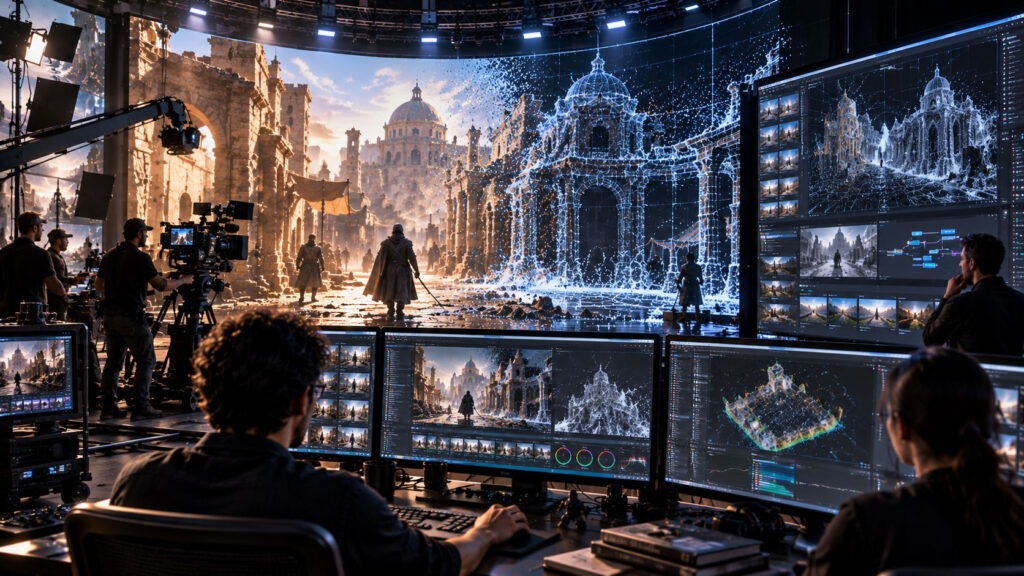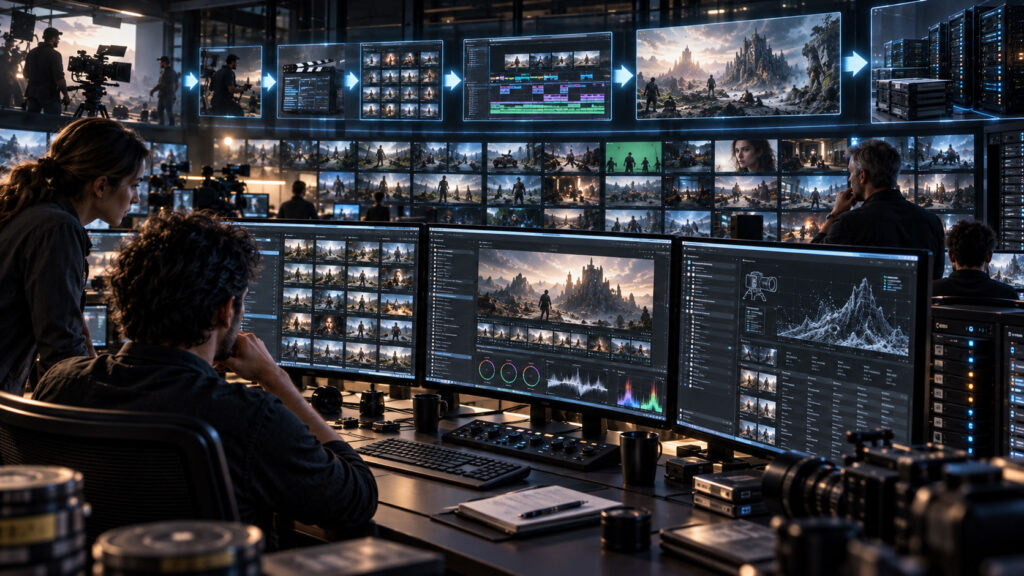
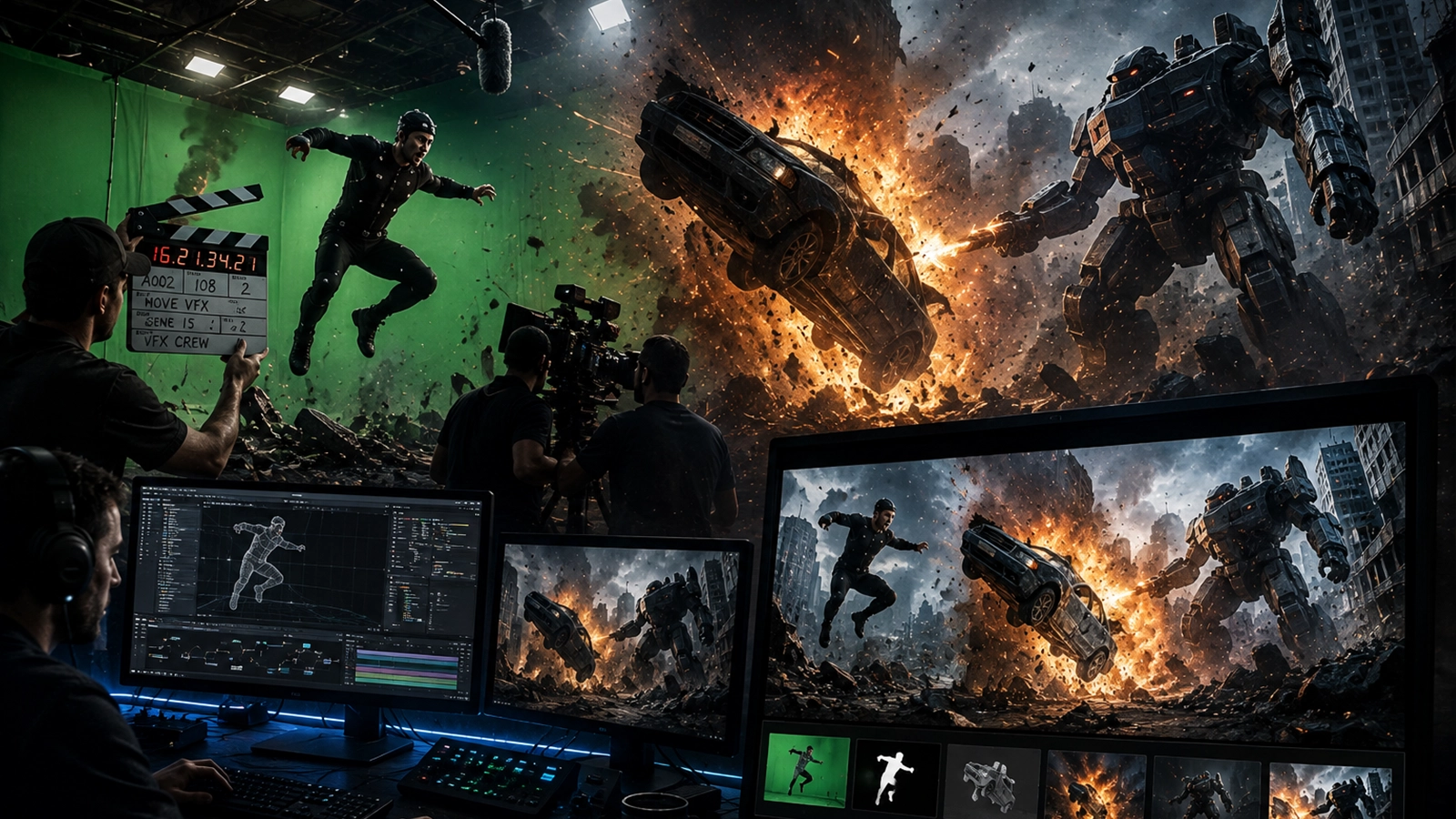
Virtual production brings digital environments into the physical stage so performers, cameras and real-time worlds can interact in the same shot. The strongest workflow combines calibrated displays, tracked cameras, accurate lens data, real-time rendering and disciplined on-set lighting.
- What virtual production changes
- VP brief and technical planning
- LED volume fundamentals
- Display calibration
- Virtual sets
- Real-time environments
- Camera tracking
- Lens matching
- Parallax and perspective
- In-camera VFX
- Virtual lighting
- Live compositing
- AI virtual production
- Real-time engine workflow
- Optimization
- Common mistakes
- Complete VP workflow
- Final VP QC
- FAQ
1. What virtual production changes
Traditional green-screen production separates performers from environments until post-production. Virtual production moves part of that environment into the stage, allowing the camera to photograph reflections, interactive lighting and perspective-correct backgrounds during the shoot.
+
CAMERA TRACKING
+
LENS DATA
+
LED DISPLAY
+
REAL-TIME WORLD
+
LIGHTING
↓
IN-CAMERA VFX
↓
POST-PRODUCTION REFINEMENT
2. VP brief and technical planning
Begin with the shot requirements rather than the LED wall. Decide which parts need to be visible on the display, which elements can be added later and how much camera movement and parallax the system must support.
| Planning item | Questions |
|---|---|
| Camera | Sensor, frame rate, resolution and movement? |
| Lens | Focal length, distortion and focus behavior? |
| Display | Required size, brightness and pixel pitch? |
| Environment | Real-time complexity and visibility? |
| Post | What remains for compositing? |
3. LED volume fundamentals
An LED volume is a large display environment used as a background and lighting source. The display geometry, camera position and rendered perspective must remain synchronized for convincing in-camera results.
| Component | Role |
|---|---|
| LED wall | Displays the environment and visible background. |
| Ceiling / floor | Extends reflections and interactive light when available. |
| Processing | Maps rendered pixels to display hardware. |
| Render system | Produces the perspective-correct real-time environment. |
4. Display calibration
Display calibration affects exposure, color, brightness and the camera’s ability to photograph the virtual environment correctly. The display and camera pipeline should be tested before principal photography.
| Calibration | Purpose |
|---|---|
| Color | Maintain predictable image response. |
| Brightness | Balance display output with physical lighting. |
| Refresh / timing | Avoid visible scan or synchronization artifacts. |
| Geometry | Keep rendered content aligned to the physical volume. |
5. Virtual sets
Virtual sets should be designed for the camera. Build high detail where the lens sees it and simplify hidden regions. Architectural scale, materials and lighting should connect the virtual set to the physical stage.
↓
CAMERA FRAMING
↓
VISIBLE DETAIL
↓
PARALLAX REGION
↓
BACKGROUND / DISTANCE
↓
REAL-TIME OPTIMIZATION
6. Real-time environments
Real-time environments need predictable performance. Geometry, materials, lighting and effects must be optimized for the target frame rate and display resolution.
| System | Optimization strategy |
|---|---|
| Geometry | LOD, instancing and camera-aware detail. |
| Materials | Shared shaders and controlled complexity. |
| Lighting | Efficient real-time techniques. |
| FX | Budget particles and volumetrics. |
| World | Stream or simplify distant regions. |
7. Camera tracking
Camera tracking provides the render engine with the camera’s position and orientation so the virtual environment changes perspective as the physical camera moves.
| Tracking data | Importance |
|---|---|
| Position | Controls world translation and parallax. |
| Rotation | Controls view direction. |
| Height | Maintains horizon and perspective. |
| Lens data | Controls field of view and optical behavior. |
8. Lens matching
Lens data is as important as camera tracking. Focal length, sensor characteristics, distortion and focus behavior influence how the virtual world appears through the physical lens.
| Lens factor | Virtual-production effect |
|---|---|
| Focal length | Changes field of view and perspective. |
| Distortion | Changes edge alignment and compositing. |
| Focus | Controls depth of field and background sharpness. |
| Sensor | Defines image framing and field of view. |
9. Parallax and perspective
Parallax is one of the defining advantages of a tracked virtual camera. Nearby virtual objects should move more rapidly relative to distant objects as the camera moves.
+
TRACKING
+
LENS MODEL
↓
PERSPECTIVE-CORRECT RENDER
↓
PARALLAX
↓
REAL-TIME BACKGROUND
10. In-camera VFX
In-camera VFX aims to capture as much of the final visual relationship as possible during photography. The result can include background imagery, reflections, interactive light and foreground integration.
| Element | On-set benefit |
|---|---|
| Background | Immediate perspective and composition. |
| Reflections | Real optical response on reflective surfaces. |
| Interactive light | Virtual world influences actors and props. |
| Atmosphere | Physical haze can blend stage and display. |
11. Virtual lighting
The LED display itself can contribute light, while additional physical fixtures shape the scene. The goal is a consistent relationship between displayed environment, practical lights and final exposure.
| Lighting source | Role |
|---|---|
| LED display | Background and interactive color/light. |
| Physical key | Primary control of subject exposure and form. |
| Fill | Controls contrast. |
| Practical | Connects environment and story. |
| Atmospheric light | Builds depth and separation. |
12. Live compositing
Live compositing combines camera, tracking, rendered environment and technical overlays for monitoring. It helps the crew identify perspective, color and integration problems before the shoot is finished.
| Monitor | Check |
|---|---|
| Director view | Composition and storytelling. |
| VFX view | Tracking, render and alignment. |
| Color view | Exposure and display response. |
| Technical view | Frame rate, sync and system health. |
13. AI virtual production
AI can accelerate environment concepts, set variations, background generation, shot planning and look exploration. For stage use, the selected result must be converted into a deterministic real-time asset or sequence.
| AI use | Benefit | Production requirement |
|---|---|---|
| Environment concepts | Rapid world exploration. | Build a consistent 3D or real-time version. |
| Set variations | Fast art-direction options. | Keep scale and continuity. |
| Lighting references | Quick mood exploration. | Translate into controllable lights. |
| Shot planning | Explore camera compositions. | Validate with real lens and tracking data. |
14. Real-time engine workflow
A real-time engine typically connects the virtual world, camera tracking, display output and lighting controls. The exact software stack can vary, but the production principles remain the same.
↓
REAL-TIME RENDER
↓
CAMERA TRACKING
+
LENS DATA
↓
DISPLAY PROCESSING
↓
LED VOLUME
↓
PHYSICAL CAMERA
↓
ON-SET MONITORING
15. Optimization
Virtual production requires stable frame rates because rendering is part of photography. Optimize before the shoot rather than discovering performance limits on set.
| Optimization | Purpose |
|---|---|
| LOD | Reduce distant geometry cost. |
| Instancing | Reuse repeated environment elements. |
| Material simplification | Reduce shader cost. |
| Visibility control | Render only what the camera can see. |
| Resolution budgeting | Balance display output and render performance. |
16. Common mistakes
| Mistake | Why it fails | Better approach |
|---|---|---|
| Tracking added too late | Perspective mismatch becomes expensive to fix. | Calibrate before camera tests. |
| Ignoring lens distortion | Edges and foreground integration drift. | Capture and match lens characteristics. |
| Overbuilding the world | Real-time performance collapses. | Build for the camera and display. |
| Display used as the only light | Subject control becomes limited. | Balance LED and physical lighting. |
| AI assets without continuity | Shots look inconsistent. | Lock style, scale and environment rules. |
17. Complete Zgian AI virtual-production workflow
↓
CAMERA + LENS PLAN
↓
LED / DISPLAY CALIBRATION
↓
VIRTUAL SET
↓
REAL-TIME OPTIMIZATION
↓
CAMERA TRACKING
↓
PARALLAX + LENS MATCH
↓
VIRTUAL + PHYSICAL LIGHTING
↓
IN-CAMERA VFX
↓
LIVE COMPOSITING
↓
AI LOOK / ENVIRONMENT ITERATION
↓
FINAL VP QC
- Define the shot and technical requirements.
- Calibrate the display and imaging pipeline.
- Build the camera-focused virtual set.
- Optimize the real-time environment.
- Calibrate camera tracking and lens data.
- Validate parallax and perspective.
- Balance LED and physical lighting.
- Run live in-camera VFX tests.
- Use AI for environment and look-development iterations where useful.
- Lock the configuration and perform final technical checks before photography.
18. Final VP QC
- Check LED display calibration.
- Check camera tracking stability.
- Check lens and distortion data.
- Check perspective and parallax.
- Check frame rate and synchronization.
- Check virtual/physical lighting integration.
- Check reflections and foreground interaction.
- Check real-time performance headroom.
- Check live composite and monitoring outputs.
- Review representative shots through the final camera pipeline before principal photography.
How this fits the Zgian VFX + AI pipeline
AI ARCHITECTURE → Digital Architecture 2.0
AI MATERIALS → Environment Materials 2.0
AI LIGHTING → Environment Lighting 2.0
AI ANIMATION → Environment Animation 2.0
AI ENVIRONMENT FX → Environment FX 2.0
AI VIRTUAL PRODUCTION → this guide
Frequently asked questions
What is virtual production?
Virtual production combines physical photography with real-time digital environments, allowing performers, cameras and virtual worlds to interact during filming.
Why is camera tracking important?
Tracking lets the real-time environment respond to camera movement so perspective and parallax remain correct.
Why does lens data matter?
The lens determines field of view, distortion and depth-of-field behavior. Matching those characteristics improves the connection between physical and virtual imagery.
Can AI create virtual-production environments?
AI can accelerate concepts and variations, but production environments need consistent geometry, materials, scale and real-time performance.
Does an LED wall replace traditional lighting?
No. The display can provide interactive illumination, but physical fixtures are still useful for precise subject lighting and control.
Continue the Zgian VFX + AI series
3D Generalist & VFX Professional · About the author →