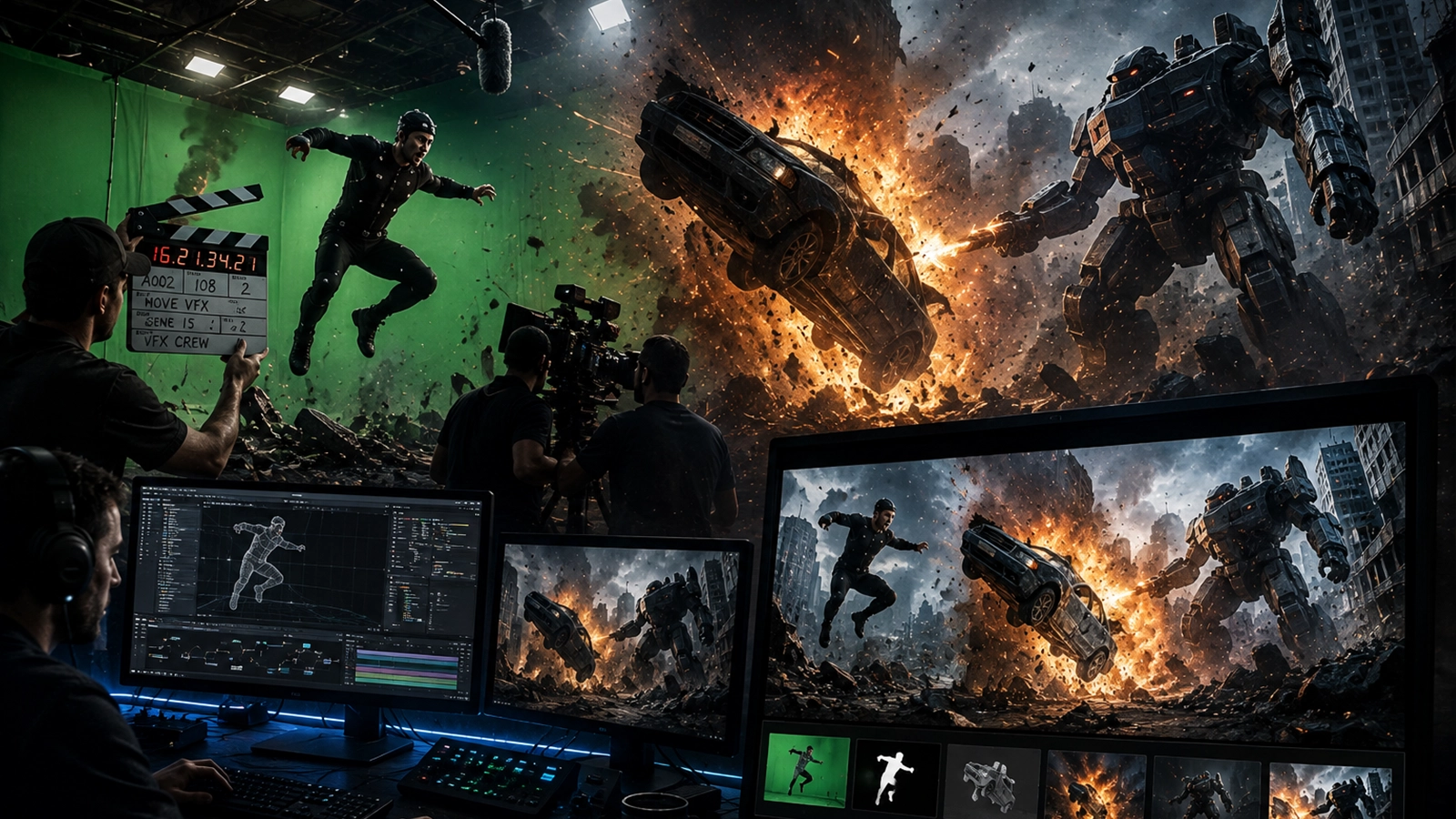
Environment lighting determines whether a digital world feels physically connected to the camera. Procedural sun and sky systems, HDRIs, global illumination, atmospheric scattering and controlled look development let artists reproduce time, weather and mood with consistency.
- What environment lighting controls
- Lighting intent and reference analysis
- Procedural sun
- Procedural sky
- HDRI lighting
- Global illumination
- Procedural weather
- Time of day
- Atmospheric scattering
- Volumetrics
- Reflections and indirect response
- Lighting matching
- AI look development
- Cinematic environment lighting
- Common mistakes
- Complete workflow
- Final lighting QC
- FAQ
1. What environment lighting controls
Lighting communicates time, location, weather, scale and mood. It also provides the visual connection between practical footage and digital environments.
+
SKY
+
WORLD LIGHT
+
BOUNCE / GI
+
ATMOSPHERE
+
REFLECTIONS
↓
ENVIRONMENT LIGHTING
↓
CINEMATIC IMAGE
2. Lighting intent and reference analysis
Start by identifying the source direction, shadow softness, sky brightness, color relationships, atmospheric density and exposure in the reference or plate.
| Reference cue | What to extract |
|---|---|
| Sun / key | Direction, height and hardness. |
| Sky | Ambient color and intensity. |
| Shadows | Length, direction and softness. |
| Atmosphere | Haze, contrast falloff and depth. |
| Reflections | World brightness and environment shape. |
3. Procedural sun
A procedural sun system can be driven by geographic latitude, date, time and artistic adjustments. This makes sun direction repeatable across shots and sequences.
| Parameter | Effect |
|---|---|
| Elevation | Controls shadow length and light angle. |
| Azimuth | Controls horizontal direction. |
| Intensity | Controls direct illumination. |
| Color | Controls perceived time and atmosphere. |
| Angular size | Affects shadow softness. |
4. Procedural sky
The sky supplies ambient illumination and often becomes visible in reflections. A physically consistent sky should respond to sun position, atmospheric conditions and time of day.
+
ATMOSPHERIC MODEL
+
CLOUD / WEATHER STATE
+
EXPOSURE
↓
PROCEDURAL SKY
↓
AMBIENT WORLD LIGHT
5. HDRI lighting
HDRI environments provide image-based lighting and visual context. They can be especially useful when a digital environment must match a photographed location or a specific studio setup.
| HDRI use | Best practice |
|---|---|
| Lighting | Use high dynamic range information for realistic illumination. |
| Reflection | Keep the environment aligned with reflective objects. |
| Background | Match camera projection and exposure. |
| Rotation | Align key light direction with the scene. |
6. Global illumination
Global illumination describes indirect light bouncing through the environment. It is critical for believable contact, color bounce and interior-to-exterior relationships.
| GI component | Visual role |
|---|---|
| Direct light | Primary illumination and shadows. |
| Diffuse bounce | Softens and colors nearby surfaces. |
| Occlusion | Strengthens contact and creases. |
| Indirect environment | Connects objects to the world. |
7. Procedural weather
Weather can be represented as a lighting state rather than only a visual effect. Cloud cover, humidity, rain and dust change key intensity, sky contribution, contrast and atmospheric depth.
| Weather | Lighting change |
|---|---|
| Clear | Strong direct sun and crisp shadows. |
| Overcast | Soft, broad illumination and low contrast. |
| Rain | Reduced contrast, wet reflections and darker surfaces. |
| Dust | Warm haze and reduced distant contrast. |
| Fog | Strong depth falloff and volumetric response. |
8. Time of day
Time-of-day systems can drive sun angle, sky color, atmospheric density and exposure changes. The transition should remain continuous across an animated sequence.
For cinematic work, the physically accurate state can be adjusted artistically while keeping the lighting relationships coherent.
9. Atmospheric scattering
Atmospheric scattering creates aerial perspective by reducing contrast and shifting color with distance. It is one of the most important tools for making large digital environments feel deep.
| Depth cue | Effect |
|---|---|
| Haze | Reduces distant contrast. |
| Color shift | Moves distant objects toward atmospheric color. |
| Sun scattering | Creates visible shafts or glow under suitable conditions. |
| Humidity | Changes scattering and visibility. |
10. Volumetrics
Volumetric lighting makes light interact with fog, dust, smoke and other participating media. It should be used with restraint so that the environment retains readable contrast.
| Volume | Use |
|---|---|
| Fog | Large-scale depth and atmosphere. |
| Dust | Dry environments and shafts of light. |
| Mist | Moist landscapes and soft depth. |
| Smoke | Localized atmospheric storytelling. |
11. Reflections and indirect response
Reflective materials reveal whether the environment lighting is correct. Glass, polished metal, wet roads and water should reflect a world consistent with the camera and sky.
| Surface | Lighting requirement |
|---|---|
| Glass | Accurate environment and sky reflections. |
| Wet asphalt | Strong low-angle world reflection. |
| Metal | Sharp or broad reflections based on roughness. |
| Water | Sky and surrounding environment continuity. |
12. Lighting matching
When extending a live-action plate, match the digital environment to the photographed lighting before adjusting the grade. Camera exposure, white balance, lens characteristics and reference measurements should guide the process.
↓
SUN / KEY MATCH
↓
SKY / AMBIENT MATCH
↓
GI / BOUNCE
↓
ATMOSPHERE
↓
REFLECTIONS
↓
FINAL GRADE
13. AI look development
AI can help artists explore alternate moods, lighting references and environment variations quickly. The selected look should then be translated into controllable lighting parameters rather than treated as an unrepeatable image.
| AI use | Benefit | Production step |
|---|---|---|
| Lighting references | Rapid mood exploration. | Extract measurable lighting relationships. |
| Sky variations | Fast time/weather options. | Match sun and atmospheric state. |
| Look exploration | More cinematic directions. | Convert into reproducible grade and light. |
| Environment analysis | Identify visual cues. | Validate against the original plate. |
14. Cinematic environment lighting
Cinematic lighting balances physical consistency with storytelling. Exposure, contrast, color separation and practical sources can guide the viewer while preserving believable world illumination.
| Technique | Purpose |
|---|---|
| Key direction | Guide attention and establish form. |
| Color contrast | Separate foreground, midground and background. |
| Practical lights | Connect architecture to story and scale. |
| Atmospheric depth | Increase spatial separation. |
| Controlled highlights | Support cinematic emphasis without clipping. |
15. Common mistakes
| Mistake | Why it fails | Better approach |
|---|---|---|
| Wrong sun direction | Digital elements contradict the plate. | Match key direction first. |
| Over-bright sky | World feels disconnected. | Match exposure and ambient contribution. |
| Fake fog everywhere | Depth becomes flat and milky. | Use distance-aware atmospheric density. |
| Ignoring reflections | Materials reveal the mismatch. | Update environment reflections. |
| AI look without parameters | Cannot reproduce the result across shots. | Translate the look into controllable lighting and grade. |
16. Complete Zgian AI environment-lighting workflow
↓
LIGHTING INTENT
↓
SUN + SKY
↓
HDRI / WORLD LIGHT
↓
GLOBAL ILLUMINATION
↓
WEATHER STATE
↓
TIME OF DAY
↓
ATMOSPHERIC SCATTERING
↓
VOLUMETRICS
↓
REFLECTIONS
↓
AI LOOK DEVELOPMENT
↓
CINEMATIC GRADE
↓
FINAL LIGHTING QC
- Analyze the original plate or environment reference.
- Define the lighting intent and key direction.
- Set sun and procedural sky parameters.
- Add HDRI or world illumination when required.
- Establish indirect light and global illumination.
- Define weather and time-of-day states.
- Build atmospheric and volumetric depth.
- Validate reflections and material response.
- Use AI references to explore the cinematic look.
- Translate the chosen look into repeatable lighting and grading controls.
17. Final lighting QC
- Check key-light direction.
- Check sun intensity and shadow softness.
- Check sky contribution.
- Check exposure and color temperature.
- Check global illumination and contact response.
- Check atmospheric depth.
- Check volumetric density.
- Check reflections.
- Check continuity between shots.
- Review the final image under the intended cinematic grade.
How this fits the Zgian VFX + AI pipeline
AI ARCHITECTURE → Digital Architecture 2.0
AI MATERIALS → Environment Materials 2.0
AI LIGHTING → this guide
AI SET EXTENSION → Environment & Set Extension 2.0
AI VIDEO → AI Video & Cinematic AI
Frequently asked questions
What is environment lighting in VFX?
It is the lighting of the surrounding world that determines how digital environments, objects and atmosphere respond to the scene’s illumination.
Is HDRI better than a procedural sky?
Neither is universally better. HDRIs provide detailed captured environments, while procedural skies offer controllable sun, atmosphere and time-of-day parameters.
How do I match CG lighting to live action?
Match key direction, shadow behavior, sky contribution, exposure, color temperature, bounce, atmosphere and reflections before final grading.
Can AI create cinematic lighting?
AI can explore references and moods quickly, but production lighting should be translated into repeatable, controllable parameters.
Why are reflections important?
Reflective surfaces show the environment to the viewer, making lighting mismatches particularly easy to notice.
Continue the Zgian VFX + AI series
3D Generalist & VFX Professional · About the author →