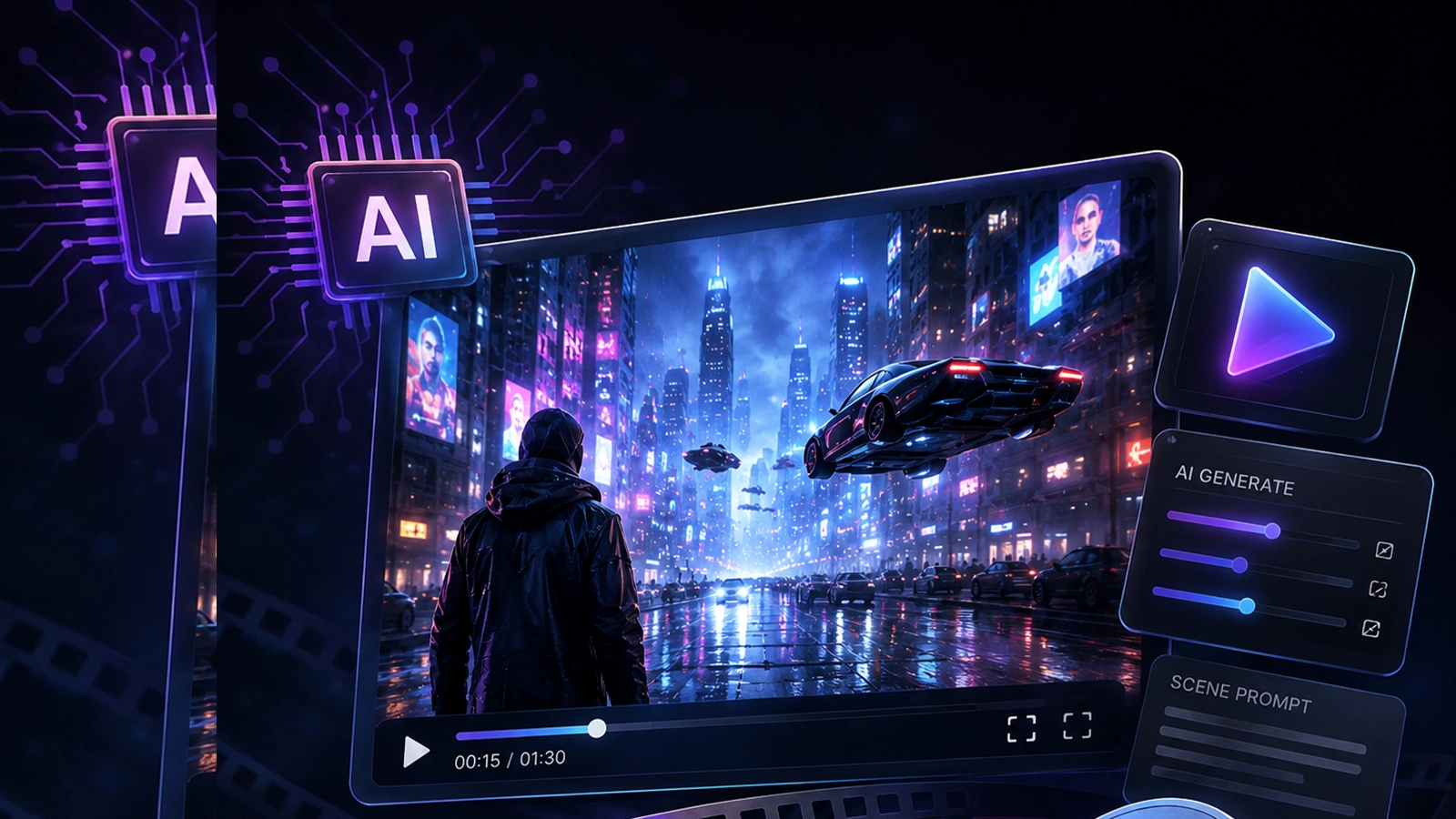

Virtual production is moving beyond LED walls and real-time engines. AI can now accelerate digital characters, motion capture, camera tracking, scene reconstruction, environments and shot development—while artists retain control through editable 3D workflows.
What is AI virtual production?
Virtual production combines live action, computer graphics, real-time rendering and virtual environments to create shots that would traditionally require extensive location work or post-production.
AI adds another layer: it can automate motion capture, camera tracking, scene reconstruction, asset generation, character creation and some rendering or compositing tasks.
AI does not make virtual production a “one-click movie set.” Its biggest value is reducing setup time while keeping the scene editable and directable.
Best AI virtual production tools: quick comparison
| Tool / platform | Best for | AI strength | Best fit |
|---|---|---|---|
| Autodesk Flow Studio | AI-first VFX and previs | Characters, mocap, tracking, clean plates, scene reconstruction and directable AI scenes | Indie creators, previs and VFX teams |
| Unreal Engine | Real-time virtual production | Real-time environments, cameras, digital humans and engine-based production | Film, TV, games and VP stages |
| Maya / Blender + AI | Custom 3D production | AI-generated assets and motion can be refined manually | Artists needing full control |
| AI environment generation | World building / previs | Rapid environment concepts and scene exploration | Previs, concept and virtual locations |
Autodesk Flow Studio: strongest AI-first VP option
Flow Studio turns live-action footage into editable CG scenes and can automatically generate motion capture, camera tracking, alpha masks, clean plates and character passes. Autodesk says these outputs can be exported to Maya, Blender, Unreal and 3ds Max through USD.
Its April 2026 AI Rigging and Neural Layer release expanded the workflow from asset generation into animation and polished rendering.
Then, in August 2026, Autodesk launched 3D Editor + Canvas. The 3D Editor brings characters, worlds, animations and camera movements into an editable scene, while Canvas provides AI image/video generation and refinement without rebuilding the scene from scratch.
Unreal Engine + AI workflows
Unreal Engine remains an important real-time production environment for virtual production. The useful strategy is not “AI instead of Unreal,” but AI feeding Unreal.
↓
CLEAN 3D ASSET
↓
UNREAL ENGINE
↓
VIRTUAL CAMERA + LIGHTING
↓
LIVE / REAL-TIME SHOT
↓
VFX COMPOSITING
This approach keeps the strengths of real-time 3D—camera control, lighting, animation and environment interaction—while using AI to accelerate asset and pre-production tasks.
Digital characters in virtual production
Digital humans and CG characters are one of the most obvious AI-assisted virtual-production applications. The current Flow Studio workflow can generate and auto-rig characters, drive them using markerless mocap and place them into live-action performances.
For believable results, focus on:
- Character scale
- Foot contact
- Eye line
- Facial performance
- Lighting direction
- Shadow interaction
- Motion blur
- Camera perspective
AI-generated environments
AI can dramatically speed up environment exploration. Instead of building a complete digital location before knowing whether the shot works, artists can generate multiple concepts, then turn the selected direction into a more controlled 3D scene.
Autodesk’s August 2026 Flow Studio update explicitly describes combining AI-generated characters, assets and scenes with AI-generated worlds and environments, including tools such as World Labs Marble.
The production rule remains simple: concept generation is not final environment production. Camera-critical shots still require reliable geometry, scale, lighting and continuity.
Virtual cameras and camera tracking
A virtual-production shot lives or dies by camera consistency. AI tools can reduce the effort required to reconstruct or track camera movement, but the artist must still validate the solve.
Flow Studio can automatically generate camera tracking as part of its live-action-to-CG workflow and export it for further work.
Camera checks
- Perspective matches the plate.
- Horizon and lens behavior are believable.
- Camera scale is correct.
- Character movement remains locked to the environment.
- Foreground and background parallax make sense.
AI + LED virtual production
AI and LED stages solve different problems. An LED volume provides a physical environment, interactive lighting and real-time background imagery. AI can accelerate the creation of characters, assets, environments and previsualization that feed into that production.
| LED stage | AI layer |
|---|---|
| Physical camera and actors | AI-generated assets and concepts |
| Real-time background | Rapid environment variations |
| Interactive light | AI-assisted character / scene preparation |
| On-set decisions | Faster previs and iteration |
Professional AI virtual-production workflow
Step 1 — Define the shot
Know the camera, action and final framing before generating large amounts of content.
Step 2 — Previsualize
Use AI to explore character and environment variations quickly.
Step 3 — Build controllable assets
Convert the winning concepts into usable 3D assets with sensible topology, textures and scale.
Step 4 — Establish the camera
Use a virtual camera for a CG scene or solve the live-action camera when replacing/inserting characters.
Step 5 — Capture performance
Use markerless mocap or traditional capture depending on the shot’s requirements.
Step 6 — Match lighting
Virtual and physical lighting must tell the same story. Contact shadows are especially important.
Step 7 — Capture the shot
Review the result on set or during real-time previs before committing to final production.
Step 8 — Finish
Use VFX paint, relighting, compositing, grain and color correction to integrate the final image.
Where AI still needs artists
| AI strength | Artist responsibility |
|---|---|
| Rapid asset generation | Design accuracy and production readiness |
| Motion capture | Acting, timing and cleanup |
| Scene generation | Camera, continuity and spatial logic |
| AI rendering | Shot consistency and final QC |
| Environment concepts | Geometry, scale and physical interaction |
| Automated tracking | Validate the solve and fix difficult frames |
The most important virtual-production skill is not knowing every AI model. It is knowing which parts of the shot must remain deterministic and editable.
AI virtual production vs traditional production
| AI-assisted VP | Traditional VP |
|---|---|
| Faster concept and asset iteration | More predictable established pipeline |
| Reduced setup for some tasks | More manual specialist work |
| Excellent for previs and rapid exploration | Strong for final controlled production |
| Requires careful consistency checks | Established quality-control practices |
Which workflow should you choose?
- Choose Flow Studio for an AI-first VFX/previs workflow with characters, mocap, tracking and editable scenes.
- Choose Unreal Engine when real-time environments, virtual cameras and stage production are central to the project.
- Combine AI + Maya/Blender/Houdini when the final asset needs detailed artist control.
- Use a hybrid pipeline for professional film work: AI accelerates preparation while established tools control final shots.
Where this fits in the Zgian roadmap
This opens a major new Zgian content branch around AI + Virtual Production, connecting our AI 3D, animation and VFX articles to filmmaking and real-time production.
Frequently asked questions
What is the best AI virtual production tool in 2026?
For an AI-first VFX and previs workflow, Autodesk Flow Studio is one of the most complete current options, combining AI characters, mocap, camera tracking, clean plates and editable 3D scenes.
Can AI be used in virtual production?
Yes. AI can accelerate characters, environments, motion capture, camera tracking, scene reconstruction and shot development. The strongest workflows keep the important creative decisions editable.
Is AI replacing Unreal Engine in virtual production?
No. AI and real-time engines solve different problems. AI can generate or prepare assets and scenes, while a real-time engine provides deterministic camera, lighting, environment and production control.
Can I do virtual production without an LED wall?
Yes. Virtual production also includes previs, real-time CG, camera tracking, digital characters and live-action/CG integration. An LED stage is one production method, not the entire category.
Can Flow Studio export to Unreal Engine?
Yes. Autodesk says Flow Studio can export mocap, camera tracking, clean plates and scenes to Unreal and other 3D tools, including through USD.
Continue the Zgian AI + VFX series
3D Generalist & VFX Professional · About the author →