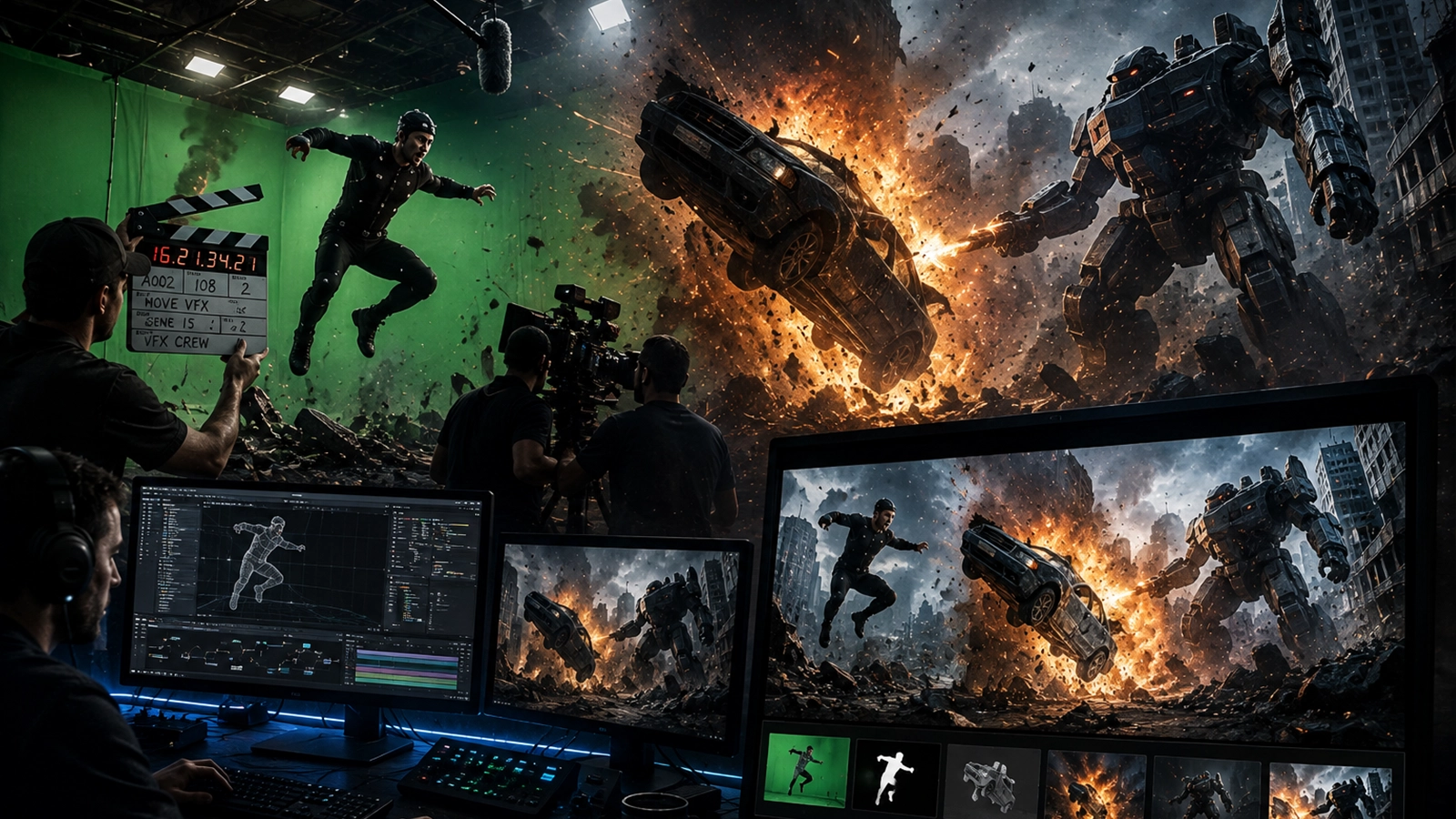
A crowd can be visually simple but computationally enormous. Efficient rendering depends on sharing assets, reducing detail intelligently, caching animation and controlling expensive hair, shading, shadows and lighting by camera importance.
- Why crowd rendering becomes expensive
- Profiling and bottlenecks
- Instancing
- LOD strategy
- Animation and simulation caching
- Hair and grooming optimization
- Materials and textures
- Shadows and lighting
- GPU and CPU optimization
- Massive scene management
- VFX compositing
- Where AI helps
- Common mistakes
- Complete workflow
- Final render QC
- FAQ
1. Why crowd rendering becomes expensive
A single character may be affordable to render, but thousands of characters multiply geometry, animation evaluation, materials, hair, shadows and lighting calculations.
×
GEOMETRY
×
MATERIALS
×
HAIR
×
SHADOWS
×
ANIMATION
↓
TOTAL RENDER COST
The solution is not simply to reduce everything. Preserve detail where the camera can see it and reduce work where it cannot.
2. Profiling and bottlenecks
Before optimizing, identify what actually consumes time. A crowd may be CPU-bound by simulation, GPU-bound by shading, memory-bound by textures or slowed by hair and shadows.
| Symptom | Possible bottleneck | First check |
|---|---|---|
| Slow scene playback | Simulation or animation evaluation. | Profile CPU time. |
| High render time | Shading, hair or shadows. | Render-pass timings. |
| Memory spikes | Textures or unique geometry. | Asset and texture usage. |
| Slow viewport | High character detail. | Viewport LOD and display settings. |
3. Instancing
Instancing allows many agents to share the same underlying geometry or assets while changing transforms, animation state or selected variations.
| Technique | Benefit |
|---|---|
| Geometry instancing | Reduces duplicated mesh memory. |
| Material sharing | Reduces shader and texture overhead. |
| Animation sharing | Reuses motion data across agents. |
| Variation sets | Creates diversity without unique assets for everyone. |
4. LOD strategy
Level of detail should be based on camera distance, screen size, motion importance and shot requirements. LOD changes must be designed to avoid visible popping.
| LOD | Character treatment |
|---|---|
| Hero | Full geometry, detailed hair and high-quality shading. |
| Midground | Reduced geometry and simplified hair. |
| Background | Lightweight geometry and shared materials. |
| Extreme distance | Very simplified representation where appropriate. |
+
SCREEN SIZE
+
MOTION IMPORTANCE
↓
LOD SELECTION
↓
GEOMETRY / SHADING / ANIMATION DETAIL
5. Animation and simulation caching
Once a simulation is approved, cache it so the renderer does not repeatedly recompute expensive behavior. Cache formats and granularity should match the pipeline.
| Cache | Useful for |
|---|---|
| Agent transforms | Stable crowd playback. |
| Animation | Reusable character motion. |
| Simulation state | Complex autonomous behavior. |
| Geometry | Expensive deformation or procedural generation. |
6. Hair and grooming optimization
Hair can become one of the most expensive parts of a crowd. Detailed grooming should be reserved for characters large enough to show it.
| Distance | Hair strategy |
|---|---|
| Hero | Full grooming and strand detail. |
| Midground | Reduced strand density and simplified clumps. |
| Background | Low-cost hair representation. |
| Extreme distance | Hair silhouette or simplified shading. |
7. Materials and textures
Sharing materials and texture atlases can reduce memory and shader overhead. Variation can be introduced through controlled parameters rather than hundreds of unique textures.
| Optimization | Approach |
|---|---|
| Texture sharing | Reuse common maps across agents. |
| Atlases | Combine related textures efficiently. |
| Material variation | Use controlled parameters instead of unique shaders. |
| Distance scaling | Reduce texture resolution for distant agents. |
8. Shadows and lighting
Shadows are important for grounding a crowd, but full-quality shadow calculations for every distant character can be wasteful. Use shot-aware strategies.
| Area | Optimization idea |
|---|---|
| Hero characters | Full-quality contact and cast shadows. |
| Midground | Reduced shadow complexity. |
| Background | Shared or simplified shadow treatment. |
| Very distant | Lighting contribution may be approximated where invisible. |
9. GPU and CPU optimization
Efficient crowds require balance between simulation and rendering. Moving work to the faster resource does not help if that resource becomes the new bottleneck.
| Resource | Typical crowd work |
|---|---|
| CPU | Agent logic, pathfinding, simulation and scene evaluation. |
| GPU | Geometry processing, shading, lighting and image generation. |
| Memory | Textures, geometry, caches and scene data. |
| Storage / I/O | Large caches and texture streaming. |
10. Massive scene management
Large crowd scenes benefit from spatial partitioning, hierarchical simulation, visibility control and shot-based asset loading.
↓
VISIBLE REGION
↓
CROWD CELLS / ZONES
↓
ACTIVE AGENTS
↓
LOD
↓
RENDER / CACHE
Do not simulate or render agents that cannot contribute to the final frame unless they are needed for downstream interactions.
11. VFX compositing
Optimization is successful only if the crowd remains believable in the final shot. Match the camera, lighting, depth, atmosphere, motion blur, grain and color pipeline.
| Composite check | Why it matters |
|---|---|
| Camera perspective | Prevents scale mismatch. |
| Depth / haze | Places agents in the environment. |
| Motion blur | Matches movement and camera exposure. |
| Grain / texture | Integrates CG into footage. |
| Color management | Maintains consistent appearance. |
12. Where AI helps
AI can assist with LOD selection, anomaly detection, render-cost prediction, asset variation and identifying agents that require more or less detail.
| AI-assisted task | Benefit | Watch for |
|---|---|---|
| LOD prediction | Automate camera-aware detail selection. | Visible quality loss. |
| Render profiling | Find expensive agents or passes. | Misleading averages. |
| Asset variation | Create diversity efficiently. | Inconsistent art direction. |
| Anomaly detection | Find pops and simulation errors. | False positives. |
13. Common mistakes
| Mistake | Why it fails | Better approach |
|---|---|---|
| Optimizing without profiling | Time is spent on the wrong bottleneck. | Measure first. |
| LOD pops | Viewers notice changes in detail. | Blend or transition intelligently. |
| Too much unique data | Memory and render costs explode. | Share assets and materials. |
| Removing all shadows | Crowd loses grounding. | Keep important contact cues. |
| Over-simplifying hair | Silhouettes become unnatural. | Preserve the dominant hair shape. |
14. Complete Zgian AI Crowd Rendering workflow
↓
PROFILE
↓
INSTANCING
↓
LOD DESIGN
↓
ANIMATION / SIM CACHE
↓
HAIR OPTIMIZATION
↓
MATERIAL / TEXTURE SHARING
↓
SHADOW / LIGHTING OPTIMIZATION
↓
CPU / GPU BALANCE
↓
MASSIVE SCENE MANAGEMENT
↓
VFX COMPOSITE
↓
FINAL RENDER QC
- Lock the approved crowd simulation.
- Profile the scene and identify real bottlenecks.
- Instance shared geometry, materials and animation.
- Create camera-aware LODs.
- Cache expensive animation and simulation.
- Reduce hair, texture and shader cost by distance.
- Optimize shadows and lighting contribution.
- Balance CPU, GPU, memory and I/O.
- Composite and validate the final shot.
15. Final render QC
- Check LOD transitions.
- Check visible geometry popping.
- Check animation continuity.
- Check hair and silhouette quality.
- Check materials and texture resolution.
- Check contact and cast shadows.
- Check lighting consistency.
- Check motion blur and temporal stability.
- Check compositing and color management.
- Compare render quality against performance targets.
How this fits the Zgian VFX + AI pipeline
AUTONOMOUS BEHAVIOR → Crowd Behavior & Autonomous Agents 2.0
CROWD RENDERING → this guide
AI CHARACTER RIGGING → Character Rigging 2.0
AI CREATURES → Creature Animation & VFX
AI COMPOSITING → AI Compositing
Frequently asked questions
What is instancing in crowd rendering?
Instancing allows many agents to reuse the same underlying assets while changing transforms, animation and selected variations.
Why is LOD important for crowds?
It reduces geometry, shading and animation work for characters that occupy fewer pixels in the final frame.
How can I optimize crowd hair?
Reserve full grooming for hero characters and reduce strand density, complexity and shading cost as characters move farther from camera.
Should distant crowds have shadows?
They often need some lighting or shadow contribution for grounding, but the quality can usually be reduced according to visibility and shot importance.
What is the best first step when a crowd renders too slowly?
Profile the scene and identify the dominant bottleneck before changing assets or render settings.
Continue the Zgian VFX + AI series
3D Generalist & VFX Professional · About the author →