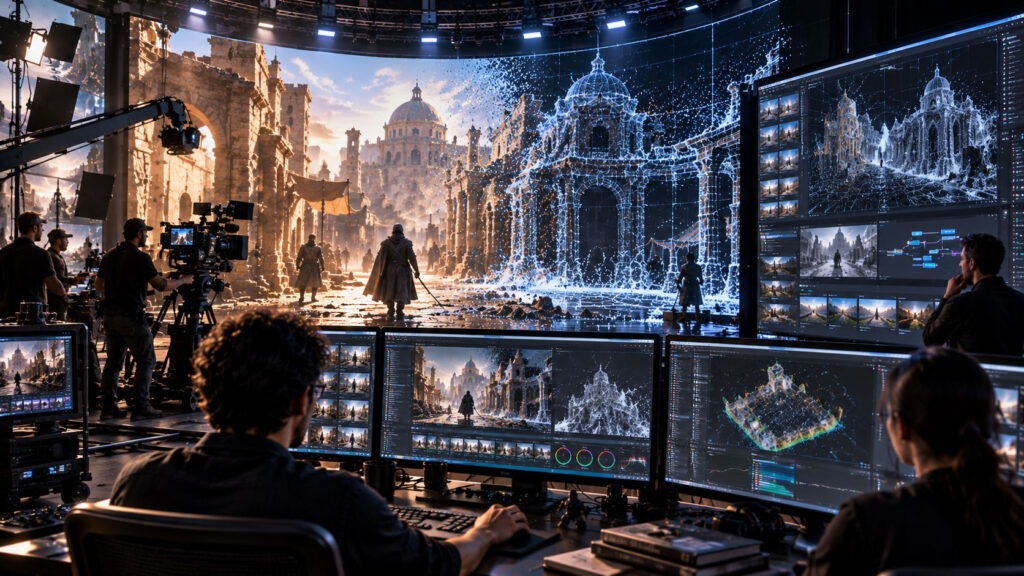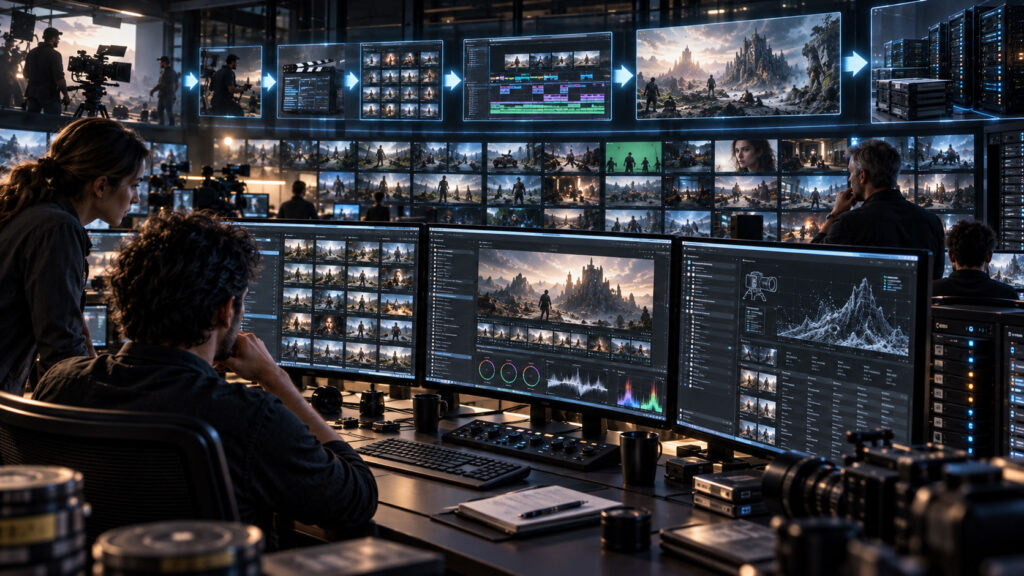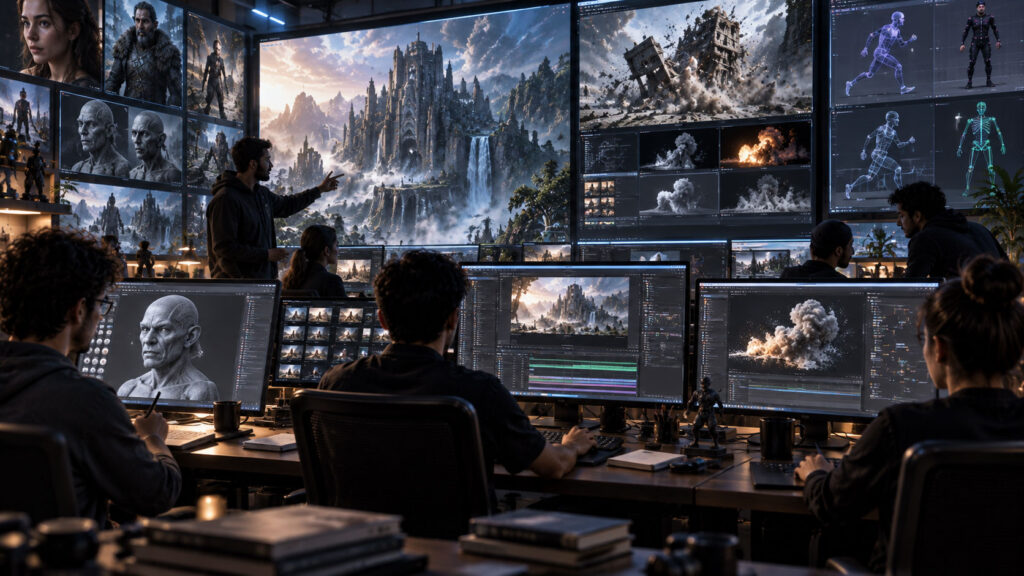
Crowd shots are a systems problem: agents need believable behavior, varied movement, sensible paths and efficient rendering. AI can help generate and organize variation while a production pipeline keeps the crowd controllable.
1. What crowd simulation does
Crowd simulation generates many digital characters from a smaller set of rules and assets. Instead of animating every person individually, the system evaluates agents according to goals, paths, states and interactions.
→ AGENTS
→ MOTION LIBRARY
→ BEHAVIOR
→ PATHFINDING
→ VARIATION
→ RENDER
→ LIVE-ACTION / CG COMPOSITE
The most important production principle is controllability: artists should be able to direct the crowd without manually rebuilding hundreds of characters.
2. Agents and behaviors
An agent is an individual simulated participant with attributes such as position, speed, destination, animation state and behavioral rules.
| Agent attribute | Purpose |
|---|---|
| Position | Defines where the character exists. |
| Velocity | Controls direction and speed. |
| Goal | Defines the intended destination. |
| State | Walking, running, waiting, reacting or exiting. |
| Personality variation | Prevents identical behavior. |
3. Motion libraries and variation
A crowd should not look like the same animation duplicated hundreds of times. Build libraries of compatible clips and vary timing, speed, stride, posture and transition points.
| Variation | Example |
|---|---|
| Clip selection | Different walking cycles. |
| Playback speed | Slightly faster or slower agents. |
| Phase offset | Different starting points in a cycle. |
| Stride variation | Different body proportions and gait. |
| Transition variation | Different timing between states. |
4. Pathfinding and navigation
Navigation determines how agents move through the environment while avoiding obstacles and other agents. Paths should support the story rather than simply produce mathematically efficient movement.
↓
DESTINATION
↓
NAVIGATION / PATH
↓
OBSTACLE AVOIDANCE
↓
LOCAL CROWD AVOIDANCE
↓
MOTION FOLLOWING
↓
FINAL AGENT POSITION
| Navigation issue | Better approach |
|---|---|
| Agents collide | Use local avoidance and spacing rules. |
| Everyone takes one path | Create multiple valid routes. |
| Movement looks robotic | Add speed and path variation. |
| Agents ignore scene logic | Use semantic areas and behavior zones. |
5. Crowd density and composition
Density should match the scene’s story and camera perspective. A crowd that is too uniform can feel synthetic, while excessive density can obscure important action.
| Shot type | Priority |
|---|---|
| Wide establishing shot | Large-scale density and silhouette. |
| Medium crowd shot | Character variation and interaction. |
| Hero foreground | Detailed animation and individual performance. |
| Background extras | Efficient silhouettes and motion variety. |
6. Scaling massive crowds
Large simulations require a clear separation between high-detail hero agents and lightweight background agents. Level of detail should change with camera distance.
| LOD | Typical strategy |
|---|---|
| Hero | Full rig, high-quality animation and detailed shading. |
| Midground | Reduced geometry and simplified controls. |
| Background | Lightweight rigs or cached animation. |
| Very distant | Impostors, cards or simplified representations where appropriate. |
7. Digital extras
Digital extras can fill environments that would otherwise require large numbers of practical performers. Their behavior should support the composition and continuity of the shot.
| Extra type | Example behavior |
|---|---|
| Pedestrian | Walking, stopping and crossing. |
| Audience | Watching, reacting and applauding. |
| Commuter | Entering, exiting and queueing. |
| Emergency crowd | Running, turning and avoiding hazards. |
| Festival crowd | Loose group movement and celebration. |
8. Behavioral AI
Behavioral AI adds higher-level decisions to crowd agents. Instead of only following a path, agents can react to events, zones and nearby characters.
↓
AGENT PERCEPTION
↓
BEHAVIOR DECISION
↓
STATE CHANGE
↓
MOTION / PATH
↓
GROUP RESPONSE
| Behavior | Example |
|---|---|
| Attraction | Move toward a point of interest. |
| Avoidance | Move away from danger. |
| Following | Maintain relationship with a group. |
| Waiting | Pause until a condition changes. |
| Reaction | Respond to an event in the scene. |
9. Crowd rendering
Rendering hundreds or thousands of characters requires careful management of geometry, textures, hair, shadows and animation evaluation.
| Optimization | Approach |
|---|---|
| Geometry | Use LODs and instancing where appropriate. |
| Textures | Share materials and reduce distant resolution. |
| Hair | Simplify grooming for background agents. |
| Shadows | Use distance-aware shadow strategies. |
| Animation | Cache or simplify distant motion. |
10. VFX integration
Crowd simulation becomes most convincing when it interacts with the live-action environment through camera perspective, lighting, shadows, atmosphere and depth.
| Integration area | QC focus |
|---|---|
| Camera | Agents must follow the solved camera perspective. |
| Grounding | Feet and bodies must sit correctly on the environment. |
| Lighting | Match direction, color and softness. |
| Shadows | Support contact and depth. |
| Atmosphere | Match haze and depth falloff. |
11. Where AI helps
AI can assist with motion generation, behavior selection, crowd variation, reference analysis and simulation control. The production value comes from using AI to expand variation while preserving shot direction.
| AI-assisted task | Benefit | Watch for |
|---|---|---|
| Motion generation | Create more usable movement clips. | Inconsistent style. |
| Behavior selection | React to scene events. | Unpredictable decisions. |
| Variation | Reduce repeated patterns. | Excessive randomness. |
| Simulation analysis | Find collisions or anomalies. | False positives. |
12. Common mistakes
| Mistake | Why it fails | Better approach |
|---|---|---|
| Copying one walk cycle | Crowd looks duplicated. | Use a varied motion library. |
| Randomness everywhere | Behavior loses intent. | Use controlled variation. |
| No LOD strategy | Simulation and rendering become expensive. | Scale detail by camera distance. |
| Ignoring ground contact | Extras float or slide. | Validate contacts and terrain. |
| No shot direction | Crowd becomes visually noisy. | Define clear behavior zones and goals. |
13. Complete Zgian AI Crowd workflow
↓
AGENT TYPES
↓
MOTION LIBRARY
↓
BEHAVIOR RULES
↓
PATHFINDING
↓
CROWD DENSITY
↓
VARIATION
↓
LOD / OPTIMIZATION
↓
LIGHTING + SHADOWS
↓
VFX INTEGRATION
↓
FINAL CROWD QC
- Define the story purpose of the crowd.
- Create agent types and visual variation.
- Build a motion library.
- Define navigation and behavioral rules.
- Generate the crowd at the required density.
- Add controlled motion and appearance variation.
- Apply LOD and caching strategies.
- Match camera, lighting, shadows and atmosphere.
- Review the crowd as part of the final shot.
14. Final crowd QC
- Check agent collisions.
- Check path continuity.
- Check motion repetition.
- Check speed variation.
- Check crowd density.
- Check ground contact.
- Check character diversity.
- Check camera perspective.
- Check lighting and shadows.
- Check performance and render cost.
How this fits the Zgian VFX + AI pipeline
AI MOTION → Motion Capture & Character Animation
AI CREATURES → Creature Animation & VFX
AI CROWDS → this guide
AI TRACKING → 3D & Object Tracking
AI COMP → AI Compositing
Frequently asked questions
What is AI crowd simulation?
It combines agent-based simulation, motion generation and behavioral rules to create large groups of digital characters efficiently.
How do I avoid a duplicated crowd look?
Use multiple animation clips, phase offsets, speed variation, different body proportions and controlled behavioral differences.
What are digital extras?
Digital extras are CG characters used to populate environments when practical performers alone are insufficient or impractical.
How can massive crowds be rendered efficiently?
Use level of detail, instancing, simplified distant rigs, shared materials, caching and camera-aware optimization.
Should crowd behavior be completely random?
No. Believable crowds combine shared goals with controlled individual variation and clear scene direction.
Continue the Zgian VFX + AI series
3D Generalist & VFX Professional · About the author →