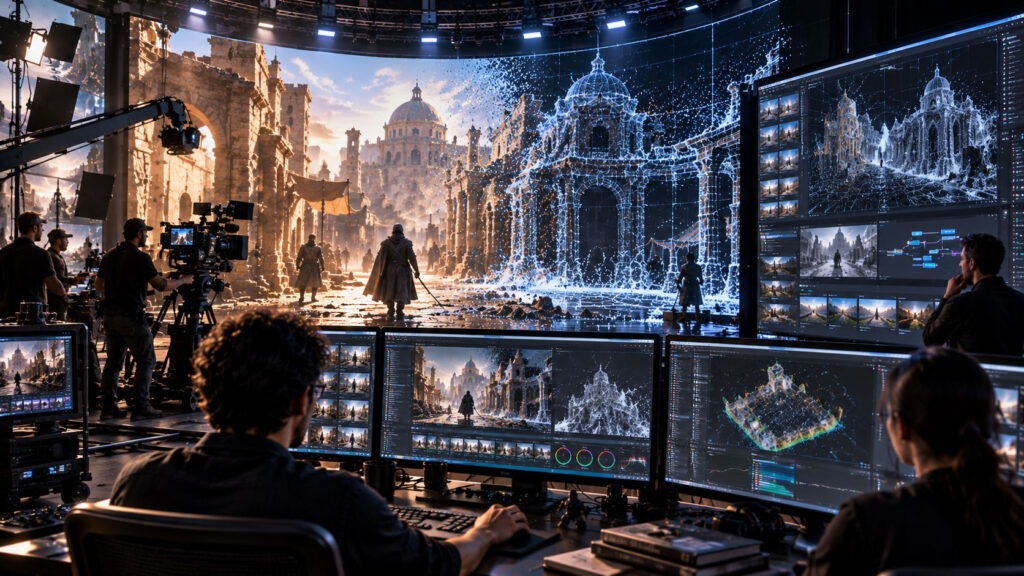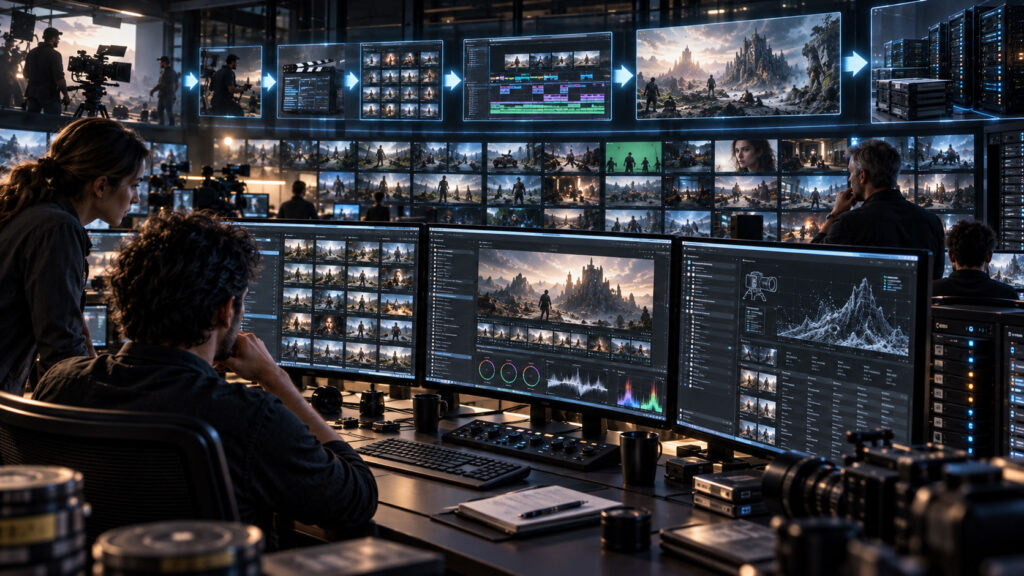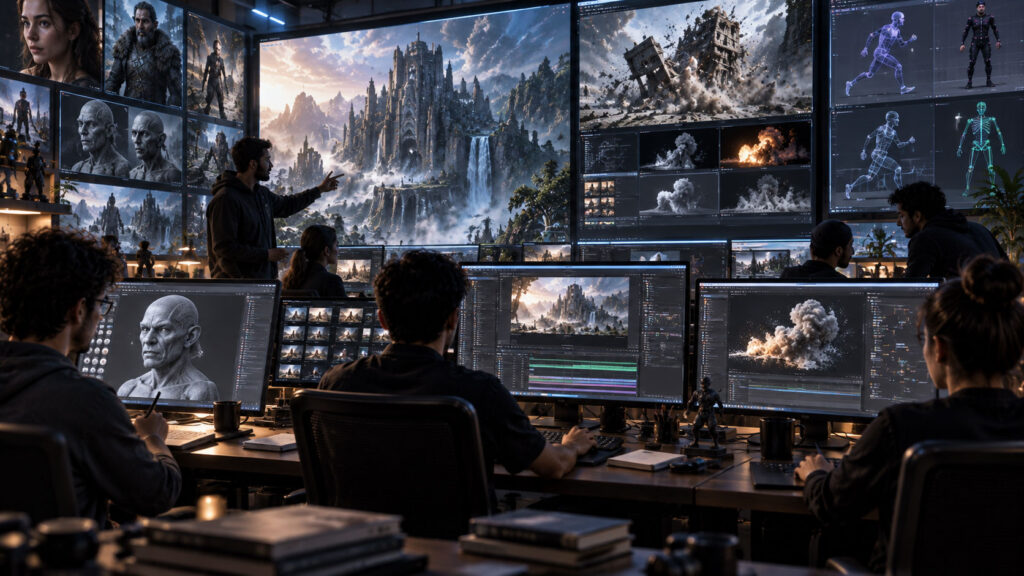
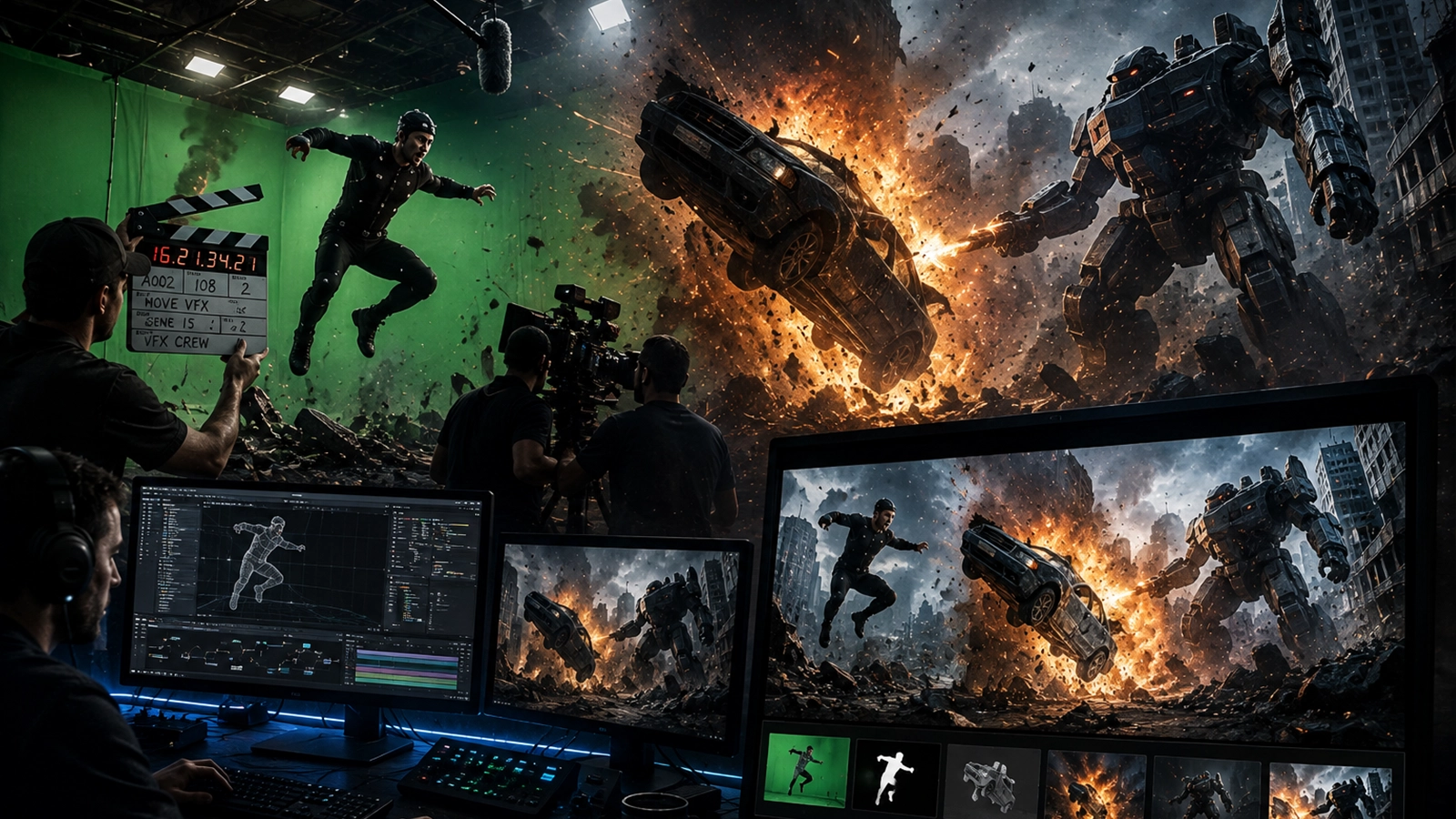
AI can accelerate keying, masking, cleanup and image generation, but believable compositing still depends on tracking, edges, light, perspective, depth and disciplined shot integration.
- What AI compositing means
- Green screen and AI keying
- Matte design
- Tracking and image alignment
- Edge treatment and despill
- Background replacement
- CG and AI integration
- Light, depth and atmosphere
- AI cleanup and generative fill
- Building a reliable comp
- AI compositing tools in 2026
- Common mistakes
- Complete workflow
- FAQ
1. What AI compositing means
Compositing combines visual elements so they appear to exist in the same image. AI changes how some of those elements are generated, isolated or repaired; it does not remove the fundamental need to match perspective, motion, lighting, depth and image characteristics.
For Zgian, the best definition is simple: AI changes the tools, not the laws of believable image integration.
+ MATTE
+ TRACK
+ BACKGROUND / CG
+ LIGHT / SHADOW
+ ATMOSPHERE
+ COLOR
= BELIEVABLE COMPOSITE
2. Green screen and AI keying
Traditional chroma keying isolates a subject from a controlled green or blue background. AI segmentation can sometimes provide a fast alternative or a supplementary matte, especially when the background is not perfectly uniform.
| Situation | Preferred approach |
|---|---|
| Clean green screen | Use a proper chroma key, then refine the matte. |
| Uneven green screen | Combine keying with masks/AI segmentation. |
| Hair and motion blur | Use a key plus edge/holdout refinement. |
| Messy natural background | AI segmentation/roto may be more useful than chroma keying. |
| Reflective/translucent subject | Build multiple mattes and treat transparency separately. |
AI should not be used simply because it is newer. If a clean green screen can produce a superior matte through a conventional key, use the reliable method.
3. Matte design: the heart of compositing
A matte determines which pixels come from the foreground and which come from another element. Good compositing often uses several mattes instead of one giant “perfect” mask.
| Matte / mask | Purpose |
|---|---|
| Core matte | Solid foreground body. |
| Edge matte | Fine hair, motion blur and soft boundaries. |
| Holdout matte | Remove areas that should not be included. |
| Shadow matte | Preserve or create grounding shadows. |
| Reflection matte | Control reflective surfaces. |
Our AI Rotoscoping guide explains how AI segmentation can become the starting point for these production mattes.
4. Tracking and image alignment
A perfect matte can still produce a bad composite if the inserted image does not move with the camera. Track the plate first and use that information to place the background, CG, graphics or generated elements.
- Analyze the camera movement.
- Choose reliable track features.
- Use planar or 3D tracking when appropriate.
- Check the track against multiple points in the shot.
- Attach the replacement or CG element to the correct coordinate system.
- Review at full speed.
AI-assisted tracking can speed analysis, but the final question remains: does the inserted element stay locked to the real shot?
5. Edge treatment and despill
After a green-screen key or AI matte, the edge usually needs work. A subject can retain green contamination, hard edges, halos or incorrect motion blur.
| Problem | Solution |
|---|---|
| Green spill on skin | Despill selectively while protecting natural skin color. |
| Green edge halo | Refine/choke the matte and rebuild edge color. |
| Hard cutout | Restore appropriate softness and motion blur. |
| Dark fringe | Check matte erosion and edge color replacement. |
| Hair contamination | Use separate hair/edge treatment rather than destroying detail. |
The goal is not the cleanest mathematical edge. It is the edge that behaves like a real object photographed in the final environment.
6. Background replacement
AI makes background creation much faster, but a generated background still has to match the foreground.
| Match factor | What to match |
|---|---|
| Perspective | Horizon, vanishing points and camera height. |
| Scale | Foreground subject must have believable physical size. |
| Depth | Near and distant elements should respond to camera movement correctly. |
| Lighting | Direction, color and softness of illumination. |
| Atmosphere | Haze, fog and distance should connect foreground/background. |
| Motion | Background movement must agree with camera movement. |
A beautiful AI background is still wrong if its perspective or lighting contradicts the plate.
7. CG and AI integration
AI-generated imagery can coexist with 3D CG, simulations and traditional VFX elements. The integration works when all elements share the same camera, lighting logic, scale and depth.
→ CAMERA TRACK
→ 3D SCENE
→ CG LIGHTING
→ RENDER PASSES
→ COMP
→ AI / MANUAL CLEANUP
→ GRADE
For a distant object, AI imagery may be enough. For a hero object that casts a shadow on a performer, reflects the environment or interacts with physical geometry, controlled 3D often remains the safer choice.
8. Light, depth and atmosphere
Integration becomes believable when the foreground and background share the same visual conditions.
| Element | Integration check |
|---|---|
| Key light | Does the foreground face the same light direction? |
| Shadow | Does it touch the correct surface and have the right softness? |
| Reflections | Do reflective surfaces contain the correct environment? |
| Depth of field | Are near/far elements blurred consistently? |
| Atmosphere | Does distance reduce contrast and saturation appropriately? |
| Grain/noise | Do all layers share similar image texture? |
9. AI cleanup and generative fill
AI cleanup is particularly useful for removing unwanted objects, extending backgrounds, repairing small areas or creating transitional material. Adobe currently documents Generative Fill in After Effects and AI-powered Object Matte, while Premiere provides generative media workflows for video and audio.
Use generative cleanup locally whenever possible. A small repair is easier to QC than regenerating the entire shot and introducing new temporal inconsistencies.
| Cleanup task | Good AI use | QC requirement |
|---|---|---|
| Remove object | Generate a clean patch. | Check every frame and reflections. |
| Extend set | Generate missing background. | Match perspective and lighting. |
| Repair plate | Fill small damaged regions. | Check texture and temporal stability. |
| Replace signage | Generate/track replacement. | Verify perspective and motion. |
10. Building a reliable composite
Whether you work in a node-based compositor or a layer-based application, keep the comp understandable. Separate technical tasks from creative tasks.
→ PREPROCESS
→ TRACK
→ ROTO / KEY
→ FOREGROUND REPAIR
→ BACKGROUND
→ CG / FX
→ LIGHT / SHADOW
→ ATMOSPHERE
→ COLOR
→ GRAIN
→ OUTPUT
Use clear versions and preserve source plates. When a client asks for a change, you should be able to replace one element without rebuilding the entire shot.
11. AI compositing tools in 2026
| Category | Examples / approach | Strength |
|---|---|---|
| AI object isolation | After Effects Object Matte and similar tools. | Fast subject mattes. |
| Generative fill | After Effects and other generative tools. | Local plate repair and extensions. |
| AI editing/generative media | Premiere workflows. | Fast editorial and media generation. |
| Node compositing | Nuke and similar professional systems. | Complex, controlled VFX integration. |
| Integrated finishing | DaVinci Resolve. | Edit, Fusion, color and delivery in one ecosystem. |
Adobe’s current documentation confirms AI-assisted object isolation and generative compositing features in After Effects, while Foundry continues to position Nuke as a professional node-based compositing platform.
12. Common AI compositing mistakes
| Mistake | Why it fails | Better approach |
|---|---|---|
| Bad perspective match | Background feels like a flat image. | Match camera and horizon. |
| No contact shadow | Subject floats. | Add grounded shadow interaction. |
| Different image texture | Layers look pasted together. | Match grain/noise and sharpness. |
| Over-clean edges | Foreground looks cut out. | Restore natural softness and motion blur. |
| Wrong lighting | Foreground and background disagree. | Relight or grade the elements. |
| Ignoring reflections | Glass/metal reveals the composite. | Build appropriate reflection passes. |
| Using AI as one-click final comp | Hidden errors survive. | Break the shot into controllable passes. |
13. Complete Zgian AI compositing workflow
↓
AI / MANUAL MATTE
↓
TRACK
↓
EDGE / DESPILL
↓
BACKGROUND / SET EXTENSION
↓
CG / FX
↓
SHADOWS / REFLECTIONS
↓
ATMOSPHERE / DEPTH
↓
COLOR MATCH
↓
GRAIN / FINISH
↓
QC
↓
MASTER
- Lock the edit.
- Prepare the best plate.
- Create the initial matte.
- Track camera and objects.
- Refine edges and remove spill.
- Build or generate the background.
- Insert CG and effects.
- Add shadows and reflections.
- Match atmosphere and depth.
- Color-match the layers.
- Apply final image texture/finish.
- QC the complete shot at full speed.
How this fits the Zgian VFX + AI pipeline
AI VFX → AI VFX Workflow
AI ROTO → AI Rotoscoping
COMPOSITING → this guide
COLOR → AI Film Color Grading
SOUND → AI Film Sound Design
Frequently asked questions
What is AI compositing?
AI compositing combines AI-assisted tasks such as object isolation, generative fill or background creation with professional compositing methods such as tracking, matte refinement, lighting integration and color matching.
Can AI replace green-screen keying?
Sometimes AI segmentation can provide a useful alternative or supplementary matte, but a clean chroma key can still be more reliable when the source was properly shot. Choose the technique based on the plate.
Can AI make a complete composite automatically?
AI can automate portions of the process, but professional shots still need inspection of edges, tracking, perspective, lighting, shadows, reflections and temporal consistency.
What is the most important compositing skill?
Understanding why an image looks integrated or fake. Tracking, matte design, edge treatment, light, depth and color all contribute to that judgment.
Should I learn traditional compositing if I use AI?
Absolutely. Traditional compositing knowledge makes AI tools more useful because you can recognize errors and know how to fix them.
Continue the Zgian VFX + AI series
3D Generalist & VFX Professional · About the author →