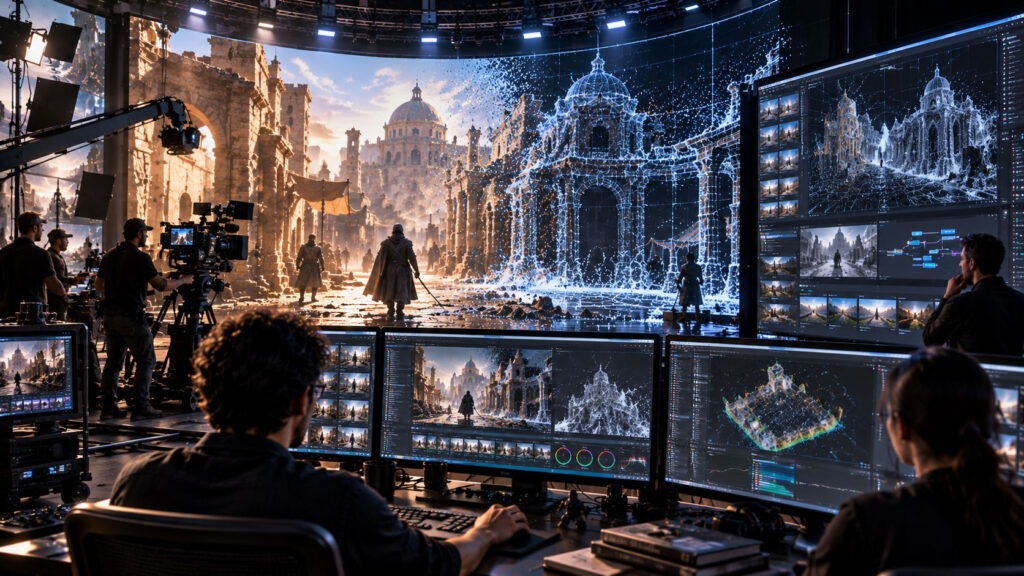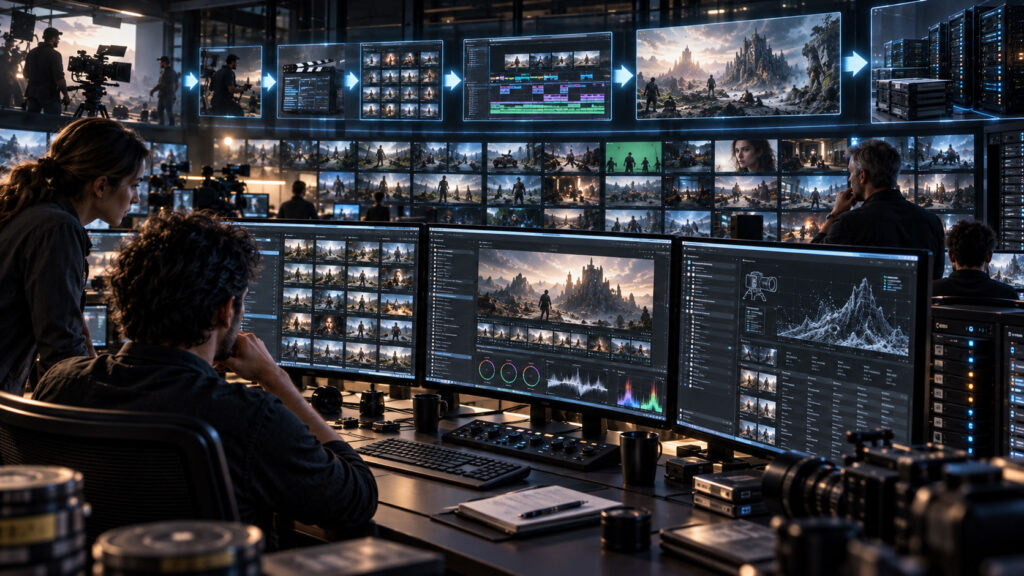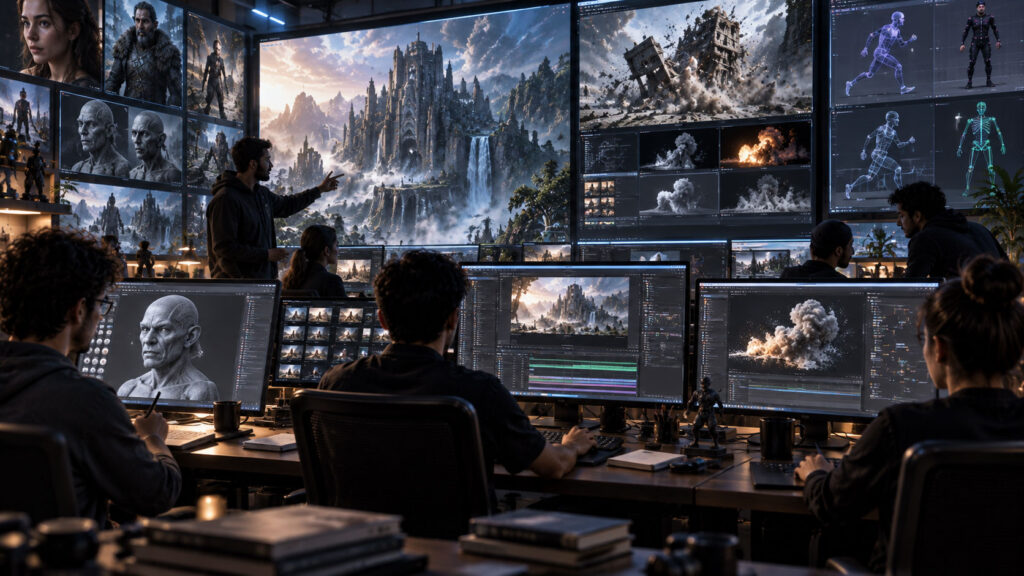
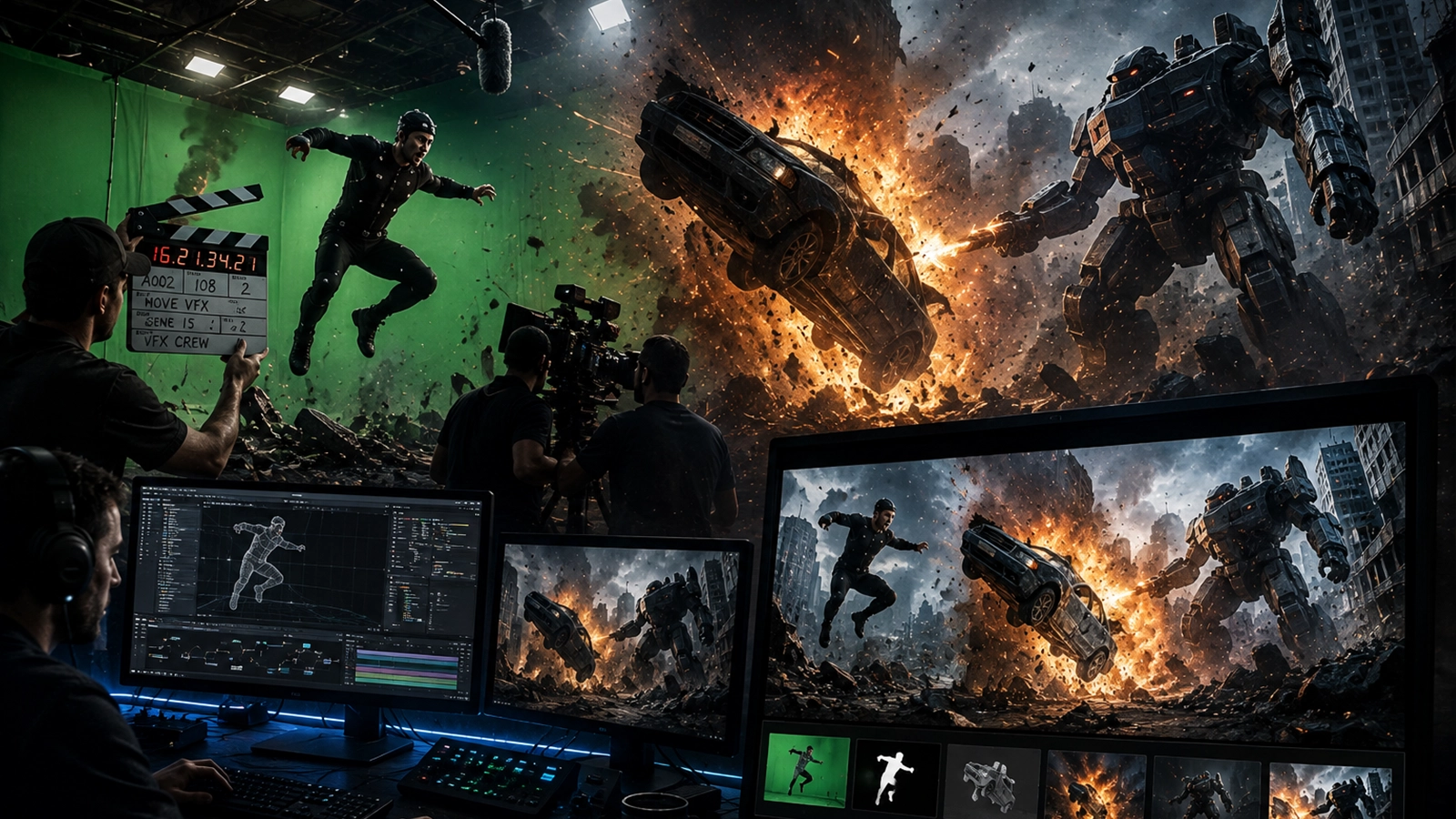
Modern environment VFX blends photography, matte painting, 3D reconstruction and AI-assisted generation. The strongest results preserve camera logic, perspective, lighting and physical continuity while expanding what was captured on set.
1. What environment set extension does
Set extension expands the photographed or filmed environment beyond the practical set. It may add architecture, landscapes, city blocks, mountains, skies, vegetation, distant structures or entire digital worlds.
→ CAMERA / LENS ANALYSIS
→ PRACTICAL SET
→ DIGITAL EXTENSION
→ LIGHT + ATMOSPHERE
→ COMPOSITE
The extension should feel as though it was always part of the original scene.
2. Plate analysis and camera
Before generating or building anything, identify the horizon, lens characteristics, camera movement, perspective, foreground objects, depth layers and lighting direction.
| Plate element | Why it matters |
|---|---|
| Horizon | Defines perspective and environment placement. |
| Lens | Controls perspective, distortion and scale. |
| Camera movement | Determines tracking and parallax requirements. |
| Foreground | Provides depth and occlusion cues. |
| Lighting | Sets the visual direction for generated or CG elements. |
For tracking fundamentals, see AI 3D & Object Tracking.
3. Environment design
Start with a visual brief: location, period, architecture, climate, time of day, scale and storytelling purpose. AI concept generation is useful for exploring options quickly.
| Design layer | Questions |
|---|---|
| Location | Where is the scene? |
| Scale | How large is the world relative to the characters? |
| Period | What architecture and objects belong here? |
| Climate | What atmosphere and surface conditions should appear? |
| Story | What should the audience notice? |
4. AI matte painting
AI can generate distant architecture, landscapes, skies, vegetation and atmospheric elements that artists can paint, project or rebuild into the shot.
| Use | Best practice |
|---|---|
| Distant mountains | Match perspective and atmospheric depth. |
| Architecture | Verify geometry, windows and perspective. |
| Vegetation | Match species, scale and lighting. |
| Background crowds | Keep detail appropriate to distance. |
| Atmosphere | Build depth rather than simply overlaying haze. |
5. Digital sets
Digital sets can be 2D, 2.5D or fully 3D. Choose the simplest representation that delivers the required camera movement and parallax.
| Method | Best for |
|---|---|
| 2D matte | Locked or minimally moving cameras. |
| 2.5D projection | Moderate camera movement with controlled depth. |
| Full 3D set | Large parallax, multiple angles or interactive shots. |
| Procedural environment | Large worlds requiring repeatable generation. |
6. 3D world building
World building combines terrain, architecture, vegetation, props, roads and atmosphere into a consistent spatial system. Procedural methods are especially useful when environments must extend far beyond the camera.
+
ARCHITECTURE
+
VEGETATION
+
PROPS
+
ATMOSPHERE
↓
COHERENT DIGITAL WORLD
Use reference images and real-world scale to prevent the common problem of attractive but physically inconsistent generated environments.
7. Sky replacement
Sky replacement is one of the most visible environment changes. The new sky must match the horizon, lighting direction, color temperature, atmospheric depth and reflections on the scene.
| Check | Requirement |
|---|---|
| Horizon | Align with the plate perspective. |
| Sun direction | Match highlights and shadows. |
| Color | Match the overall grade. |
| Atmosphere | Match haze and aerial perspective. |
| Reflections | Update reflective surfaces when necessary. |
8. Camera matching
Environment extensions must move with the camera. A visually perfect matte can fail immediately if its parallax does not match the original plate.
↓
CAMERA TRACK / SOLVE
↓
LENS / DISTORTION
↓
ENVIRONMENT ALIGNMENT
↓
PARALLAX TEST
↓
FINAL COMPOSITE
For moving cameras, validate the extension throughout the entire shot rather than checking only one frame.
9. Lighting and atmosphere
Lighting is the bridge between practical photography and digital environments. Match direction, softness, color, exposure and atmospheric depth.
| Element | Integration cue |
|---|---|
| Direct light | Match direction and hardness. |
| Sky illumination | Match ambient color. |
| Haze | Increase with distance. |
| Fog | Use depth-aware layering. |
| Color grade | Apply consistent final color management. |
10. Virtual production
Virtual production uses digital environments during photography rather than only after capture. AI-assisted world building can accelerate the creation of background options, reference environments and design variations.
| Virtual-production layer | Role |
|---|---|
| Environment | Provides the visual world. |
| Camera tracking | Keeps the digital world aligned. |
| Lighting | Connects practical and digital illumination. |
| Realtime rendering | Provides interactive background imagery. |
| Post refinement | Finishes details and integration. |
11. Where AI helps
AI is particularly useful for concept exploration, image generation, texture ideas, environment variations, sky options, reference analysis and repetitive matte-painting tasks.
| AI-assisted task | Benefit | Watch for |
|---|---|---|
| Concept generation | Rapid environment exploration. | Inconsistent visual rules. |
| Sky generation | More background options. | Lighting mismatch. |
| Matte elements | Fast background material. | Perspective errors. |
| Texture ideation | Rapid surface exploration. | Scale and repetition. |
| Reference analysis | Faster visual research. | Incorrect interpretation. |
12. Common mistakes
| Mistake | Why it fails | Better approach |
|---|---|---|
| Ignoring lens perspective | Environment feels pasted on. | Match the camera and lens first. |
| Sky has different lighting | Scene illumination becomes contradictory. | Match sun and ambient direction. |
| Too much detail everywhere | Depth becomes flat. | Use atmospheric perspective. |
| Generated architecture is inconsistent | Repeated or impossible structures are noticeable. | Curate and rebuild critical elements. |
| No parallax testing | Moving shots reveal the illusion. | Review the extension through the entire camera move. |
13. Complete Zgian AI Environment workflow
↓
CAMERA + LENS ANALYSIS
↓
ENVIRONMENT DESIGN
↓
AI CONCEPT / REFERENCE
↓
2D / 2.5D / 3D BUILD
↓
CAMERA MATCH
↓
LIGHT + SKY
↓
ATMOSPHERE + DEPTH
↓
VIRTUAL PRODUCTION / COMPOSITE
↓
FINAL ENVIRONMENT QC
- Analyze the plate and define the extension boundary.
- Solve camera and lens requirements.
- Create the environment design brief.
- Generate or gather visual references.
- Choose 2D, 2.5D or full 3D representation.
- Build critical foreground and midground elements accurately.
- Match sky, lighting and atmospheric perspective.
- Test parallax and camera movement.
- Composite, grade and perform final QC.
14. Final environment QC
- Check camera tracking.
- Check lens perspective and distortion.
- Check horizon placement.
- Check scale and geometry.
- Check sky and lighting direction.
- Check atmospheric depth.
- Check foreground occlusion.
- Check parallax throughout the shot.
- Check reflections and shadows.
- Review the final composite at normal playback speed.
How this fits the Zgian VFX + AI pipeline
AI ENVIRONMENT → this guide
AI CROWD → Crowd Simulation & Digital Extras
AI CROWD BEHAVIOR → Autonomous Agents 2.0
AI COMPOSITING → AI Compositing
AI VIRTUAL PRODUCTION → AI Video & Cinematic AI
Frequently asked questions
What is AI set extension?
It is the use of AI-assisted imagery, assets or concepts to expand a photographed set into a larger digital environment.
Can AI replace a matte painter?
AI can accelerate image creation and exploration, but production matte painting still requires composition, perspective, continuity and integration skills.
When should I use 3D instead of a matte?
Use 3D when camera movement, parallax, multiple angles or interaction require real spatial depth.
How do I make an AI sky replacement believable?
Match horizon, lens, lighting direction, color, atmospheric depth and reflections rather than treating the sky as an isolated image.
What is the biggest set-extension mistake?
Ignoring the original camera and lighting logic. A beautiful environment still fails if perspective, scale or illumination does not match the plate.
Continue the Zgian VFX + AI series
3D Generalist & VFX Professional · About the author →