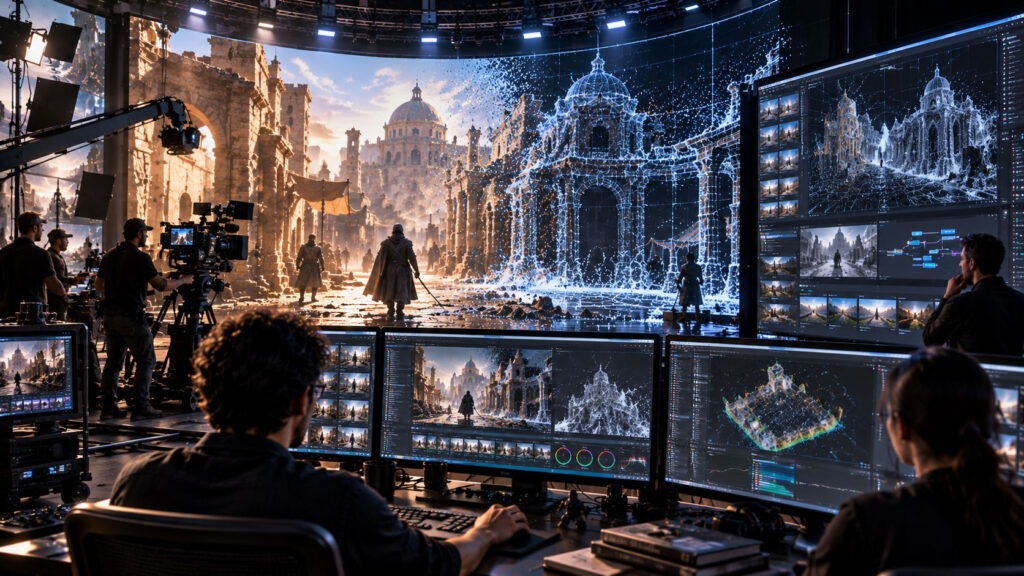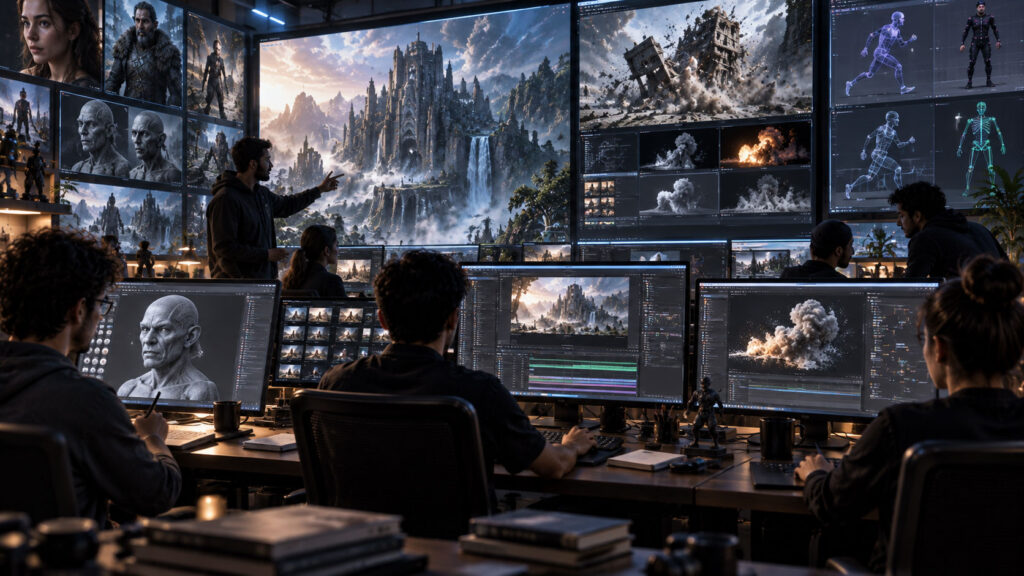

Procedural world building turns a handful of rules, references and assets into large environments. AI can accelerate design and asset variation, while procedural systems provide the consistency, scale and repeatability required for production.
- What procedural world building means
- World rules and references
- Terrain generation
- Mountains, valleys and erosion
- Cities and urban layouts
- Architecture generation
- Roads and infrastructure
- Vegetation and scattering
- Rivers, lakes and water
- AI asset generation
- World scale and optimization
- Where AI helps
- Common mistakes
- Complete workflow
- Final world-building QC
- FAQ
1. What procedural world building means
Procedural world building creates environments from rules rather than manually placing every object. The rules can control terrain, road networks, buildings, vegetation, props, materials and population density.
→ TERRAIN
→ INFRASTRUCTURE
→ ARCHITECTURE
→ VEGETATION
→ PROPS
→ ATMOSPHERE
→ MASSIVE DIGITAL WORLD
A strong system produces variation without losing the visual identity of the world.
2. World rules and references
Before generation, define climate, geography, culture, architecture, time period, population density and storytelling priorities. Reference images provide constraints that keep generated content coherent.
| Rule | Example |
|---|---|
| Climate | Dry desert, tropical, alpine or temperate. |
| Geography | Coast, valley, plateau, island or basin. |
| Architecture | Historic, modern, industrial or fantasy. |
| Density | Dense city, suburb, village or wilderness. |
| Era | Ancient, contemporary, future or fictional. |
3. Terrain generation
Terrain establishes the physical foundation for every other system. Elevation, slope, drainage and biome rules should be considered before placing buildings or vegetation.
| Terrain layer | Purpose |
|---|---|
| Elevation | Defines large landforms. |
| Slope | Controls buildable and non-buildable areas. |
| Noise / detail | Adds natural variation. |
| Drainage | Defines rivers and water flow. |
| Biome masks | Controls vegetation and materials. |
4. Mountains, valleys and erosion
Natural landscapes become more believable when large forms and small-scale erosion support each other. Use broad shapes first, then add geological detail.
↓
MOUNTAIN / VALLEY SHAPE
↓
EROSION
↓
RIVER / DRAINAGE
↓
SURFACE DETAIL
↓
VEGETATION
AI-generated landscape references can help explore shapes, but production terrain should retain consistent scale and physical logic.
5. Cities and urban layouts
Procedural cities are easier to build when roads, districts and parcels are generated before individual buildings. The resulting hierarchy creates urban logic.
| Urban layer | Function |
|---|---|
| City boundary | Defines the overall footprint. |
| Districts | Creates neighborhoods with distinct character. |
| Road hierarchy | Primary, secondary and local routes. |
| Parcels | Defines building locations. |
| Buildings | Populates parcels with controlled variation. |
| Street detail | Props, signs, lights and vegetation. |
6. Architecture generation
AI can generate architectural concepts and asset variations, while procedural rules can control footprint, height, spacing, façade families and repetition.
| Parameter | Variation |
|---|---|
| Building height | Low, medium and high-rise groups. |
| Footprint | Rectangular, irregular or modular. |
| Façade | Material, window and structural variations. |
| Age | New, maintained, weathered or abandoned. |
| District style | Shared architectural language by zone. |
7. Roads and infrastructure
Roads should respond to terrain and urban hierarchy. Infrastructure also provides strong visual clues about scale and location.
| Infrastructure | Procedural rule |
|---|---|
| Highways | Long-distance connectivity. |
| Arterial roads | Connect major districts. |
| Local streets | Serve individual parcels. |
| Bridges | Resolve terrain and water crossings. |
| Utilities | Power, pipes and service infrastructure. |
8. Vegetation and scattering
Vegetation is a natural fit for procedural scattering. Density, species, scale and orientation can be driven by terrain, climate, water proximity and biome masks.
+
ELEVATION
+
SLOPE
+
WATER DISTANCE
+
DENSITY
↓
VEGETATION SCATTER
↓
TREES / GRASS / SHRUBS / DEBRIS
Use multiple asset variants and controlled randomness to prevent visible repetition.
9. Rivers, lakes and water
Water systems should follow the geography rather than appearing as decorative shapes. Procedural drainage can connect terrain elevation with river and lake placement.
| Water feature | Key rule |
|---|---|
| River | Follow downhill flow and terrain. |
| Lake | Collect in suitable low areas. |
| Coast | Follow terrain and shoreline logic. |
| Wetland | Connect water proximity with vegetation. |
10. AI asset generation
AI can help create references and variations for buildings, props, vegetation, signs and surface materials. The generated assets should then be curated, optimized and placed under procedural rules.
| Asset | AI contribution | Production step |
|---|---|---|
| Buildings | Concept and façade variation. | Model, optimize and modularize. |
| Props | Design exploration. | Clean topology and materials. |
| Vegetation | Species and visual reference. | Create efficient variants. |
| Textures | Surface ideas. | Normalize scale and maps. |
11. World scale and optimization
Massive worlds require streaming, LOD, instancing and spatial partitioning. Do not keep maximum detail active everywhere.
| World distance | Strategy |
|---|---|
| Hero zone | High-detail geometry and materials. |
| Near environment | Moderate detail and instancing. |
| Far environment | Low-detail representations. |
| Extreme distance | Terrain proxies, matte elements or simplified worlds. |
For camera-driven environment extension, see AI Environment & Set Extension 2.0.
12. Where AI helps
AI is strongest in exploration and variation: concepts, architectural families, vegetation references, texture ideas, asset generation and semantic classification.
| AI task | Benefit | Watch for |
|---|---|---|
| Environment concepts | Fast visual exploration. | Inconsistent world rules. |
| Asset variation | More visual diversity. | Style drift. |
| Semantic labeling | Automated world masks. | Classification errors. |
| Texture generation | Rapid material exploration. | Scale and tiling issues. |
13. Common mistakes
| Mistake | Why it fails | Better approach |
|---|---|---|
| Generating objects before world rules | Assets do not belong together. | Define the world grammar first. |
| Uniform scattering | World looks artificial. | Use biome and density masks. |
| No road hierarchy | City feels random. | Build networks from primary to local. |
| Ignoring scale | Buildings and vegetation feel wrong. | Use real-world dimensions. |
| Too much detail everywhere | Performance collapses. | Use LOD, instancing and streaming. |
14. Complete Zgian procedural world workflow
↓
WORLD RULES
↓
TERRAIN
↓
WATER / DRAINAGE
↓
ROADS / INFRASTRUCTURE
↓
DISTRICTS / PARCELS
↓
ARCHITECTURE
↓
VEGETATION / SCATTERING
↓
AI ASSET VARIATION
↓
LOD / STREAMING / INSTANCING
↓
LIGHT + ATMOSPHERE
↓
FINAL WORLD QC
- Define the world’s geographic and visual rules.
- Generate the terrain and major landforms.
- Establish water and drainage systems.
- Build road and infrastructure networks.
- Create districts and building parcels.
- Populate architecture with controlled variation.
- Scatter vegetation and environmental details.
- Add AI-assisted asset variations.
- Optimize the world for camera distance and streaming.
- Integrate lighting, atmosphere and final VFX.
15. Final world-building QC
- Check geographic continuity.
- Check terrain scale.
- Check road and infrastructure logic.
- Check architectural consistency.
- Check vegetation biome rules.
- Check water flow and shorelines.
- Check asset repetition.
- Check LOD and streaming transitions.
- Check camera-visible detail.
- Review the complete world from every required shot angle.
How this fits the Zgian VFX + AI pipeline
PROCEDURAL WORLD BUILDING → this guide
AI CROWD → Crowd Simulation & Digital Extras
AI CROWD RENDERING → Crowd Rendering 2.0
AI TRACKING → 3D & Object Tracking
AI VIDEO → AI Video & Cinematic AI
Frequently asked questions
What is procedural world building?
It is the generation of large environments from reusable rules, systems and assets rather than manually constructing every element.
Can AI generate an entire city?
AI can assist with concepts and asset variation, while procedural systems are better suited to enforcing roads, parcels, scale, density and spatial consistency.
How do I make procedural vegetation believable?
Drive scattering with terrain, climate, water proximity and biome masks, then introduce controlled variation in species, size and orientation.
What is the most important rule for massive digital worlds?
Build at multiple scales and only spend high detail where the camera can see it. Streaming, LOD and instancing are essential.
Should every generated asset be unique?
No. A curated library of modular assets with controlled variation usually gives better consistency, performance and art direction.
Continue the Zgian VFX + AI series
3D Generalist & VFX Professional · About the author →