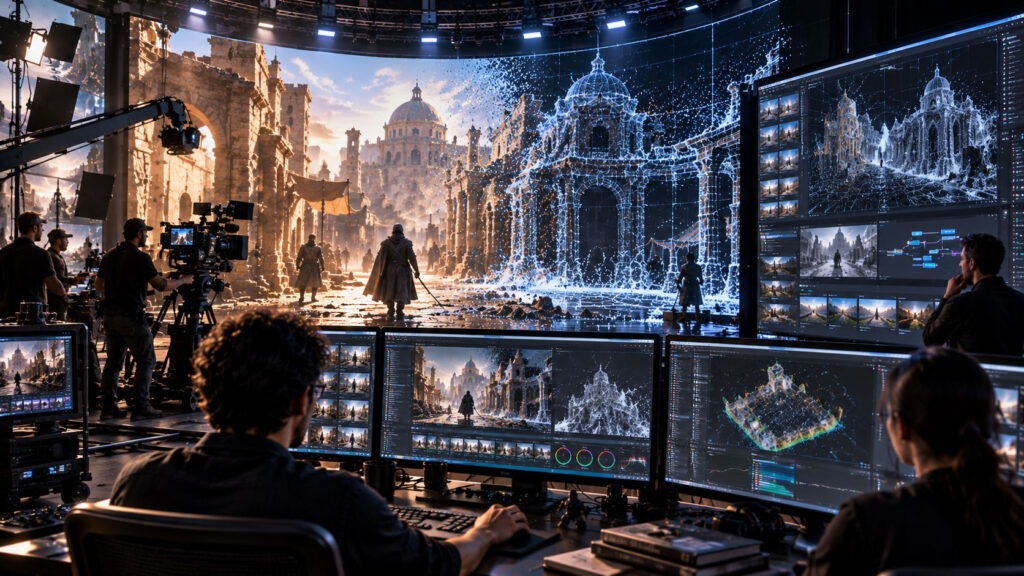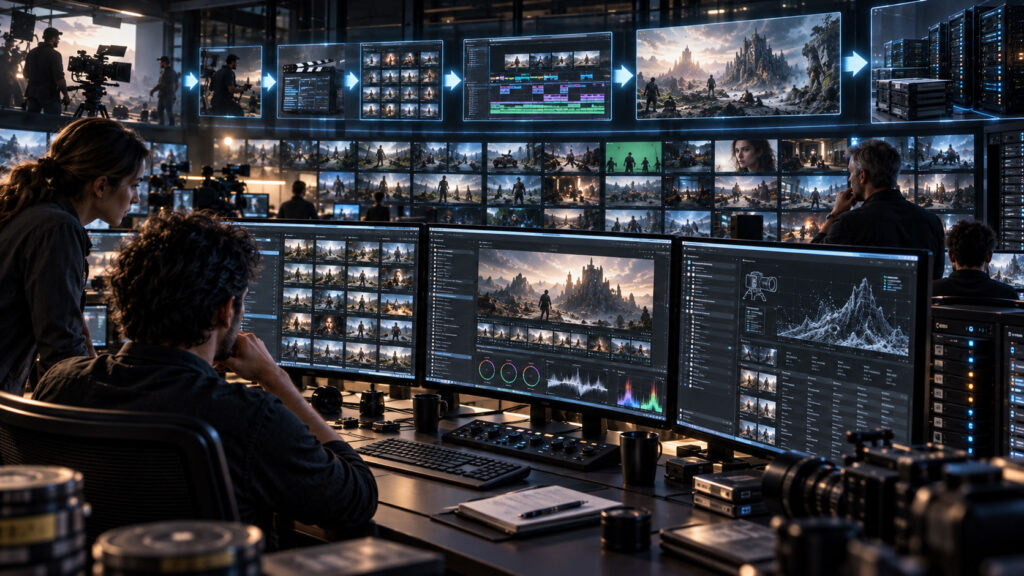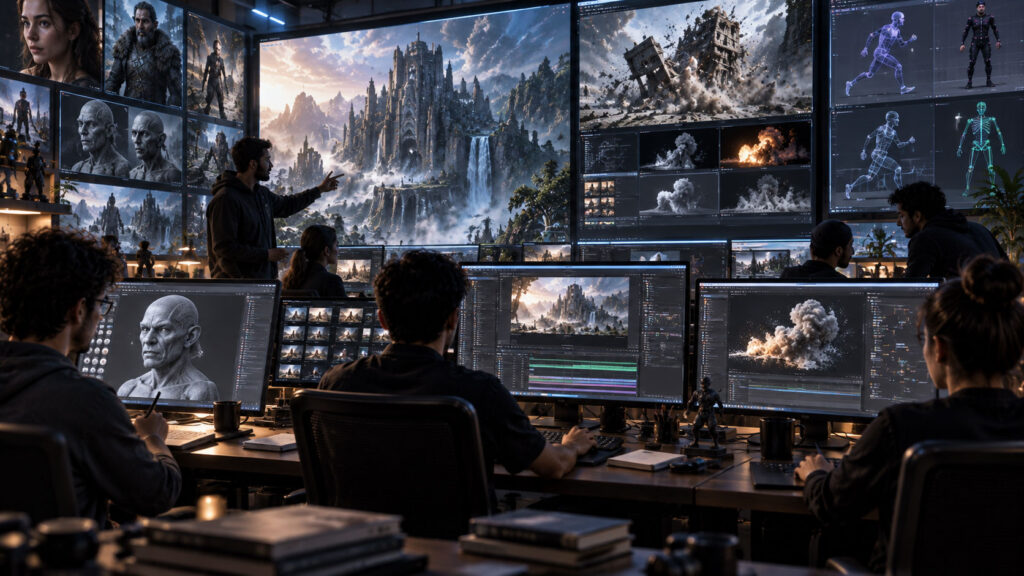
Believable environments are built from believable surfaces. AI can accelerate texture exploration and material creation, while physically based workflows, procedural masks and controlled imperfection turn those assets into production-ready surfaces.
- What makes an environment material believable
- PBR material foundations
- Procedural texture layers
- AI texture generation
- Material scanning
- Weathering
- Aging and oxidation
- Dirt and accumulation
- Damage and surface breakup
- Surface imperfections
- Smart material variation
- Large-scale texture management
- Common mistakes
- Complete workflow
- Final material QC
- FAQ
1. What makes an environment material believable
A convincing material communicates composition, scale, roughness, reflectivity, wear and environmental history. The viewer should understand whether a surface is concrete, glass, painted metal, wood, stone or something else from the way it responds to light.
+
PHYSICAL RESPONSE
+
SCALE
+
WEAR
+
IMPERFECTION
↓
SURFACE REALISM
2. PBR material foundations
Physically based rendering workflows describe surfaces through maps or parameters such as base color, roughness and normal information. Additional channels can represent metallic response, displacement, opacity or ambient detail depending on the renderer.
| Property | What it controls |
|---|---|
| Base color | Underlying surface color. |
| Roughness | How broadly light reflects. |
| Metallic | Metal versus non-metal response. |
| Normal | Small-scale shading detail. |
| Displacement | Actual or rendered surface relief. |
3. Procedural texture layers
Procedural masks create repeatable variation without painting every surface manually. They can be driven by object coordinates, world position, curvature, ambient exposure, height and randomness.
↓
MACRO VARIATION
↓
MEDIUM DETAIL
↓
MICRO DETAIL
↓
WEATHERING MASKS
↓
FINAL MATERIAL
| Layer | Purpose |
|---|---|
| Macro | Large color and material variation. |
| Medium | Cracks, panels, stains or repeated forms. |
| Micro | Fine roughness and surface noise. |
| Masks | Control where effects appear. |
4. AI texture generation
AI image generation can rapidly explore material appearance, surface patterns and reference variations. Production requires cleanup, scale correction, seamless tiling where needed and consistent PBR interpretation.
| AI use | Benefit | Production correction |
|---|---|---|
| Material concepts | Fast visual exploration. | Establish real scale and physical response. |
| Texture variation | More surface options. | Remove unwanted seams and artifacts. |
| Damage references | Useful visual ideas. | Match damage to material and environment. |
| Surface patterns | Rapid design iteration. | Build consistent procedural masks. |
5. Material scanning
Scanned materials provide strong real-world references for surface color, roughness and geometry. They are especially useful when the camera gets close enough to reveal physical texture.
| Scan element | Purpose |
|---|---|
| Color | Capture surface appearance. |
| Roughness | Capture reflection behavior. |
| Normal / height | Capture surface relief. |
| Reference scale | Ensure texture size is physically believable. |
6. Weathering
Weathering should respond to exposure. Rain, sunlight, wind, pollution and repeated contact affect surfaces differently. Procedural masks can place weathering where it makes sense.
| Weather effect | Typical placement |
|---|---|
| Rain streaks | Vertical or runoff-facing surfaces. |
| Sun fading | Exposed surfaces. |
| Wind erosion | Edges and exposed regions. |
| Pollution | Urban walls, ledges and sheltered zones. |
| Salt deposits | Coastal or wet environments. |
7. Aging and oxidation
Age should be communicated through accumulated changes rather than a single grunge layer. Metals may oxidize, paint can fade and concrete can stain or crack.
| Material | Possible aging |
|---|---|
| Metal | Oxidation, scratches, dulling and corrosion. |
| Paint | Fading, peeling and edge wear. |
| Concrete | Staining, cracking and surface erosion. |
| Wood | Fading, grain exposure and moisture damage. |
| Stone | Polishing, staining and erosion. |
8. Dirt and accumulation
Dirt tends to collect according to gravity, contact, water flow, wind and surface shape. A believable dirt system therefore uses masks based on position and geometry rather than random noise alone.
+
CONTACT
+
WATER FLOW
+
WIND
+
SURFACE CAVITIES
↓
DIRT / DEPOSIT MASK
9. Damage and surface breakup
Damage should match the cause and material. A collision, impact, abrasion, construction defect and long-term erosion produce different patterns.
| Cause | Visual result |
|---|---|
| Impact | Localized cracks, dents or chips. |
| Abrasion | Repeated surface wear. |
| Moisture | Stains, swelling or biological growth. |
| Construction | Seams, rough patches or repairs. |
| Age | Accumulated small imperfections. |
10. Surface imperfections
Perfect surfaces often look synthetic. Subtle variation in roughness, color, micro-normal detail and edge condition creates realism without requiring extreme geometry.
| Imperfection | Effect |
|---|---|
| Micro scratches | Breaks perfect reflections. |
| Roughness variation | Adds natural response changes. |
| Color variation | Prevents uniform surfaces. |
| Edge wear | Communicates contact and use. |
11. Smart material variation
Large environments should not use one identical material on every building. Variation can be controlled by building age, district, exposure, material family and camera distance.
| Variation driver | Example |
|---|---|
| District | Older downtown versus new development. |
| Age | New, maintained or weathered. |
| Exposure | Sun-facing versus sheltered. |
| Function | Industrial, residential or commercial. |
| Distance | High detail near camera, simplified far away. |
12. Large-scale texture management
Massive digital worlds need efficient texture memory and consistent texel density. Use shared materials, tiled textures, atlases, procedural detail and streaming where appropriate.
| Technique | Use |
|---|---|
| Material instances | Share a base shader while changing parameters. |
| Tiling textures | Cover large surfaces efficiently. |
| Atlases | Group related assets efficiently. |
| Procedural detail | Add variation without huge maps. |
| Streaming | Load texture detail based on visibility. |
13. Common mistakes
| Mistake | Why it fails | Better approach |
|---|---|---|
| One grunge layer everywhere | All surfaces look identical. | Use material-specific and location-aware masks. |
| Wrong texture scale | Surfaces look miniature or oversized. | Use real-world measurements. |
| Overly strong roughness noise | Surface becomes visually dirty. | Keep micro variation subtle. |
| AI texture used without cleanup | Artifacts and inconsistent patterns appear. | Clean, tile and convert it into a controlled material. |
| Damage without a cause | Surface story feels random. | Connect damage to environment and use. |
14. Complete Zgian AI environment-material workflow
↓
PHYSICAL PROPERTIES
↓
PBR FOUNDATION
↓
AI / SCAN REFERENCE
↓
PROCEDURAL MACRO DETAIL
↓
MEDIUM + MICRO DETAIL
↓
WEATHERING
↓
AGING / OXIDATION
↓
DIRT / DEPOSITS
↓
DAMAGE / IMPERFECTIONS
↓
SMART VARIATION
↓
LARGE-SCALE OPTIMIZATION
↓
FINAL MATERIAL QC
- Identify the physical material and its environment.
- Establish PBR properties and real-world scale.
- Gather scans, photos or AI references.
- Build the base material.
- Add procedural macro, medium and micro detail.
- Layer weathering and age based on exposure.
- Add dirt, deposits, damage and imperfections.
- Create controlled variations for the environment.
- Optimize textures and material memory.
- Validate under the final scene lighting.
15. Final material QC
- Check physical material identity.
- Check texture scale and texel density.
- Check PBR values.
- Check roughness variation.
- Check normal and displacement intensity.
- Check weathering direction.
- Check dirt and accumulation logic.
- Check damage realism.
- Check repetition across large surfaces.
- Review materials in the final camera and lighting conditions.
How this fits the Zgian VFX + AI pipeline
AI ARCHITECTURE → Digital Architecture 2.0
AI MATERIALS → this guide
AI SET EXTENSION → Environment & Set Extension 2.0
AI CROWD → Crowd Simulation & Digital Extras
AI RENDERING → Crowd Rendering 2.0
Frequently asked questions
What is a PBR material?
A physically based material uses parameters and texture information designed to produce plausible responses to lighting and viewing conditions.
Can AI generate production-ready textures?
AI can provide useful starting material, but production textures generally need scale correction, cleanup, PBR interpretation, tiling or projection and art direction.
How do I make procedural materials look less repetitive?
Combine multiple scales of variation and drive them with masks based on geometry, exposure, age, location and material type.
How should weathering be placed?
Use environmental causes such as gravity, rain, sunlight, contact, wind and moisture rather than applying uniform grunge.
Why is texture scale important?
The size of cracks, dirt, scratches and other details tells the viewer how large the object is. Incorrect scale quickly breaks realism.
Continue the Zgian VFX + AI series
3D Generalist & VFX Professional · About the author →