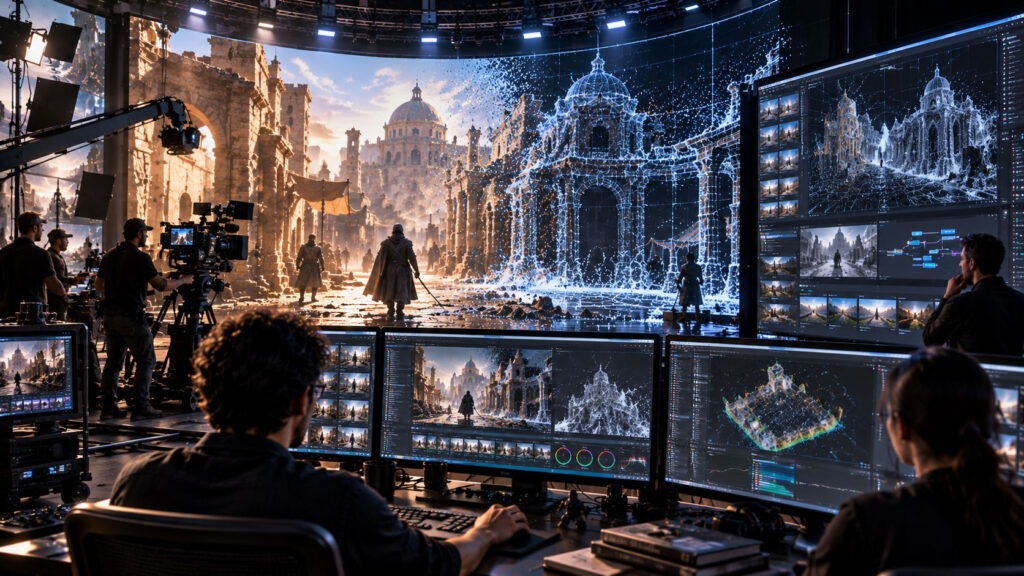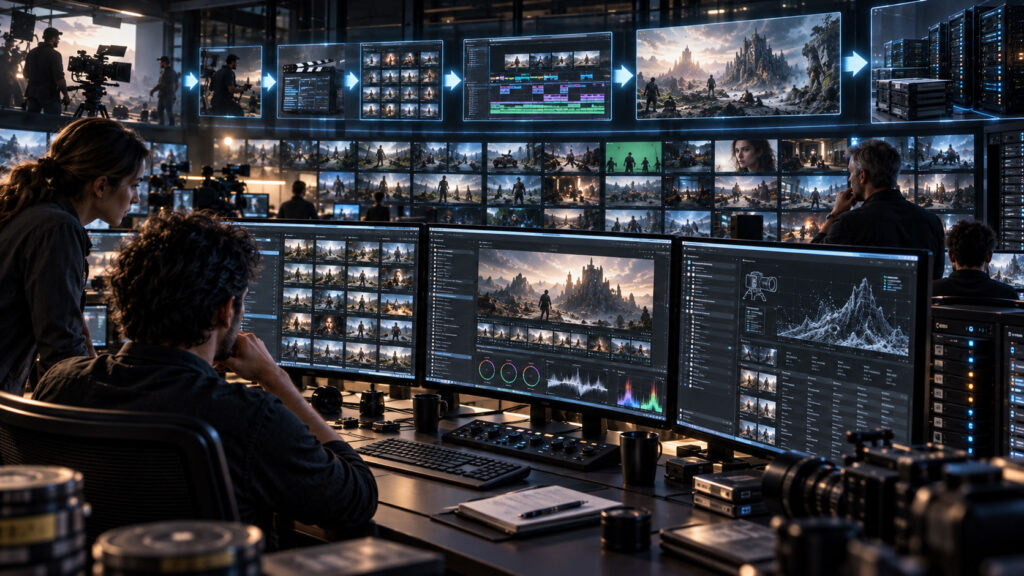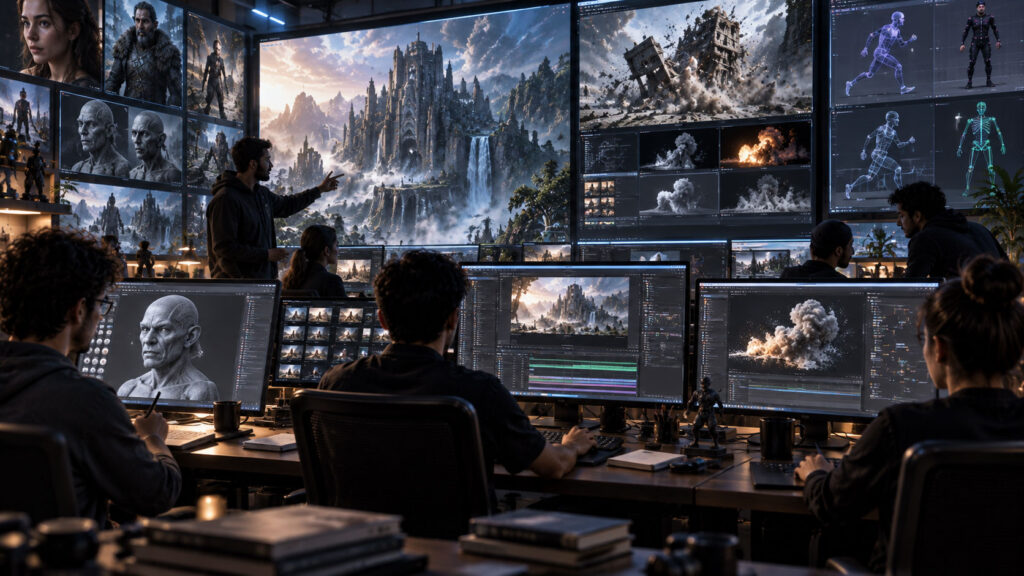
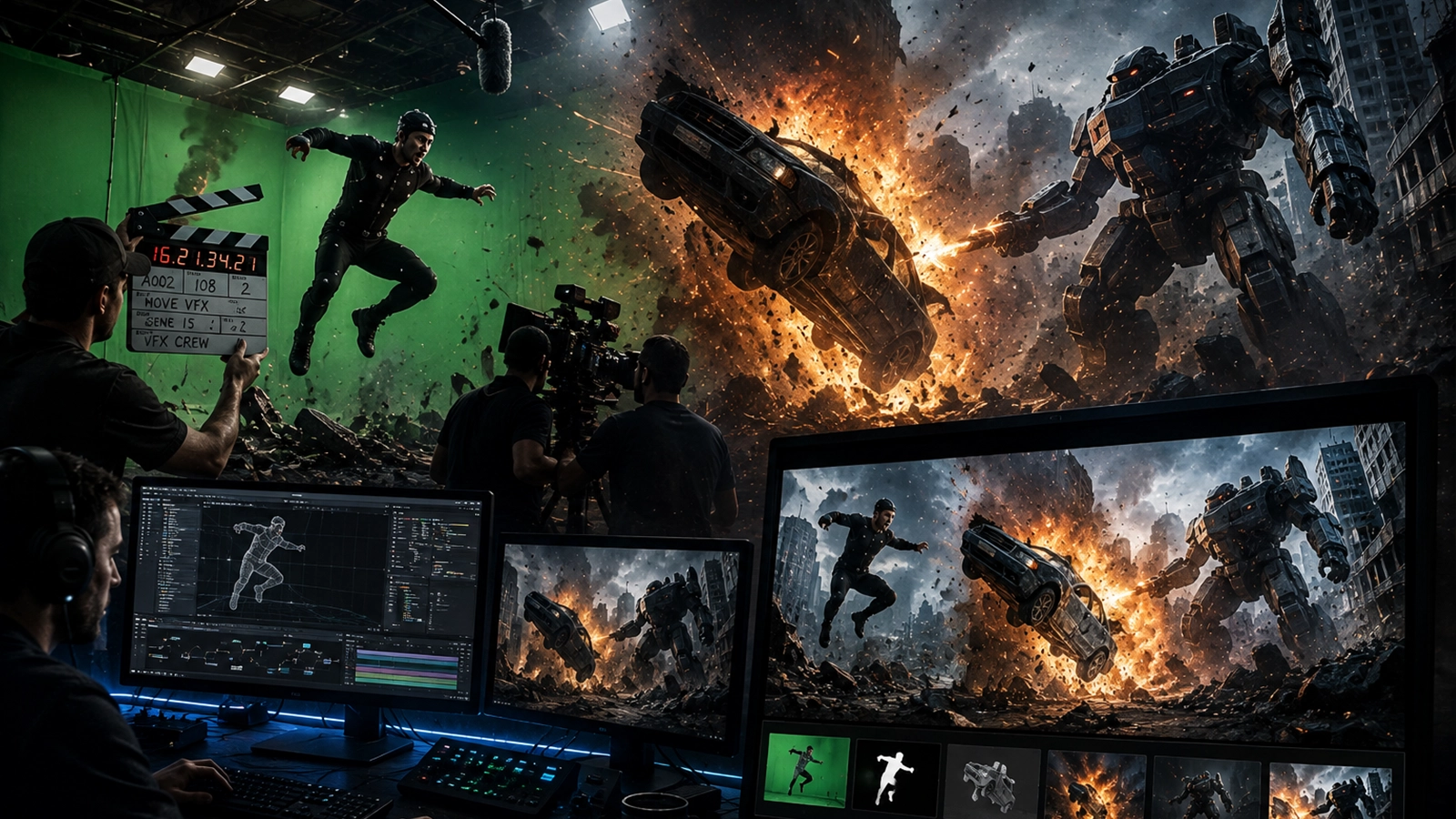
The generated plate is now treated as a professional VFX source. We clean it, track it, integrate effects, match lighting and color, solve artifacts and deliver approved finished shots.
🎨 Production Decision #8
Final AI footage becomes a clean VFX plate. This stage turns generated material into believable finished shots through professional compositing and continuity control.
- Why VFX finishing comes after generation
- Plate inspection
- Cleanup and paint
- Rotoscoping
- Tracking and matchmove
- Keying and extraction
- CG and VFX element integration
- Lighting and shadow integration
- Color and exposure matching
- Atmosphere and depth
- AI artifact correction
- Temporal consistency
- Compositing structure
- Version control
- Shot QC
- Sequence continuity
- Common finishing mistakes
- VFX approval gate
- Final shot master
- Next production decision
1. Why VFX finishing comes after generation
Generated footage is the raw plate, not automatically the finished shot. VFX finishing corrects artifacts, integrates elements and makes the visual result behave like one photographed or designed image.
2. Plate inspection
Before touching a shot, identify defects, camera movement, exposure changes, unwanted objects, continuity problems and areas that need replacement. Create a shot-specific cleanup plan.
3. Cleanup and paint
Remove unwanted objects, AI artifacts, flicker, warped details, accidental text, background errors or distracting inconsistencies while preserving natural texture.
4. Rotoscoping
Create accurate mattes for characters, objects and foreground elements that need separation. Maintain edge quality and motion continuity across the shot.
5. Tracking and matchmove
Track camera or object movement so CG, cleanup and replacement elements remain locked to the plate. Validate tracks before building dependent work.
6. Keying and extraction
When green-screen, blue-screen or other controlled backgrounds are used, build clean mattes while protecting hair, transparent areas and fine edges.
7. CG and VFX element integration
Add approved CG, particles, atmospherics, extensions or effects using the correct camera, scale, perspective and world lighting references.
8. Lighting and shadow integration
A new element should respond to the same light direction, softness, color and environmental conditions as the plate. Contact shadows and reflections are important depth cues.
9. Color and exposure matching
Match inserted elements to the plate’s exposure, contrast, white balance, saturation and local color response. Grade decisions should remain consistent across the sequence.
10. Atmosphere and depth
Fog, haze, dust, rain, smoke and depth cues can integrate elements into the same environment. Apply them according to the scene’s approved weather and atmosphere state.
11. AI artifact correction
Watch for temporal flicker, changing faces, melting objects, unstable textures, geometry deformation and impossible reflections. Decide whether to repair, replace or regenerate.
12. Temporal consistency
A single frame can look perfect while the sequence flickers. Review the entire shot for texture, lighting, edges, tracking and object stability over time.
13. Compositing structure
Build a logical comp hierarchy so elements, mattes, corrections and effects remain editable. Keep source plates and intermediate renders separate from the final master.
14. Version control
Keep versions of important comp changes and clearly label approved outputs. Never overwrite the last approved master while experimenting.
15. Shot QC
Review framing, edges, tracking, lighting, color, atmosphere, temporal stability and unwanted artifacts at full resolution and normal playback speed.
16. Sequence continuity
Review adjacent shots for color, exposure, VFX intensity, atmospheric conditions, scale and visual style. A perfect individual shot can still fail at sequence level.
17. Common finishing mistakes
Avoid over-cleaning, sharp matte edges, mismatched grain, incorrect shadows, inconsistent color and excessive effects that call attention to the composite.
18. VFX approval gate
Approve a shot only when technical defects are solved and the composite supports the story without drawing attention to the VFX work itself.
19. Final shot master
Create the approved VFX master while retaining source plate, mattes, tracking data, project files, references and notes for future changes.
20. Next production decision
Once VFX shots are finished, the next stage is editorial, sound and color finishing: assembling the final cut, designing sound, balancing color and preparing the final master.
The VFX Finishing Pipeline
↓
02 PLATE INSPECTION
↓
03 CLEANUP / PAINT
↓
04 ROTOSCOPING
↓
05 TRACKING / MATCHMOVE
↓
06 KEYING / EXTRACTION
↓
07 CG / VFX INTEGRATION
↓
08 LIGHT / SHADOW MATCH
↓
09 COLOR / EXPOSURE MATCH
↓
10 ATMOSPHERE / DEPTH
↓
11 TEMPORAL QC
↓
12 SEQUENCE QC
↓
13 VFX APPROVAL
↓
14 FINISHED SHOT MASTER
Connection to the Practical AI Film Series
AI Film Production 9.0 → this guide
Next → Editorial, sound, color finishing and final delivery.
Frequently asked questions
Should every AI shot receive heavy VFX?
No. Apply only the work needed to solve artifacts, integrate required elements and support the story. Over-processing can make a shot less natural.
When should I regenerate instead of fixing in VFX?
Regenerate when the underlying performance, identity, camera or environment is fundamentally wrong. Use VFX when the source is good and the problem can be reliably repaired.
Why is temporal QC important?
AI artifacts can appear only during motion. A frame-by-frame check alone can miss flicker, texture instability, warped edges or changing object geometry.
What makes a VFX shot approved?
The shot should pass technical, visual and story checks, match adjacent shots and have its source, project and final master properly tracked.