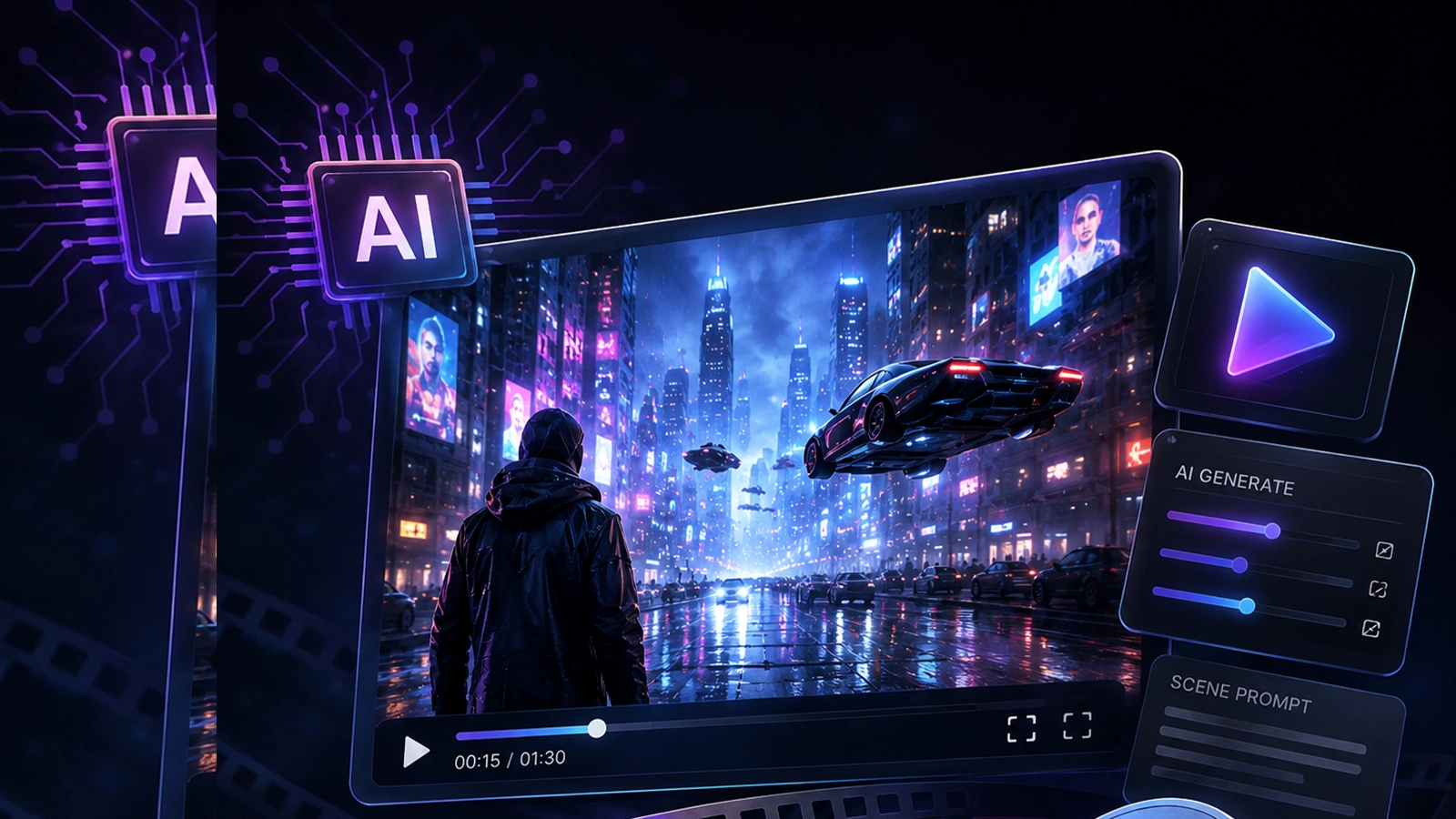

Use AI to test story, camera blocking, character continuity, environments, pacing and VFX ideas before spending time and generation credits on final shots.
- What is AI previs?
- Why previs matters for AI filmmaking
- Three levels of previs
- Prepare the production inputs
- Step-by-step AI previs workflow
- Camera blocking and screen geography
- Character and environment continuity
- Pacing, dialogue and sound
- Previs for VFX-heavy shots
- AI previs approaches in 2026
- Common mistakes
- Previs approval checklist
- FAQ
1. What is AI previsualization?
Previsualization—usually called previs—is the process of planning a film or sequence visually before final production. Traditional previs can use storyboards, 3D scenes, animatics and virtual cameras. AI adds a fast way to generate and animate visual references while keeping the planning stage relatively inexpensive.
A storyboard answers what a shot looks like. An animatic adds timing and motion. Full 3D previs can add spatially accurate camera blocking. AI previs can combine parts of all three, but the exact level of geometric accuracy depends on the workflow.
2. Why previs matters even more for AI filmmaking
AI video makes it easy to generate many clips. That is useful—but it can also create enormous waste. Without a plan, you can spend generation credits on beautiful shots that do not fit the story, break continuity or use the wrong camera language.
The current AI-previs discussion is increasingly focused on using visual planning to reduce generation waste and make decisions before expensive production.
Generate fewer final shots by making more decisions during previs. Story and composition are cheaper to change before final video generation.
3. Three levels of AI previs
| Level | What it contains | Best use |
|---|---|---|
| Storyboard previs | Approved still panels + shot notes. | Story, composition and coverage. |
| AI animatic | Moving storyboard panels + temporary sound. | Pacing, editing and performance timing. |
| Full/advanced previs | Moving scenes, camera blocking, rough VFX and spatial planning. | Complex action, VFX and production decisions. |
Current 2026 sources describe this progression from storyboard to animatic to more complete scene previs, with AI increasingly bridging the stages.
4. Prepare the production inputs
Do not start by asking the AI to “make a movie.” Give the previs system a controlled information set.
| Input | Purpose |
|---|---|
| Script | Story, dialogue, action and scene order. |
| Character bible | Identity, wardrobe, props and appearance. |
| Location references | Environment, geography and visual style. |
| Storyboard | Composition and shot intent. |
| Shot list | Camera, framing, movement and action. |
| Look references | Lighting, color, lens and production design. |
| Scratch audio | Dialogue timing, rhythm and scene duration. |
Current AI previs tools increasingly describe persistent project context—script, cast, locations and look references—as important inputs that downstream visuals can inherit.
5. Step-by-step AI previs workflow
- Lock the story. Confirm scene objectives and major beats.
- Lock character references. Use the approved identity set.
- Lock locations. Establish spatial and visual references.
- Build the shot list. Define framing, camera and action.
- Generate storyboard frames. Approve composition before motion.
- Animate each approved panel. Use image-to-video or an appropriate previs method.
- Assemble the sequence. Put clips in story order.
- Add scratch dialogue. Use temporary voice if needed.
- Add temp music/SFX. Establish rhythm and transitions.
- Review the whole sequence. Do not judge only individual clips.
- Revise. Change weak shots before final generation.
- Lock the previs. Use it as the blueprint for final production.
→ STORYBOARD
→ SHOT LIST
→ MOVING PREVIS
→ SCRATCH AUDIO
→ EDIT / REVIEW
→ APPROVAL
→ FINAL VIDEO
6. Camera blocking and screen geography
Previs is especially valuable when the camera must move through a scene. Test where the camera starts, where it travels, what it reveals and how the subject moves relative to it.
| Question | Previs test |
|---|---|
| Where is the camera? | Mark starting position and framing. |
| Where does it move? | Preview track, dolly, orbit or crane path. |
| Where does the subject move? | Check screen direction and blocking. |
| What is revealed? | Time the reveal. |
| Where is the next shot? | Check continuity across the cut. |
Research such as Autodesk’s 2026 PrevizWhiz work explores combining rough 3D scenes with generative image/video models to bridge spatial precision and fast visual iteration.
For detailed prompt language, see Zgian’s AI Video Camera Control guide.
7. Character and environment continuity
A moving previs exposes continuity errors that may be invisible in isolated storyboard panels. Watch for changing faces, costumes, props, architecture and lighting.
+ LOCATION MASTER
+ STORYBOARD
+ CAMERA PLAN
→ CONTINUITY-AWARE PREVIS
Our previous AI Character Consistency guide should be treated as the identity reference system for this stage.
8. Pacing, dialogue and sound
A sequence can look good shot by shot and still fail when edited. An animatic gives you a chance to discover that problem early.
- Put temporary dialogue under the scene.
- Trim shots to the actual dramatic beat.
- Test reaction-shot duration.
- Use temporary music to establish rhythm.
- Add placeholder sound effects for major actions.
- Review transitions and pauses.
Current 2026 AI animatic workflows commonly use storyboard stills, image-to-video motion, temporary voiceover and music to test timing before final production.
9. Using AI previs for VFX-heavy scenes
For VFX, previs can save even more time because it lets you test complex shots before building final assets, simulations or composites.
| VFX problem | What previs can test |
|---|---|
| Explosion | Camera distance, timing and screen direction. |
| Creature | Scale, blocking and interaction. |
| Vehicle chase | Camera path, geography and cuts. |
| Destruction | Impact timing and coverage. |
| Green-screen composite | Camera framing, eyelines and plate concept. |
| Virtual production | Camera position and environment composition. |
SIGGRAPH’s 2026 discussion of previs emphasizes its role in making creative decisions in context and rapidly iterating camera, characters, lighting, atmospherics and FX before production.
10. AI previs approaches in 2026
There is no single “best AI previs tool.” The useful distinction is the type of control you need.
| Approach | Strength | Best for |
|---|---|---|
| Script-to-storyboard | Fast scene and shot breakdown | Early planning. |
| Storyboard-to-animatic | Timing and pacing | Commercials and narrative sequences. |
| All-in-one AI filmmaking | Persistent project context | Solo creators and small teams. |
| 3D previs + AI | Spatial/camera accuracy | VFX-heavy production. |
| Multi-model canvas | Compare image/video/3D methods | Creative development. |
Current 2026 tools and research span script-driven platforms, storyboard/animatic systems, integrated AI filmmaking workspaces and hybrid 3D-plus-generative approaches.
11. Common AI previs mistakes
| Mistake | Problem | Fix |
|---|---|---|
| Calling final video “previs” | Too much time spent polishing. | Keep previs rough enough to revise. |
| Skipping the storyboard | Motion hides composition problems. | Approve still frames first. |
| No scratch audio | Pacing problems appear late. | Use temporary dialogue/music. |
| Ignoring spatial accuracy | Camera moves do not work in production. | Use 3D blocking for complex shots. |
| Changing character references | Continuity drift. | Use master references. |
| Generating every shot at final quality | Wasted credits and time. | Use low-cost tests and approve first. |
12. AI previs approval checklist
- Does the sequence tell the intended story?
- Are the scene objectives clear?
- Does every shot have a purpose?
- Are characters consistent?
- Are locations and screen geography clear?
- Do camera movements work?
- Do cuts make sense?
- Does the pacing match the intended emotion?
- Does temporary dialogue fit the images?
- Are VFX beats correctly timed?
- Can the approved previs be handed to final generation without rewriting the whole plan?
How this fits the Zgian AI filmmaking pipeline
02 CAMERA → AI Video Camera Control
03 STORYBOARD → AI Storyboarding
04 PREVIS → this guide
05 AI FILMMAKING → AI Filmmaking Hub
06 CINEMATIC AI → Cinematic AI Hub
07 VFX → VFX Hub
Frequently asked questions
What is AI previs?
AI previs is the use of AI-assisted visual tools to plan shots, camera movement, blocking, pacing and scene continuity before final production. It can include storyboards, animatics, generated video previews and hybrid 3D workflows.
What is the difference between an AI storyboard and AI previs?
A storyboard is usually a set of still visual panels. Previs can go further by showing motion, camera blocking, timing and scene relationships. An animatic is one common form of moving previs.
Can AI previs replace traditional 3D previs?
Not always. AI is excellent for fast visual exploration, but complex shots requiring precise spatial measurements may still benefit from 3D previs. Research such as PrevizWhiz specifically explores combining rough 3D with generative models to bridge these strengths.
Can I make an AI previs from a script?
Yes. Current tools can take a script or shot breakdown and help generate storyboard frames, animatics and scene previews. Human review remains important for story, continuity and production decisions.
Should AI previs use final-quality video?
Usually no. The purpose is to make decisions cheaply and quickly. Use enough quality to evaluate story, composition, motion and continuity, then reserve final-quality generation for approved shots.
Continue the Zgian AI Filmmaking series
3D Generalist & VFX Professional · About the author →