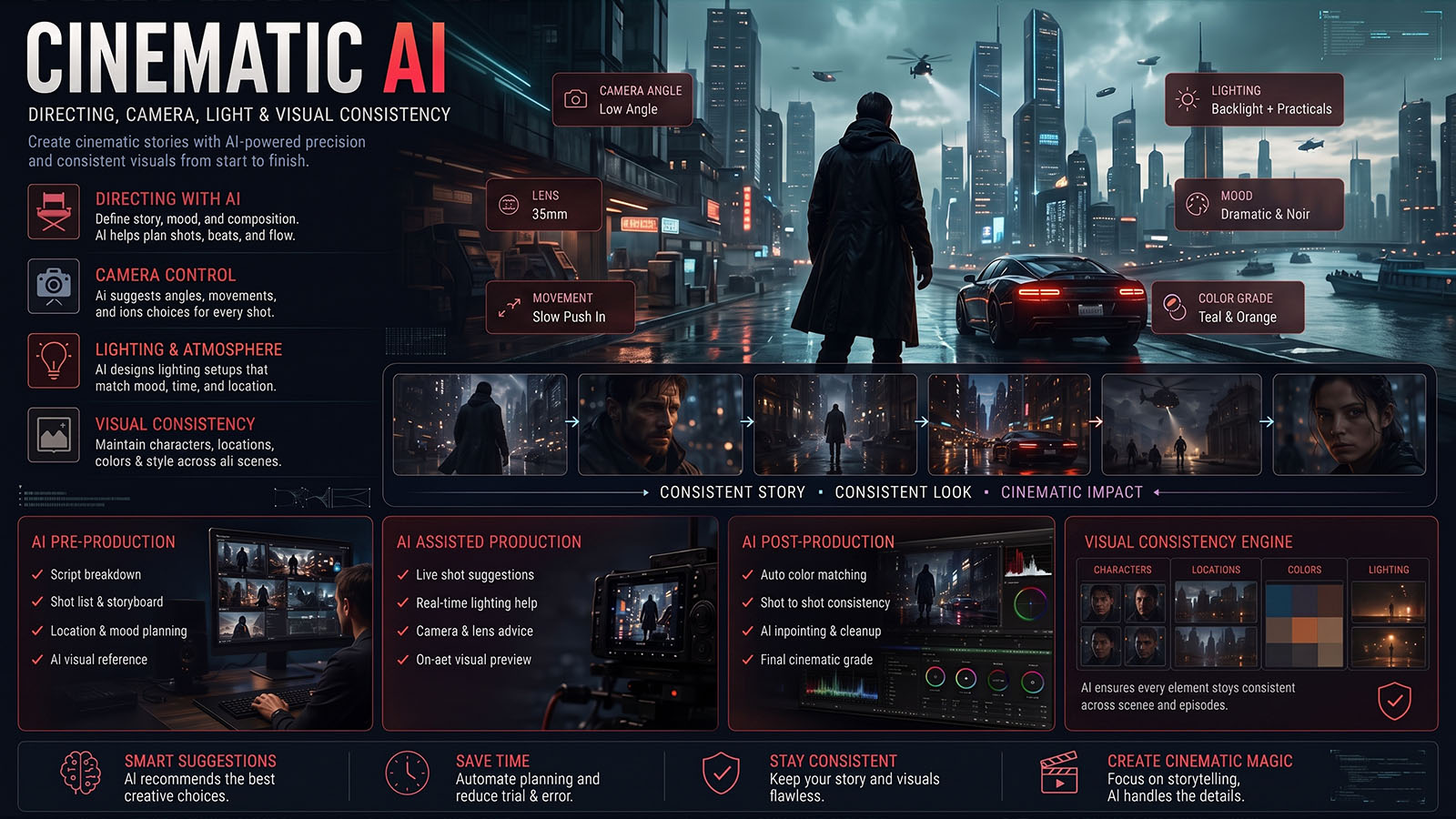


Go beyond “AI video” and learn how to direct generated images and shots with cinematic composition, camera language, lighting, continuity and mood.
Camera
Shot size, lens feel, camera movement, perspective and motivated motion.
Lighting
Key, fill, rim, color temperature, contrast and environmental light.
Composition
Foreground, subject placement, depth, leading lines and negative space.
Performance
Gesture, blocking, eye-lines, timing and emotional intent.
Consistency
Characters, costumes, props, locations and visual style across shots.
Finishing
Editing, VFX, color, grain, sound and final cinematic polish.
Cinematic AI learning path
The cinematic AI mindset
Think like a director and cinematographer first. Decide what the audience should see, where the camera should be, what the light should communicate and how one shot connects to the next. AI is the production instrument—not the director.
That human-guided approach is increasingly visible in current AI-film practice and industry discussion.
Where Cinematic AI: Directing, Camera, Light & Visual Consistency fits in the production workflow
Cinematic AI: Directing, Camera, Light & Visual Consistency is best understood as part of a wider creative and technical pipeline. Depending on the project, it may connect with text-to-video, image-to-video, AI filmmaking, AI VFX, and AI editing. Understanding those relationships helps artists choose an efficient workflow instead of treating a technique or software feature in isolation.
What to evaluate on a real project
- What is the intended final output and what quality level is required?
- Which parts of the shot are best handled manually, procedurally, or with tracking/automation?
- How will the work be reviewed, revised, versioned and handed off to the next department?
- What happens when lighting, motion blur, transparency, perspective or other difficult shot conditions change?
Related Zgian guides
Editorial note: software interfaces and AI capabilities change over time. Check current vendor documentation before relying on version-specific features.