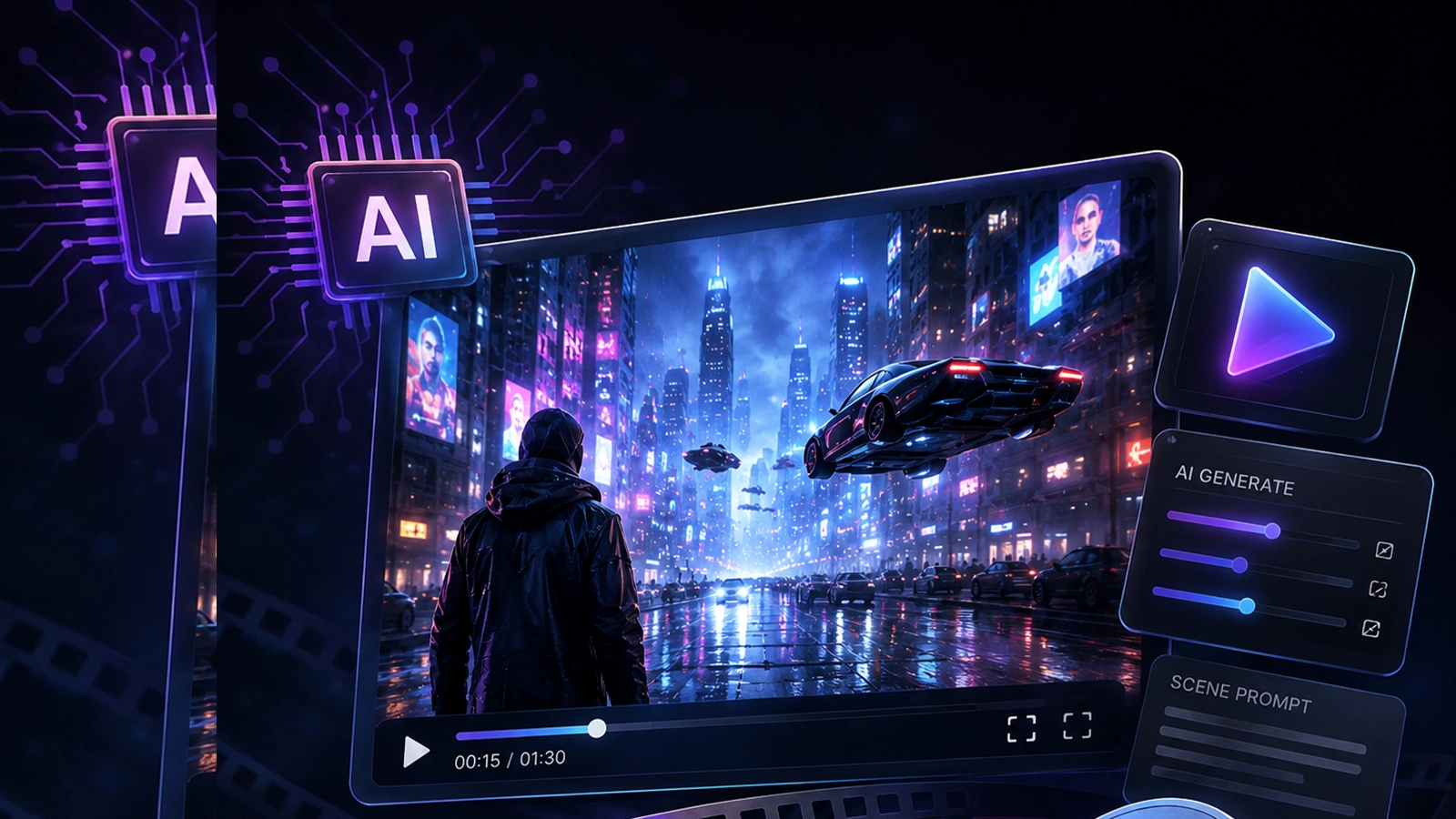

Stop asking for a “dynamic cinematic camera.” Learn how to direct the virtual camera with specific shot sizes, angles, movements, speed, lenses and subject relationships.
1. The AI camera prompt formula
A useful structure is:
Runway’s current guide uses essentially this structure and explains that named camera terms are more actionable for models than broad aesthetic instructions.
Example: Medium close-up, eye-level, slow dolly push-in toward a detective standing in the rain, 35mm lens, shallow depth of field, neon reflections, the movement gradually reveals his worried expression.
2. AI video camera movements
| Movement | What it does | Typical use |
|---|---|---|
| Dolly / push-in | Camera physically moves closer. | Tension, intimacy, discovery. |
| Dolly out / pull-back | Camera retreats from the subject. | Reveal, isolation, scale. |
| Pan | Camera rotates horizontally. | Follow or reveal. |
| Tilt | Camera rotates vertically. | Reveal height or change attention. |
| Tracking / follow | Camera travels with the subject. | Walking, running, action. |
| Orbit / arc | Camera moves around the subject. | Hero shots, dramatic reveals. |
| Crane / pedestal | Camera moves vertically through space. | Scale and production value. |
| Handheld | Controlled irregular camera motion. | Documentary, urgency, realism. |
| Locked-off | Camera remains fixed. | Calm, tension, controlled composition. |
| Zoom | Lens magnifies or widens without physically moving camera. | Emphasis or stylized transitions. |
Current 2026 camera-prompt references consistently recommend naming one clear primary movement and specifying direction or speed rather than stacking many unrelated moves.
3. Shot sizes and camera angles
| Shot | Best for |
|---|---|
| Extreme wide / establishing | Location, scale and geography. |
| Wide shot | Full body and environment. |
| Medium shot | Dialogue and body language. |
| Medium close-up | Emotion while retaining context. |
| Close-up | Facial emotion and important details. |
| Extreme close-up | Eyes, objects and visual emphasis. |
| Low angle | Power, scale or vulnerability from below. |
| High angle | Vulnerability or overview. |
| POV | Subjective first-person perspective. |
| Over-the-shoulder | Dialogue and relationship between characters. |
4. Lens language: 24mm, 35mm, 50mm and beyond
Lens language can help communicate perspective and visual feel, but do not assume a model will reproduce real optical behavior perfectly. Use lens terms as creative direction and test the result.
| Lens | Creative tendency |
|---|---|
| 18–24mm | Wide environment, stronger perspective, energetic proximity. |
| 28–35mm | Natural cinematic wide/normal feel. |
| 50mm | Natural perspective and portrait-friendly framing. |
| 85mm+ | Compressed background and portrait emphasis. |
| Macro | Extreme detail and shallow depth of field. |
5. Give the camera a purpose
The best camera move is motivated by what the audience needs to discover. A push-in can reveal emotion. A pan can reveal a second character. A crane can reveal scale. A tracking shot can keep a character connected to the environment.
Weak: “cinematic, dynamic camera.”
Better: “medium-full shot, eye-level, steady tracking camera follows the woman at walking pace, 35mm lens, revealing the crowded market behind her.”
Runway’s current guide specifically warns that vague camera language leaves multiple decisions to the model and can cause subject-camera relationships to drift.
6. Copy-ready AI camera prompts
| Shot | Prompt |
|---|---|
| Push-in | Medium close-up, eye-level, slow dolly push-in toward the actor over four seconds, 50mm lens, soft window light, the move emphasizes a subtle change in expression. |
| Tracking | Medium-full shot, steady tracking camera follows a woman walking through a rainy neon street, matching her pace, 35mm lens, reflections on wet pavement. |
| Reveal pan | Wide shot, slow pan right from an empty doorway to reveal a character standing in the moonlight, 28mm lens, quiet suspense. |
| Orbit | Medium shot, slow 180-degree orbit around the character while she remains centered, 50mm lens, warm backlight, dramatic reveal. |
| Crane | Wide establishing shot, slow crane upward from street level to reveal the entire futuristic city, 24mm lens, atmospheric haze. |
| Handheld | Medium shot, restrained handheld camera follows the runner through a narrow corridor, 35mm lens, urgent documentary realism. |
| Locked-off | Locked-off medium-wide shot, static camera, character enters frame and stops, symmetrical composition, soft practical lighting. |
| Dolly zoom | Medium close-up, controlled dolly push-in while the lens zooms out, background perspective compresses behind the stationary subject, vertigo effect. |
7. Common AI camera-control mistakes
| Mistake | Typical result | Fix |
|---|---|---|
| “Dynamic cinematic camera” | Random drift | Name the movement. |
| Three or four moves in one short shot | Confused motion and warping | Use one dominant move. |
| No speed | Unexpectedly fast motion | Say slow, steady, rapid or give timing. |
| No subject-camera relationship | Subject glides or leaves frame | Say “camera follows,” “keeps subject centered,” etc. |
| Dolly and zoom treated as identical | Wrong perspective | Specify physical camera movement vs lens zoom. |
| Camera movement without a reveal | Motion feels pointless | State what the move reveals or emphasizes. |
8. Professional AI camera workflow
- Design the shot. Decide what the audience should see.
- Choose framing. Wide, medium, close-up, POV, etc.
- Choose one primary movement. Keep it readable.
- Define subject relationship. Follow, orbit, reveal, maintain center, etc.
- Add lens and lighting. Use them to support the visual intent.
- Generate a short test. Do not render the whole sequence immediately.
- Inspect motion. Check faces, hands, background geometry and perspective.
- Refine one variable at a time. Change movement, speed or lens separately.
- Build the edit. Generate individual directed shots and assemble them in the NLE.
This one-shot-at-a-time approach is also recommended by current AI camera-prompt guidance because stacking multiple movements can make short generations difficult to control.
9. Camera control is the bridge to Cinematic AI
Camera control belongs at the intersection of our three Zgian AI sections. AI Video gives you generation tools. AI Filmmaking gives you the production workflow. Cinematic AI gives the shot a visual and narrative purpose.
AI FILMMAKING → DIRECT
CINEMATIC AI → COMPOSE + MOVE + REVEAL
VFX → INTEGRATE + FINISH
Current AI filmmaking practice is increasingly moving toward deliberate camera direction and production-oriented workflows rather than simple prompt-and-generate experimentation.
10. AI camera control checklist
- Is the shot size clear?
- Is the camera angle clear?
- Is there one dominant movement?
- Is the direction specified?
- Is the speed specified?
- Does the camera have a relationship with the subject?
- Is the lens appropriate?
- Does the movement reveal something?
- Does the background remain stable?
- Does the shot connect naturally to the next shot?
How this fits the Zgian AI Video cluster
AI FILMMAKING → AI Filmmaking Hub
CINEMATIC AI → Cinematic AI Hub
AI RESTORATION → AI Video Restoration
AI UPSCALING → AI Video Upscaling
AI VFX → AI VFX Workflow for Film
Frequently asked questions
What is an AI camera prompt?
An AI camera prompt describes how the virtual camera should frame and move through a generated scene, including shot size, angle, movement, speed and sometimes lens and visual purpose.
What camera movements work best in AI video?
Common cinematography terms such as dolly, tracking, pan, tilt, crane, orbit, handheld and locked-off are useful starting points. Results vary by model and generation mode.
How many camera movements should I put in one AI video prompt?
Start with one dominant movement per short shot. If the story needs several movements, split them into separate beats or shots rather than forcing every move into one generation.
How do I make AI video camera movement less random?
Specify the movement, direction, speed, subject-camera relationship and what the movement should reveal. Avoid relying only on phrases such as “dynamic” or “cinematic.”
Can AI video understand lens terms like 35mm?
Many current systems respond to common cinematography vocabulary, but the optical result varies. Treat lens terms as creative guidance and evaluate the generated shot.
Continue the Zgian AI Video series
3D Generalist & VFX Professional · About the author →