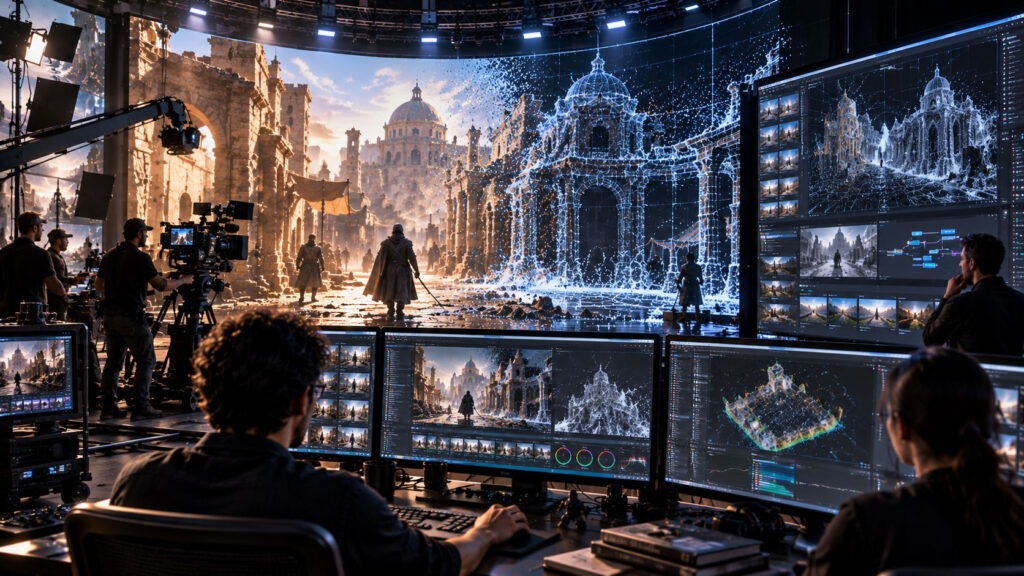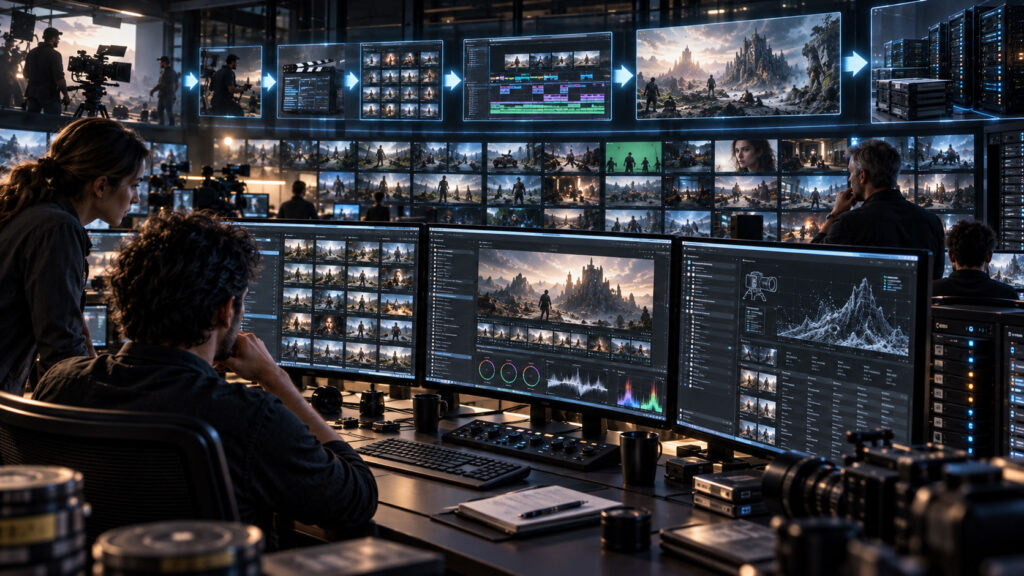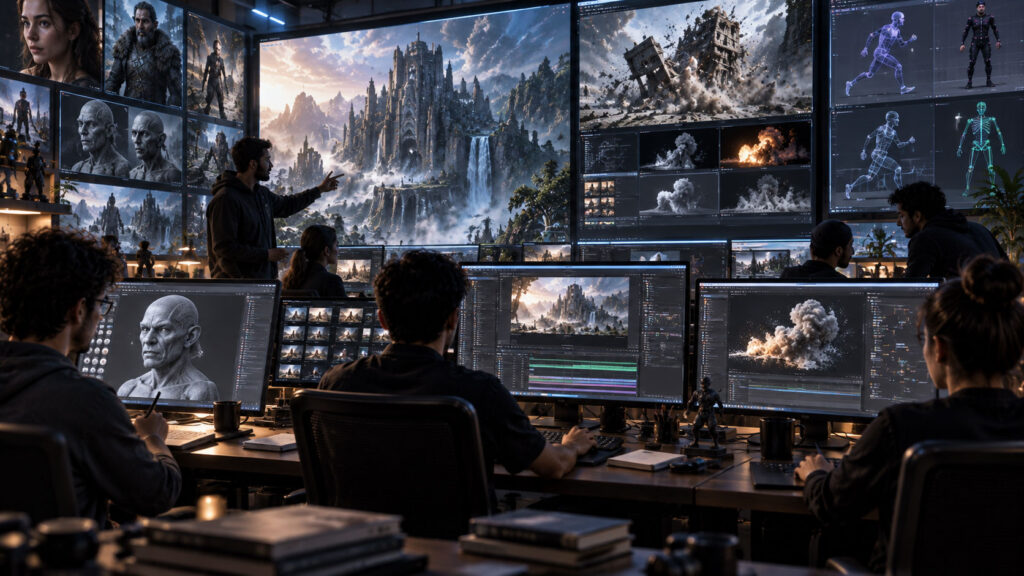
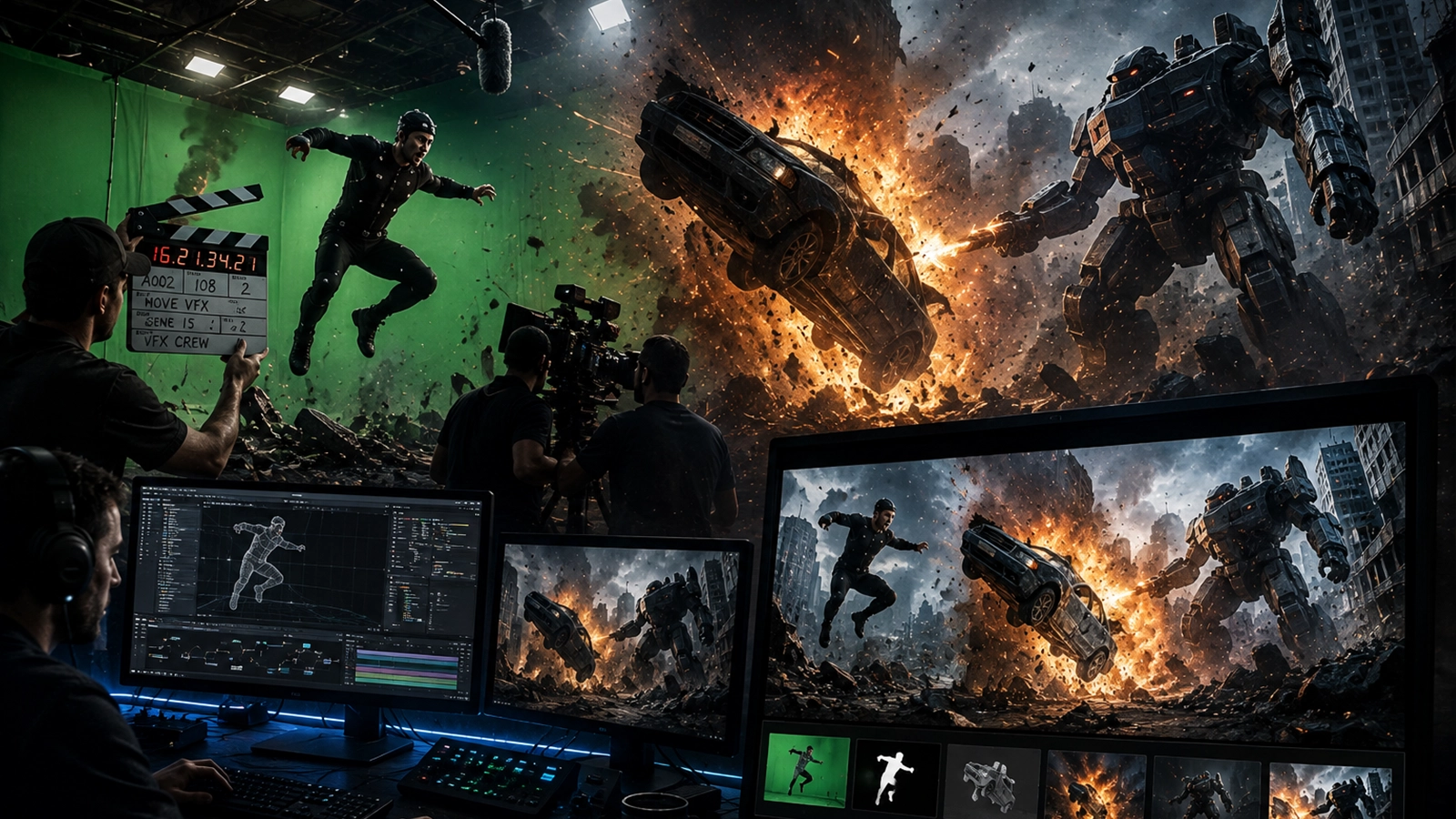
AI can accelerate world building from a single concept into large environments, but believable worlds depend on spatial logic, scale, continuity, variation and performance. The goal is not simply to generate more detail—it is to build a world that remains coherent from every camera.
- What AI environment generation changes
- AI environment generation
- Text-to-world workflows
- Image-to-world
- Procedural terrain
- AI cities
- Architecture
- Vegetation
- Digital landscapes
- Weather
- Atmosphere
- World consistency
- Optimization
- Common mistakes
- Complete Zgian AI environment workflow
- Final environment QC
1. What AI environment generation changes
AI can accelerate the creation of landscapes, architecture, cities, vegetation and atmospheric worlds. Production environments still need art direction, spatial consistency, camera logic and optimization.
2. AI environment generation
Generative systems can produce visual concepts for environments from text, images or references. Treat generated imagery as design exploration until scale, geometry and continuity are established.
3. Text-to-world workflows
Text descriptions can establish mood, location, architecture, weather and time of day. Strong prompts define relationships between elements rather than listing isolated objects.
4. Image-to-world
A concept image can become the visual foundation for a 3D environment. Extract composition, materials, architectural language and lighting before rebuilding the scene.
5. Procedural terrain
Procedural systems can generate large landscapes using height fields, masks, erosion logic, scattering and biome rules.
6. AI cities
AI-assisted city generation can accelerate road layouts, building variation, facade concepts and urban dressing. Repetition and impossible geometry must be controlled.
7. Architecture
Generated architecture needs structural logic, scale, proportion and consistent design language. Use modular systems where possible so changes remain manageable.
8. Vegetation
Vegetation systems combine species selection, distribution, scale variation, density and environmental rules. AI can help design references while procedural tools provide repeatable placement.
9. Digital landscapes
Mountains, valleys, deserts, forests and coastlines need coherent geological and visual relationships. Large-scale composition should be solved before micro-detail.
10. Weather
Weather affects lighting, visibility, materials and motion. Rain, fog, snow, dust and cloud systems should respond to the environment rather than acting as isolated effects.
11. Atmosphere
Depth haze, aerial perspective, clouds and environmental particles establish scale. Atmospheric layers should match camera exposure and scene lighting.
12. World consistency
Generated environments can drift between shots. Lock important geometry, materials, lighting direction, color language and camera references across the sequence.
13. Optimization
Large worlds require level of detail, instancing, culling, streaming and texture management. Visual quality must be balanced against real-time or render performance.
14. Common mistakes
Avoid beautiful but spatially impossible environments, inconsistent scale, repeated assets, unstable weather, changing architecture and uncontrolled texture detail.
15. Complete Zgian AI environment workflow
Define the world, establish visual references and spatial rules, generate concepts, build procedural terrain and modular assets, assemble vegetation and atmosphere, lock continuity, optimize the world and validate it from every required camera.
16. Final environment QC
Check scale, composition, geometry, materials, repetition, lighting, atmosphere, camera continuity, performance and final render quality before approving the environment.
How this fits the Zgian AI VFX series
AI VFX 2.0 → Video Transformation
AI VFX 3.0 → Digital Humans
AI VFX 4.0 → this guide
Frequently asked questions
Can AI generate a complete 3D world?
AI can accelerate concepts, assets and parts of world construction, but a production-ready world still needs spatial organization, scale control, materials, lighting, optimization and continuity.
What is text-to-world?
It describes an environment in language and uses generative systems to create visual or structural starting points for the world.
Why is procedural generation useful?
Procedural rules make large environments repeatable, editable and scalable while reducing manual placement work.
How do you avoid repeated AI assets?
Use variation in geometry, scale, materials, orientation and distribution rules, then inspect the world from the final camera positions.
What is the biggest environment-generation mistake?
Building detailed assets before solving the macro composition and spatial logic. A beautiful asset cannot fix a world that does not make sense as a place.