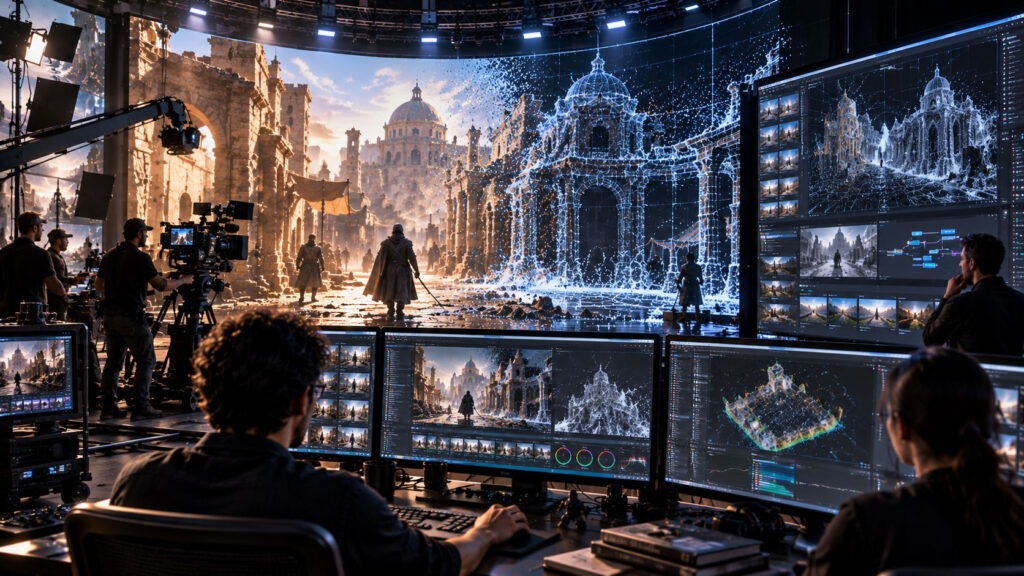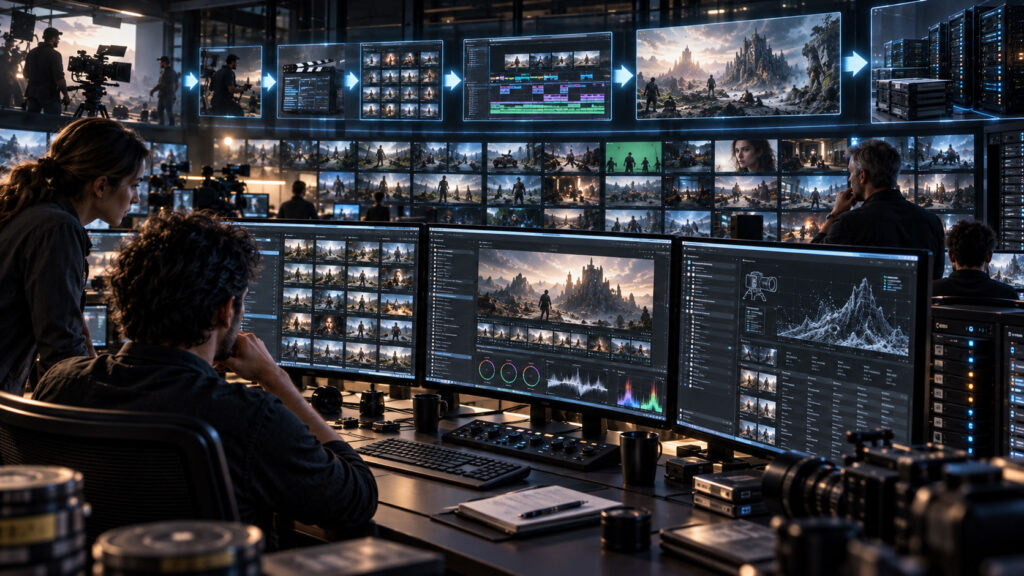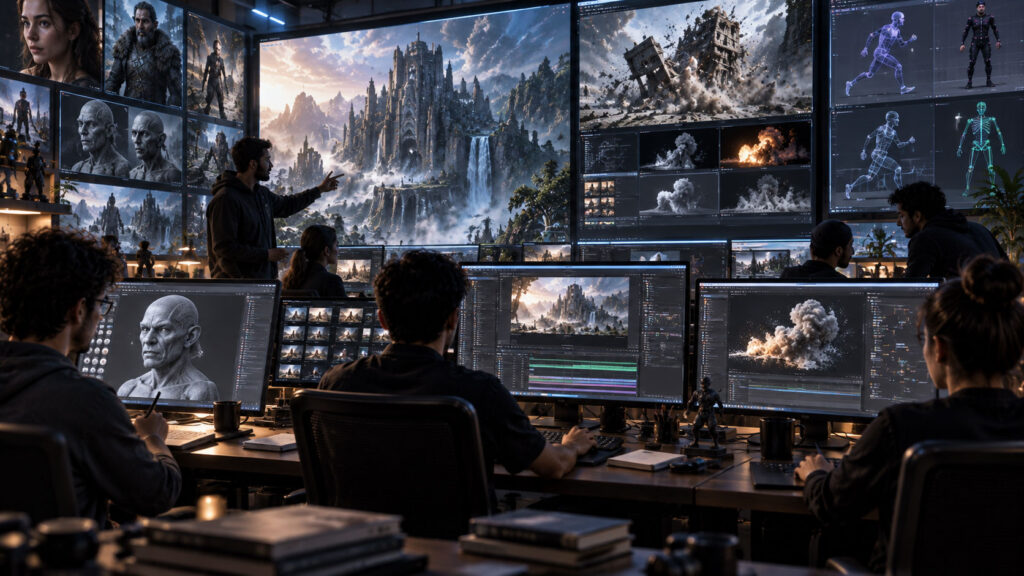
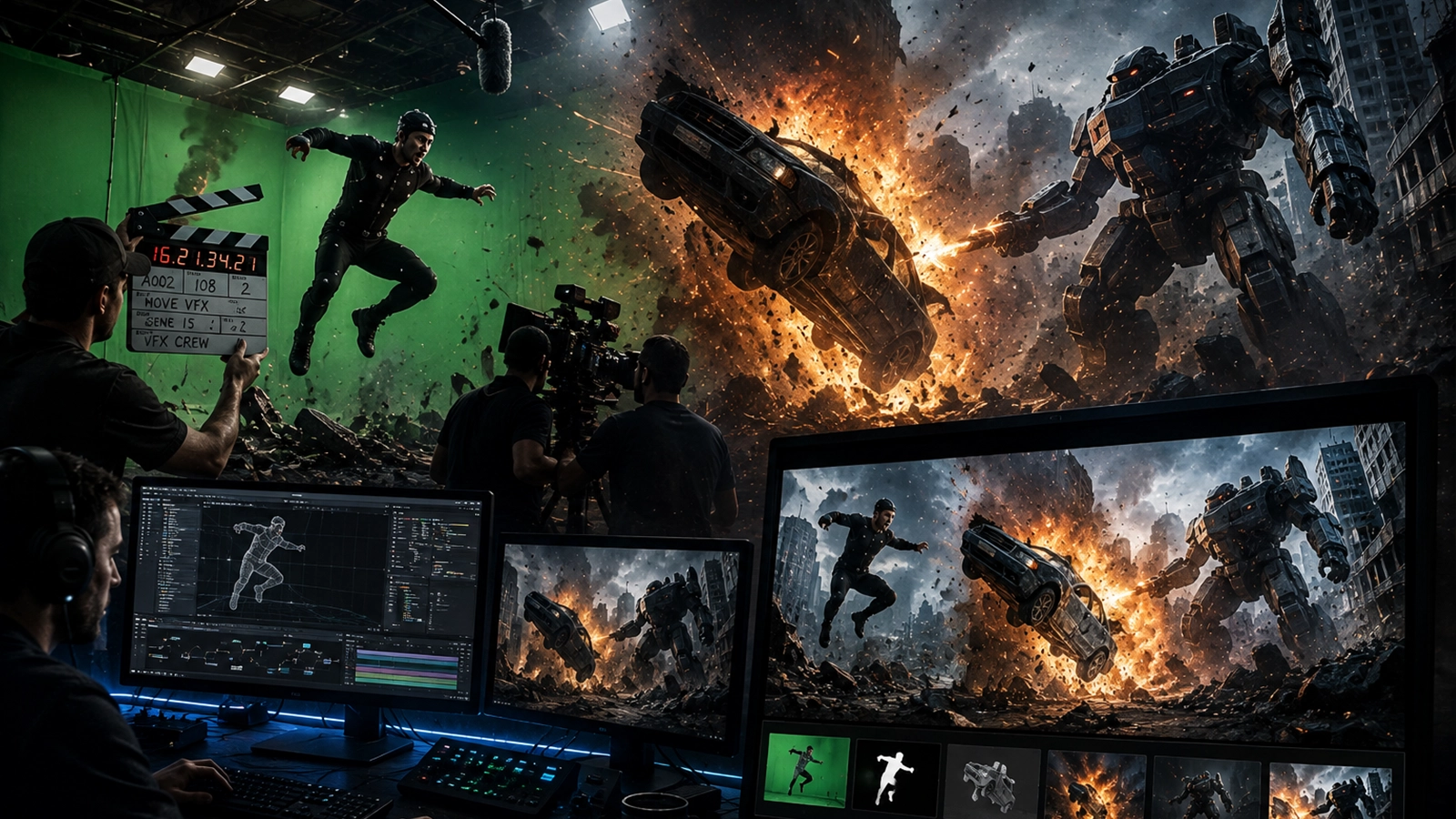
Real-time VFX turns the engine into an interactive production environment where worlds, cameras, lighting, effects and characters can be reviewed at production speed. The key is a disciplined performance budget combined with cinematic control.
- What the real-time VFX pipeline changes
- Unreal Engine workflow
- Real-time rendering
- Procedural environments
- Niagara FX
- Lumen lighting
- Nanite assets
- Real-time materials
- Virtual cameras
- Real-time characters
- Performance optimization
- AI-assisted engine workflows
- Virtual production integration
- Real-time color and look development
- Common mistakes
- Complete Zgian real-time VFX workflow
- Final real-time QC
1. What the real-time VFX pipeline changes
Real-time VFX brings rendering, effects, lighting, cameras, environments and characters into an interactive production loop. The goal is faster creative iteration with predictable performance.
2. Unreal Engine workflow
A production engine becomes the central scene, rendering and interaction layer. Establish project standards before importing large numbers of assets.
3. Real-time rendering
Real-time rendering prioritizes responsiveness, stable frame rate and visual consistency. Build a performance budget around the target display, camera and production stage.
4. Procedural environments
Procedural tools can generate terrain, vegetation, architecture and repeated set dressing while keeping rules editable and reproducible.
5. Niagara FX
Niagara particle systems can drive smoke, sparks, dust, fire, debris and atmospheric effects. Build effects as controllable systems rather than isolated one-off shots.
6. Lumen lighting
Dynamic global illumination and reflections can make real-time environments respond naturally as cameras and lights move. Validate quality against the actual production camera.
7. Nanite assets
Virtualized geometry can support highly detailed environments, but asset density, materials, foliage and scene complexity still need a performance budget.
8. Real-time materials
Materials should be physically coherent and optimized for the engine. Keep shader complexity, texture memory and parameter counts under control.
9. Virtual cameras
Connect the engine camera to the cinematography workflow and preserve lens, sensor, transform, focus and movement information.
10. Real-time characters
Characters combine animation, facial performance, materials, hair, clothing and effects. Profile the whole character rather than only the mesh.
11. Performance optimization
Profile the complete frame. Reduce expensive geometry, materials, effects and animation only where they affect the target camera or production requirement.
12. AI-assisted engine workflows
AI can help with code scaffolding, procedural variations, material ideas, asset tagging, shot exploration and debugging assistance. Production changes should remain reviewable and versioned.
13. Virtual production integration
The engine must connect reliably with tracking, LED displays, camera systems, lighting and production control when used on stage.
14. Real-time color and look development
Establish a consistent color-management and look-development process so interactive previews remain aligned with the intended final image.
15. Common mistakes
Avoid treating a real-time engine as an unlimited renderer, importing unoptimized assets, ignoring shader cost, changing project settings mid-production or accepting AI changes without review.
16. Complete Zgian real-time VFX workflow
Start with the story and target frame rate, establish engine standards, build the world, add assets and materials, develop lighting and Niagara FX, integrate cameras and characters, then profile and validate the complete production scene.
17. Final real-time QC
Validate frame rate, GPU/CPU load, asset streaming, shader cost, lighting, FX stability, camera accuracy, character playback, color and stage integration before approval.
How this fits the Zgian VFX + AI pipeline
VIRTUAL CHARACTERS → Digital Humans 3.0
VIRTUAL CINEMATOGRAPHY → Virtual Cinematography 4.0
VIRTUAL ART DEPARTMENT → VAD 5.0
REAL-TIME VFX → this guide
Frequently asked questions
Why use a real-time engine for VFX?
It allows cameras, lighting, environments, characters and effects to be reviewed interactively, shortening creative iteration.
What is Niagara?
Niagara is a real-time visual-effects system used for particle and procedural effects such as smoke, sparks, dust, fire and debris.
What are Lumen and Nanite?
They are Unreal Engine technologies for dynamic lighting and reflections, and highly detailed virtualized geometry respectively.
How important is optimization?
Critical. A production scene must maintain the target frame rate while the camera, characters, lighting and effects are active.
How can AI help the engine workflow?
AI can assist with procedural ideas, code scaffolding, asset organization, material exploration and troubleshooting, while artists and engineers validate every change.
Continue the Zgian VFX + AI series
Digital sets, scouting and asset management.AI Virtual Cinematography
Cameras, lenses, previs and techvis.AI Virtual Characters
Digital humans and performance capture.
Related Zgian Coverage
- XGRIDS Brings 3D Gaussian Splatting Into Unreal Engine for Virtual Production
- Colorfront and Qumulo Make VFX Footage Searchable With AI
- Gnomon Best of Term Showcases the Next Generation of VFX and CG Artists
- IBC 2026 Shows How AI Agents Are Automating Media Localization at Scale
- Zerply Is Shutting Down: What VFX Artists Need to Do Before September 28
- Reuters Brings AI-Assisted Video Editing to Newsrooms With CuttingRoom
- Adobe Adds AI Video Generation and AI Assistant to Premiere Pro and After Effects
- How Milk VFX Used Unreal Engine to Build the Lost Worlds of Surviving Earth
- Prime Video Uses AI and VFX to Improve Lip-Sync for Dubbing