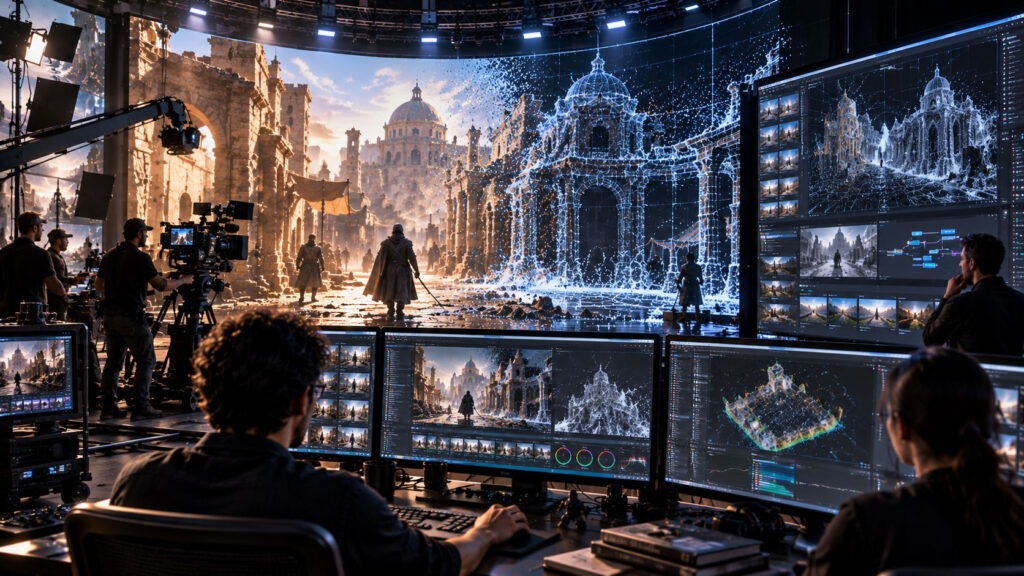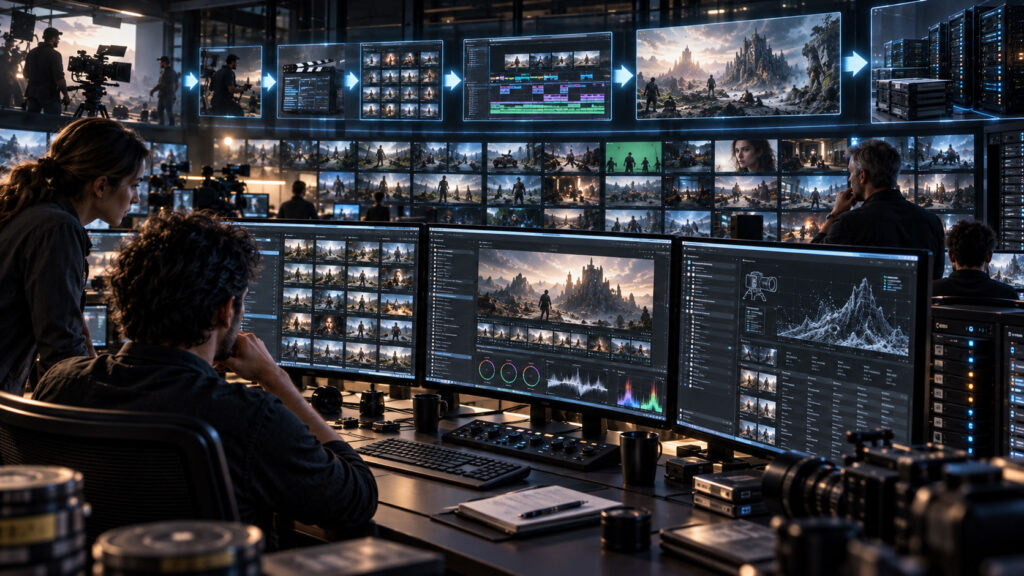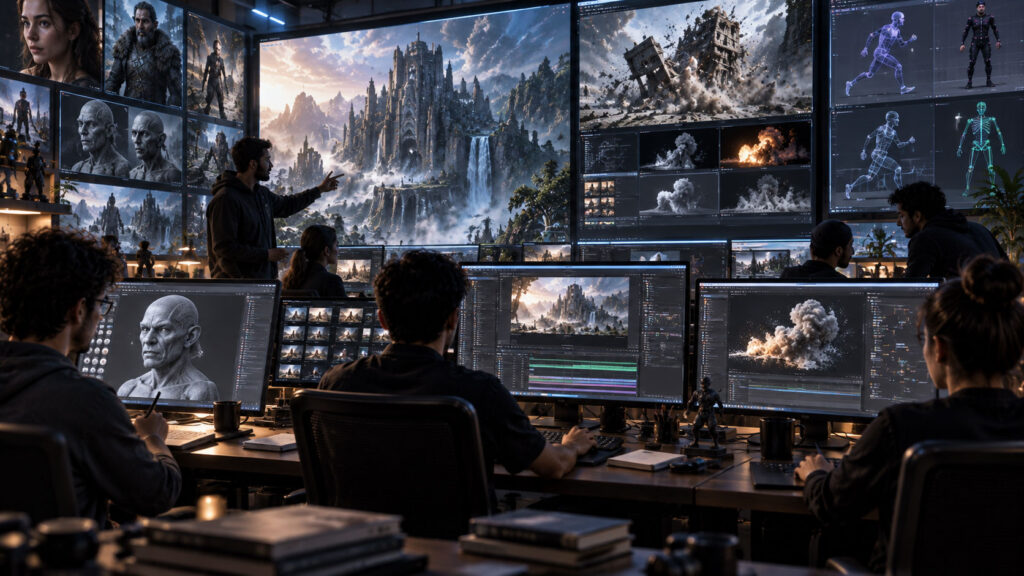
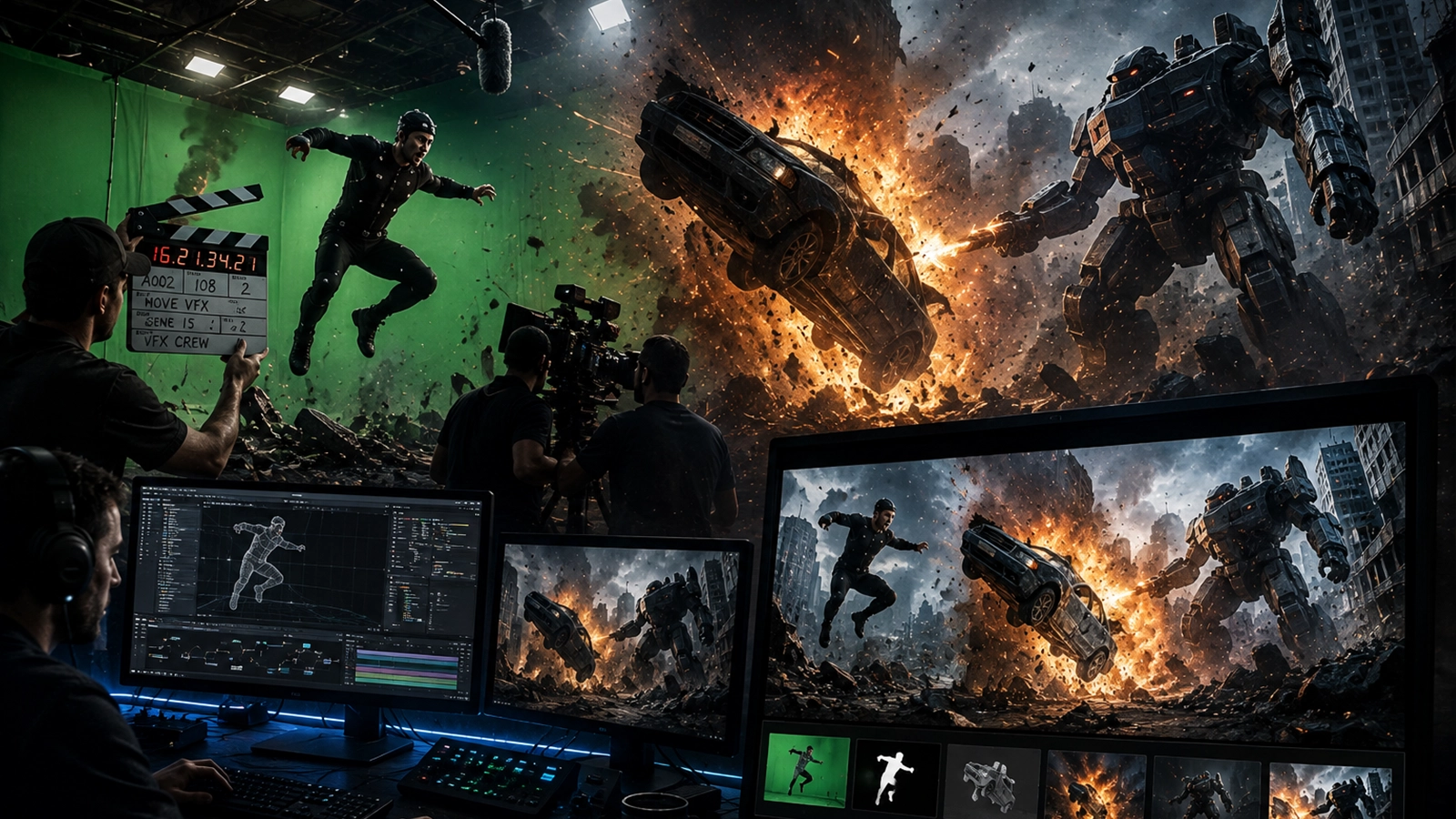
Virtual production is not only a visual workflow. Dialogue, ambience, spatial sound, interactive effects and music must remain synchronized with the digital world so the final scene feels like one coherent physical space.
- What virtual production audio changes
- Production audio fundamentals
- Dialogue capture
- ADR and replacement dialogue
- Spatial audio
- Dolby Atmos and object-based mixing
- Ambisonics and 360 environments
- Real-time sound
- Virtual set acoustics
- AI dialogue cleanup
- AI sound design
- Music integration
- Sync and timecode
- Monitoring and recording
- Common mistakes
- Complete Zgian virtual-production audio workflow
- Final audio QC
1. What virtual production audio changes
Virtual production audio must connect production dialogue, real-time environments, spatial sound and post-production without losing synchronization. The sound pipeline should be planned alongside camera, lighting and performance.
2. Production audio fundamentals
Capture clean dialogue and useful production ambience while keeping timecode, microphone metadata and take information consistent.
3. Dialogue capture
Dialogue remains the most important intelligibility element. Choose microphone placement, room strategy and monitoring based on the scene and physical set.
4. ADR and replacement dialogue
ADR can replace noisy or unusable production lines. Matching timing, performance, perspective and acoustic character keeps replacement dialogue believable.
5. Spatial audio
Spatial audio places sound in three-dimensional space, supporting immersion and helping connect digital environments to the viewer’s perspective.
6. Dolby Atmos and object-based mixing
Object-based workflows can describe sound elements independently of a fixed speaker layout, allowing the final mix to adapt to supported playback systems.
7. Ambisonics and 360 environments
Ambisonic workflows are useful for immersive environments and interactive experiences because the sound field can rotate with the listener or camera.
8. Real-time sound
Real-time sound can react to camera movement, character position, environment changes and virtual effects. Keep interactive logic predictable and controllable.
9. Virtual set acoustics
Digital environments need believable acoustic responses. Reverb, early reflections and environmental tone should change consistently with location and distance.
10. AI dialogue cleanup
AI-assisted noise reduction, dereverberation and dialogue isolation can improve difficult recordings, but aggressive processing can damage natural voice detail.
11. AI sound design
AI can generate sound ideas, variations and searchable audio concepts. Human sound designers should select, edit, synchronize and approve the final result.
12. Music integration
Music must support story and dialogue while leaving appropriate frequency and spatial space for important sound elements.
13. Sync and timecode
Audio, camera and virtual-production systems must share reliable timing. Good synchronization prevents drift and simplifies editorial and VFX workflows.
14. Monitoring and recording
Monitor the same signals that matter to production and maintain redundant recordings whenever possible. Verify levels, channels and metadata before moving on.
15. Common mistakes
Avoid relying on one microphone, inconsistent timecode, over-processing dialogue, ignoring room tone, mixing without picture context or accepting AI audio without artifact checks.
16. Complete Zgian virtual-production audio workflow
Plan the sound requirements, capture production dialogue and ambience, maintain timecode, build spatial and real-time sound behavior, use AI carefully for cleanup and design, integrate music, then complete the immersive and final mix.
17. Final audio QC
Check dialogue intelligibility, sync, noise, room tone, spatial placement, automation, loudness, phase, artifacts, deliverable channels and playback compatibility.
How this fits the Zgian VFX + AI pipeline
REAL-TIME COMPOSITING → Real-Time Compositing 7.0
PERFORMANCE CAPTURE → Performance Capture 8.0
VIRTUAL PRODUCTION AUDIO → this guide
Frequently asked questions
Why is audio important in virtual production?
Audio reinforces the physical and emotional reality of the digital environment and must stay synchronized with picture and performance.
What is spatial audio?
Spatial audio represents sound in three-dimensional space so position and movement can contribute to immersion.
What is Dolby Atmos?
It is an object-based immersive audio format and workflow that can represent sound elements independently of a fixed speaker layout.
Can AI clean dialogue?
AI can reduce noise or reverberation and isolate speech, but aggressive processing may introduce artifacts, so every result needs listening QC.
What is the most important audio QC?
Dialogue intelligibility, synchronization, noise, spatial placement, loudness, phase, artifacts and correct delivery channels are core checks.