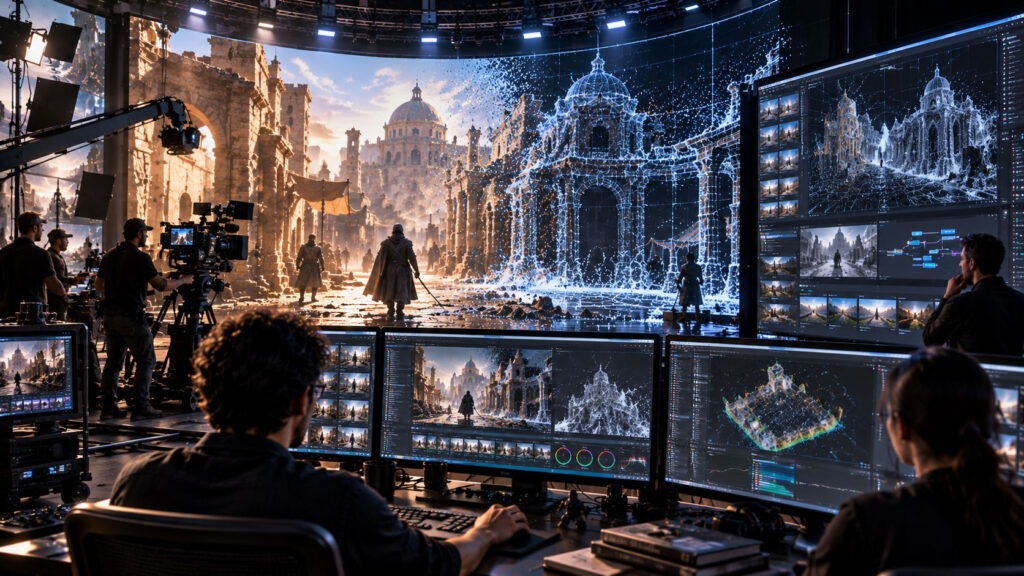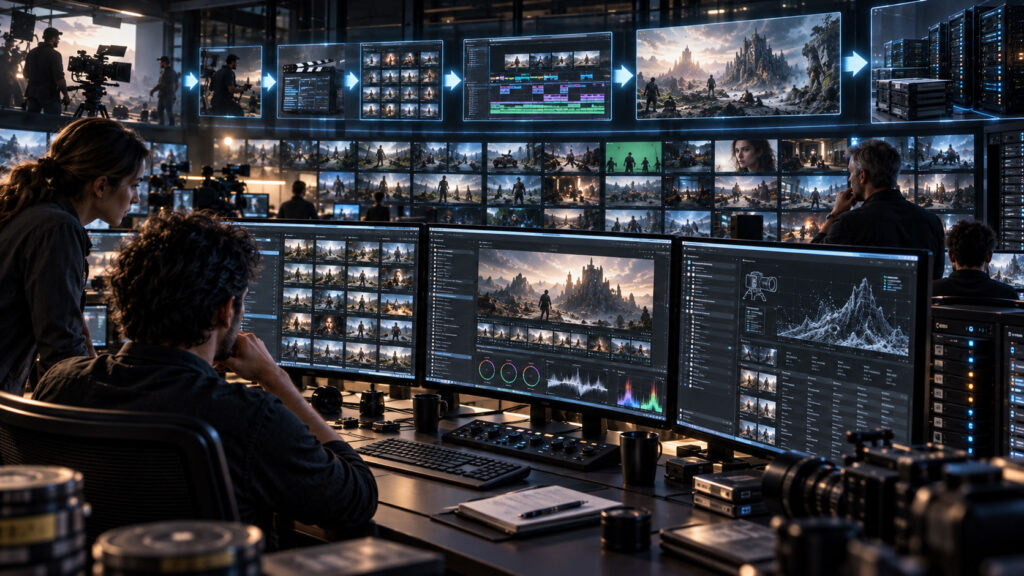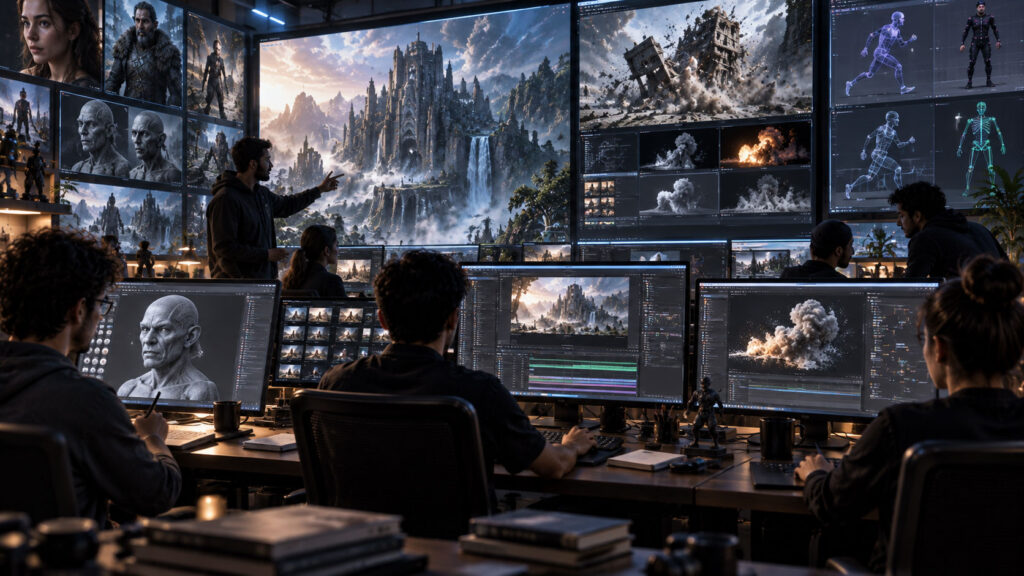

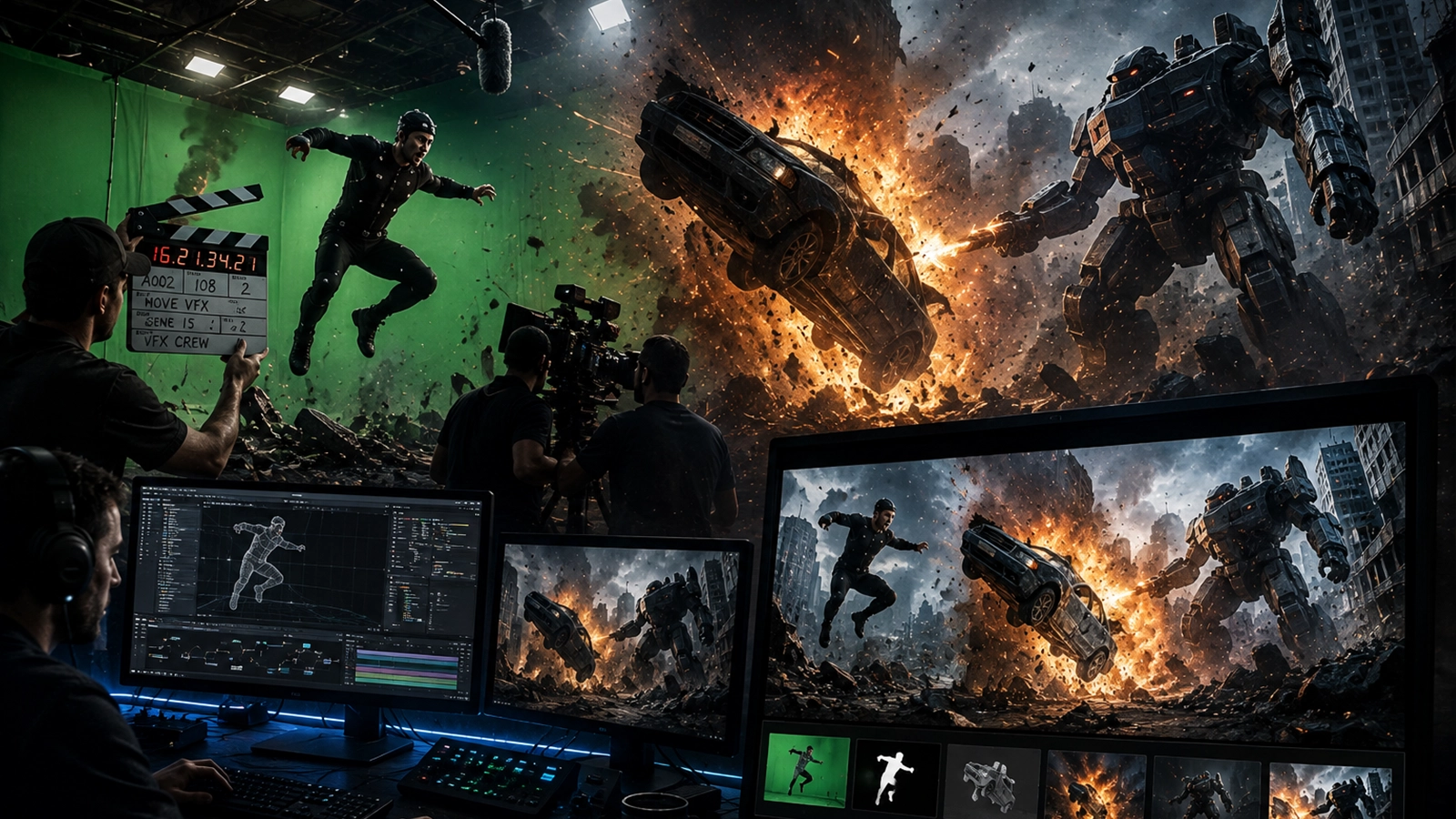
Real-time compositing connects photographed subjects with digital worlds while the crew can see the result immediately. The best workflow chooses the right capture method for each shot and keeps camera, tracking, color, depth and lighting synchronized.
- What real-time compositing changes
- Real-time compositing pipeline
- Keying fundamentals
- Green-screen workflow
- LED vs green screen
- Virtual set extensions
- Virtual backgrounds
- Camera tracking
- Depth compositing
- AI keying
- Live grade
- Hybrid VFX
- Reflection and transparency management
- Common mistakes
- Complete Zgian real-time compositing workflow
- Final Pixel QC
1. What real-time compositing changes
Real-time compositing combines live camera images with digital environments, keyed subjects, tracked backgrounds and interactive graphics while the production team can review the result immediately.
2. Real-time compositing pipeline
Build the composite as a predictable signal chain. Identify every input, transform, key, color conversion and output before shooting.
3. Keying fundamentals
Keying separates a foreground subject from a controlled background. Good lighting, clean edges and consistent color make the extraction easier.
4. Green-screen workflow
Green screen remains useful when the background must be replaced extensively in post or when an LED volume is impractical. The screen, lighting and camera need to be designed together.
5. LED vs green screen
LED and green screen solve different production problems. LED can provide photographed backgrounds and interactive light, while green screen offers flexible post-production separation.
GREEN: FLEXIBLE POST KEY + LARGE REPLACEMENT OPTIONS
6. Virtual set extensions
Set extensions add digital architecture, landscapes or distant environments beyond the physical stage. They work best when perspective, lighting and lens behavior are consistent.
7. Virtual backgrounds
A virtual background must respond correctly to camera position, lens and depth. Static images can work for locked shots; moving cameras need perspective-aware imagery.
8. Camera tracking
Tracking provides the transform information required to align virtual elements with the photographed camera.
9. Depth compositing
Depth allows foreground, subject and background elements to interact correctly. It is particularly useful for atmospheric effects, occlusion and complex set extensions.
10. AI keying
AI-assisted keying can help estimate mattes, hair detail and difficult edges. Always inspect the result at full resolution and through motion.
11. Live grade
The live image should remain visually consistent with the intended final look while preserving enough information for post-production.
12. Hybrid VFX
Many modern shots combine LED, green screen, practical elements and traditional CG. Divide the shot into responsibilities before production.
13. Reflection and transparency management
Reflective and transparent surfaces can expose weak composites. Plan their interaction with the background, lighting and keying strategy.
TRANSPARENCY → EDGE / MATTE RESPONSE
14. Common mistakes
Avoid poor screen lighting, inaccurate tracking, mismatched color, weak edge treatment, uncontrolled spill and trying to solve every problem with one technique.
15. Complete Zgian real-time compositing workflow
Define the shot, choose LED or keying strategy, calibrate camera and color, build the background, generate mattes and tracking, integrate depth and lighting, then record and QC the final pixel.
16. Final Pixel QC
Review edges, tracking, perspective, color, spill, reflections, depth order, motion and output integrity before a shot is approved.
How this fits the Zgian VFX + AI pipeline
VIRTUAL PRODUCTION → Virtual Production 2.0
VIRTUAL CINEMATOGRAPHY → Virtual Cinematography 4.0
REAL-TIME COMPOSITING → this guide
Frequently asked questions
When should I use LED instead of green screen?
LED is valuable when photographed environments, reflections and interactive light are important. Green screen is often preferable when extensive background replacement and post-production flexibility are the priority.
What makes a good key?
Even background lighting, appropriate exposure, separation from the screen and controlled edge treatment make the matte easier to produce.
Why is camera tracking important?
Tracking keeps virtual backgrounds and set extensions aligned with the real camera as it moves.
Can AI replace traditional keying?
AI can assist with difficult mattes, hair and edge estimation, but the result still needs motion, edge, color and compositing QC.
What is final-pixel QC?
It is the final review of the complete shot for edges, tracking, perspective, color, spill, reflections, depth, motion and output integrity.