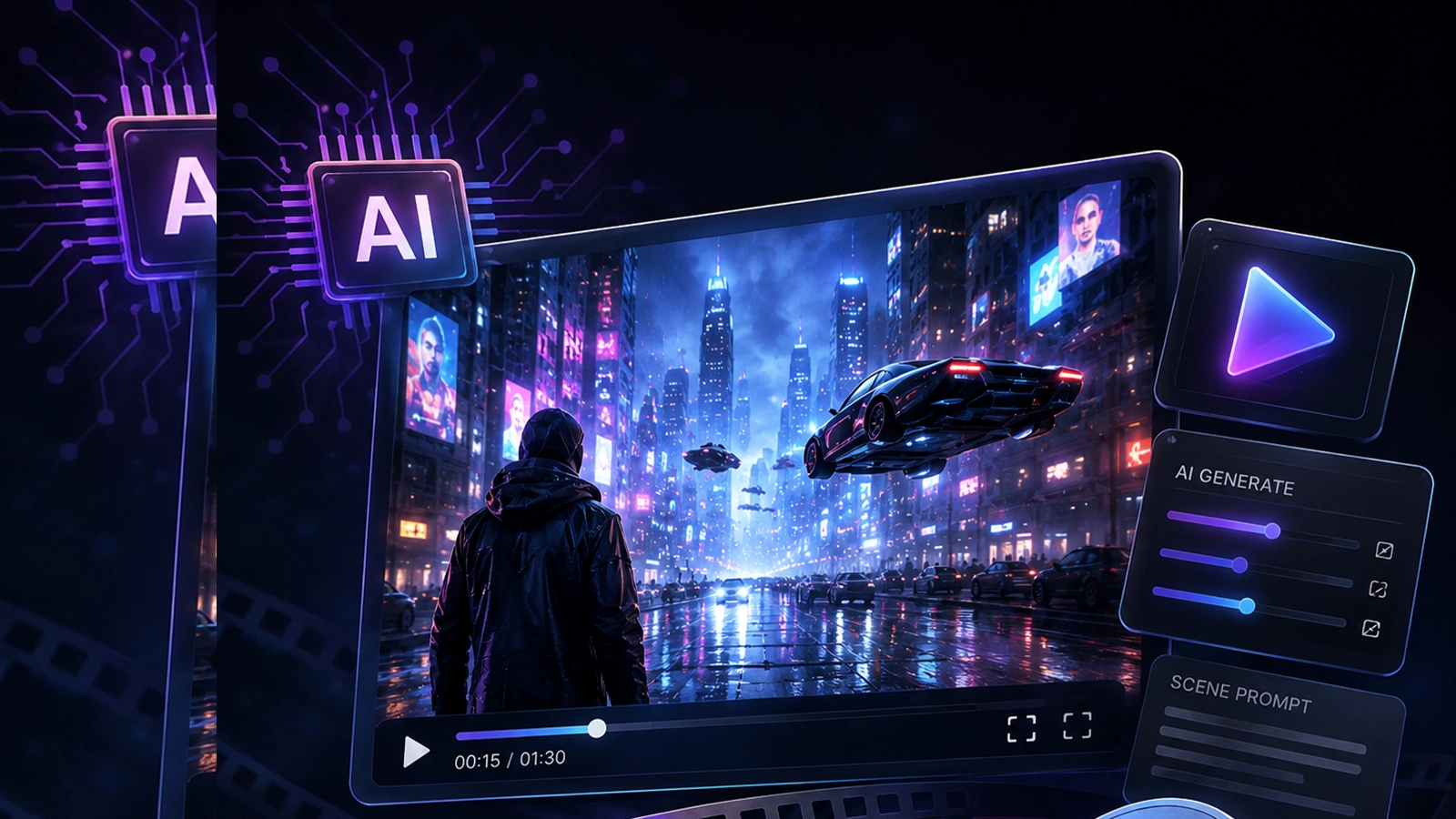

Camera tracking is the bridge between live-action footage and a controllable 3D scene. Learn how AI-assisted tracking works, what lens data matters, and how to validate a solve before using it in VFX.
By Wickrama Deegalla · August 23, 2026 · 16 min read
What does camera tracking do?
Camera tracking, matchmoving or camera solving estimates the movement and optical characteristics of a real camera so a 3D camera can reproduce the same perspective. This lets CG objects stay locked to live-action footage.
Step 1 — Prepare the footage
Good tracking starts with usable footage. Avoid unnecessary motion blur, extreme compression and frames where the image contains too few trackable features.
- Keep original resolution.
- Check frame rate and frame range.
- Identify rolling-shutter issues.
- Record lens information when possible.
- Keep the original plate untouched.
Step 2 — Solve the camera
AI-assisted systems can reduce manual tracking work by identifying image features and estimating camera motion. Flow Studio currently lists automatic camera tracking among its live-action-to-CG capabilities.
The result is not automatically correct. Compare the reconstructed camera against visible geometry and perspective.
Step 3 — Check lens and scale
A camera solve can look plausible while using the wrong focal length or scene scale. For production, camera position, lens characteristics and object scale need to agree.
| Check | Why it matters |
|---|---|
| Focal length | Controls perspective and field of view. |
| Sensor / filmback | Influences field of view calculations. |
| Camera height | Changes horizon/object relationships. |
| Scene scale | Affects believable motion and lighting. |
Step 4 — Validate the solve
Place simple 3D geometry into the scene and scrub through the shot. If geometry slides against the plate, investigate the solve before adding detailed assets.
Use three simple objects at different depths. A correct solve should preserve their relative parallax as the camera moves.
Step 5 — Use tracking in virtual production
Once the camera is reliable, it can drive CG characters, environments and virtual cameras. Flow Studio’s 3D Editor + Canvas also provides editable scene and camera controls for directable AI scenes.
Common camera-tracking problems
| Problem | Likely cause | Response |
|---|---|---|
| CG slides | Weak solve or wrong lens | Recheck features, lens and scale. |
| Horizon mismatch | Incorrect camera orientation | Recalibrate camera axes. |
| Jitter | Noisy tracking | Smooth or manually correct the solve. |
| Wrong perspective | Incorrect focal length | Verify lens metadata or solve parameters. |
| Drift | Long shot with weak features | Add constraints and stronger references. |
Frequently asked questions
What is AI camera tracking?
It is the use of machine-learning or automated vision systems to identify image features and estimate camera movement and scene information faster than fully manual tracking.
Is AI camera tracking accurate enough for VFX?
It can provide a strong starting solve, but production shots should still be validated with geometry, lens information and manual corrections where necessary.
Can camera tracking be used with virtual production?
Yes. A tracked camera can connect live-action photography with CG environments and characters, while virtual cameras use the same principles to maintain reproducible shot control.
Continue the Zgian series
Wickrama Deegalla
3D Generalist & VFX Professional · About the author →