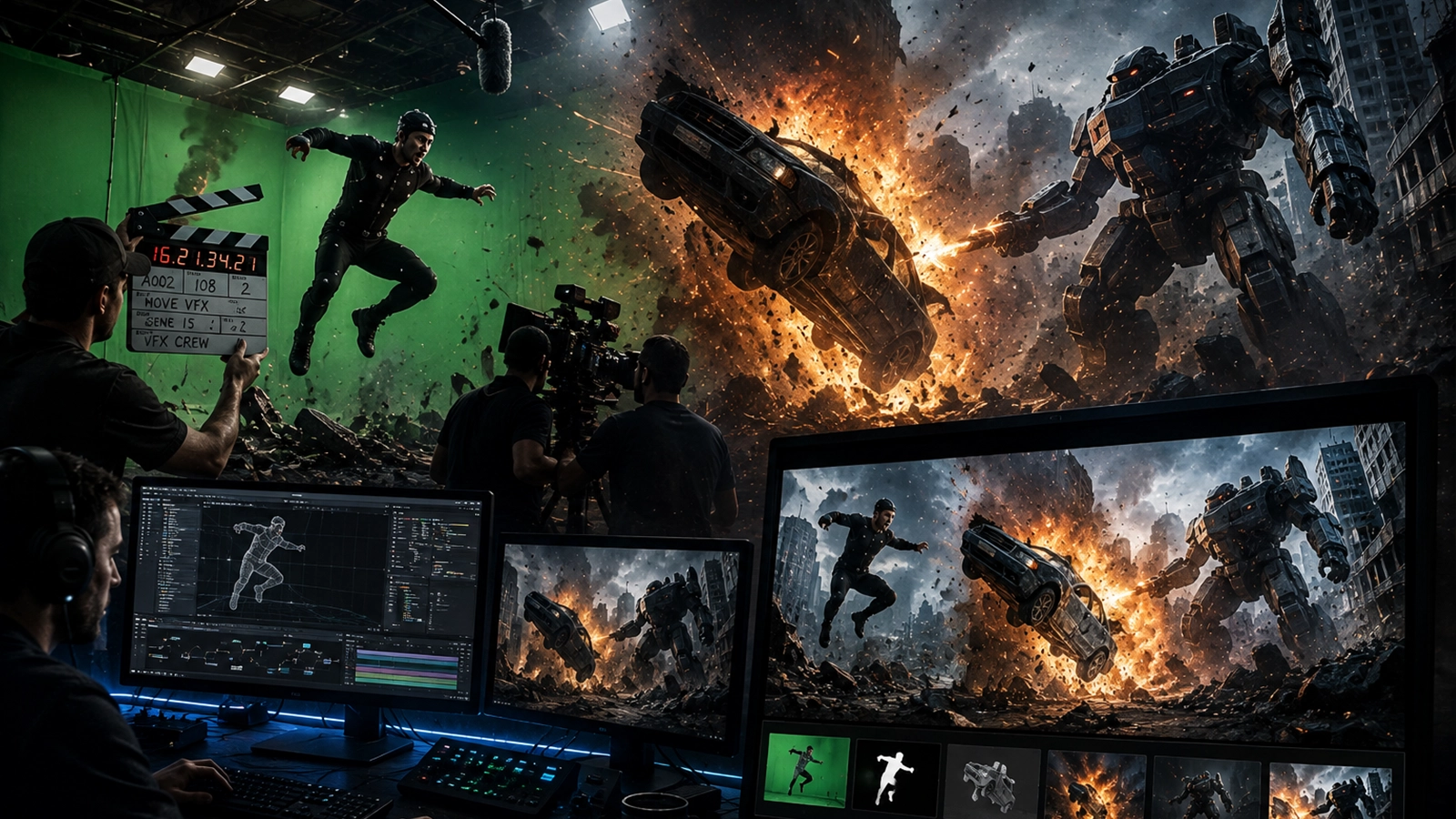
Rotoscoping is one of the quiet workhorses of visual effects: artists create precise masks that let a subject, object or part of a frame be separated, replaced or affected independently.
What does rotoscoping mean?
Rotoscoping is a VFX technique for isolating parts of an image with animated masks. An artist follows the outline of a person, prop, vehicle or other subject over time so that the chosen area can be treated separately.
The result is usually a matte: an image that tells the compositor which pixels belong to the selected subject and which do not.
Roto is often invisible in the finished movie, but it can determine whether a composite works. A small edge error repeated across hundreds of frames can become much more noticeable than the original VFX trick.
Why is rotoscoping important in VFX?
Not every shot has a clean green screen. Even when a green screen exists, hair, motion blur, transparent objects, shadows or difficult edges may require additional roto work.
Roto also has many uses beyond extracting a person from a background. Artists can isolate an actor’s face, a hand, a weapon, a window, a foreground object or a specific part of a set so another department can manipulate it independently.
What is a matte or mask?
A mask defines an area of an image. A simple black-and-white matte can be thought of as a visibility map: white represents the selected area, black represents the excluded area, and gray can represent partial transparency.
In real VFX work, masks can be combined, feathered and animated, and different mattes can be created for different parts of a subject.
How does rotoscoping work?
A typical roto task can be broken into stages:
Study movement and edges
Create masks around the subject
Adjust shapes as the subject moves
Check edges and motion frame by frame
Start with simple shapes
Artists generally avoid making one enormous, complicated mask when several simpler shapes can produce better control. A body, arm, head and prop might each receive separate shapes.
Track where possible
Tracking can reduce repetitive work by helping a mask follow predictable movement. But tracking is not a replacement for artistic supervision.
Adjust through the shot
As the subject changes direction, bends, overlaps another object or becomes partially hidden, the artist changes the mask’s position and shape.
Refine the edge
Feathering, edge softness and motion blur have to match the original photography. A mathematically perfect hard edge can look less realistic than a carefully softened one.
What makes rotoscoping difficult?
- Fast movement: Motion blur can make the true edge ambiguous.
- Hair: Fine strands rarely behave like a simple solid shape.
- Transparency: Glass, smoke and thin fabric may require special treatment.
- Occlusion: A subject can pass behind another object and reappear later.
- Changing silhouettes: Running, fighting and bending can change a shape dramatically.
- Large frame counts: Small corrections multiply across long shots.
Rotoscoping vs green-screen keying
Keying and rotoscoping can achieve related goals, but they work differently. A keyer separates pixels based primarily on image characteristics such as color. Roto uses manually or semi-automatically animated shapes to define the desired region.
In production, the two techniques are often used together. A clean key may handle the main subject while roto fixes problem areas, holds difficult edges or separates foreground elements.
How does roto connect to compositing?
Roto is closely connected to compositing because mattes determine where a compositor can make changes.
Original plate
Subject matte
Digital element
Combine layers
Finished shot
For example, a compositor may need to place a digital object behind an actor’s hand. A precise matte for the hand can determine exactly where the CG object disappears and where the live-action hand remains visible.
The best roto is designed for the next stage of the pipeline. The question is not just “Can I draw around this person?” but “What does the compositor need this matte to accomplish?”
What tools are used for rotoscoping?
Rotoscoping can be performed in dedicated compositing and VFX applications. Modern tools increasingly include tracking, spline assistance and machine-learning features that can reduce repetitive work.
Even with automation, artists still need to inspect edges, correct failures and make judgment calls about motion blur, overlaps and transparency.
What is the future of rotoscoping?
Machine learning is making subject segmentation and object tracking faster. This can turn some tasks that once required extensive manual work into a supervised workflow.
However, difficult shots still contain ambiguity. Hair, motion blur, transparent objects and complex overlaps can challenge automated systems. The likely future is a hybrid workflow in which software produces a starting point and artists refine the result.
Frequently asked questions
What is rotoscoping in VFX?
Rotoscoping is the process of creating and animating masks to isolate subjects or objects in footage.
Is rotoscoping the same as green screen?
No. Green-screen keying separates pixels primarily by color, while roto uses animated masks. Both can be combined in a VFX shot.
Why is rotoscoping difficult?
Subjects move, change shape, become occluded and may have hair, motion blur or transparency, making precise edges difficult to define.
Is rotoscoping still used with AI?
Yes. AI can accelerate segmentation and tracking, but artists are still needed to review and refine difficult results.
3D Generalist & VFX Professional · About the author →