In this guide
What does VFX mean?
VFX stands for visual effects. In filmmaking, it describes the techniques used to create or manipulate imagery that cannot be captured in its final form through ordinary photography alone.
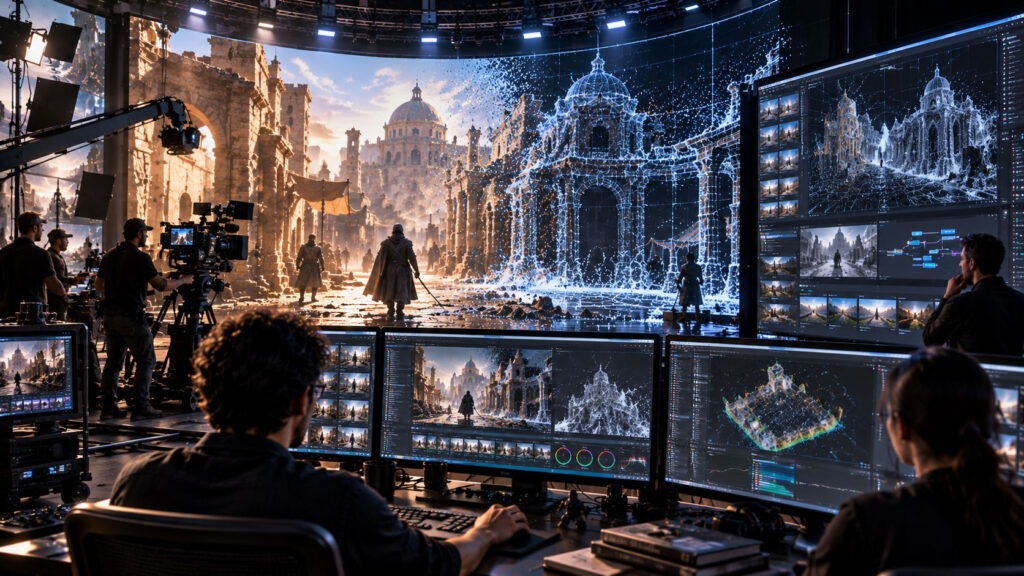
A VFX shot might start with a real actor on a real set. Artists can then remove unwanted objects, replace a sky, extend the set, add a digital character, simulate smoke or destruction, or combine several different elements into one finished image.
The most useful way to think about VFX is not simply “computer graphics.” A finished visual-effects shot is often a combination of real photography, digital imagery and careful compositing. The computer is a tool; the goal is believable storytelling.
How does VFX work?
Most visual-effects work begins with a plan. Before filming, the production team decides which parts of a shot will be captured practically and which parts will be created or changed digitally.
During production, artists and technicians may capture tracking information, reference images, HDR lighting information, clean plates, green-screen footage and other data. After filming, artists use those materials to build the final shot.
What are the main types of VFX?
Compositing
Compositing combines multiple visual elements into a single image. A foreground actor, a digital background, atmospheric effects and color adjustments can all become part of the same shot.
CGI and 3D
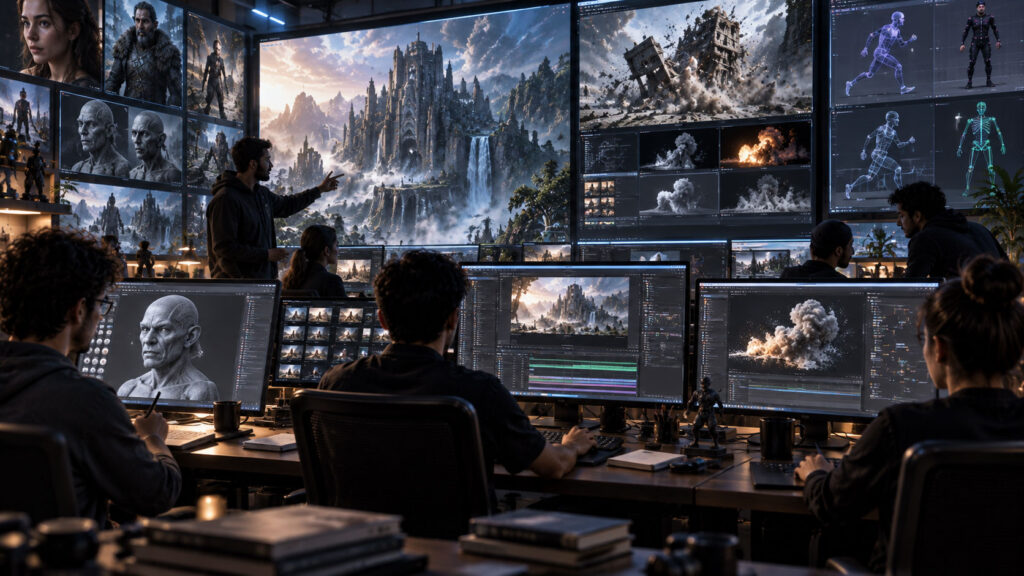
Computer-generated imagery can create objects, characters, environments and effects that do not exist physically. A 3D asset can be modeled, textured, rigged, animated, lit and rendered before being composited into the shot.
Rotoscoping
Rotoscoping isolates people or objects from their backgrounds by creating detailed masks or mattes. It is often used when a simple green screen is unavailable or insufficient.
Motion tracking
Tracking analyzes movement in footage so digital elements can follow the camera or an object accurately. This is fundamental to believable screen replacements, set extensions and CG integration.
Simulations
Digital simulations can reproduce complex physical behavior such as smoke, fire, water, cloth, particles and destruction. Artists tune these systems to achieve the visual result required by the story.
The VFX production pipeline
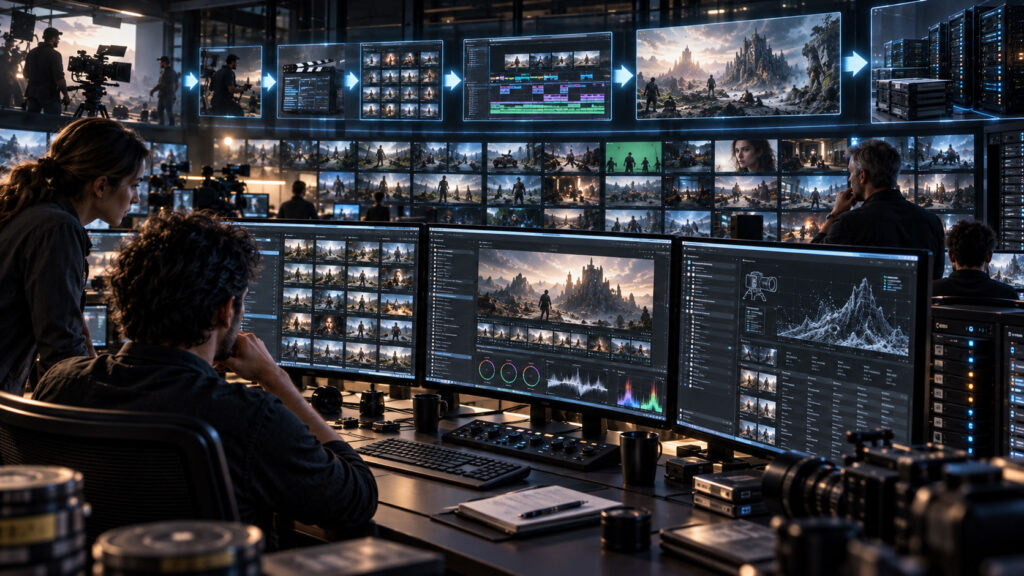
Every production is different, but a simplified pipeline often looks like this:
Planning: The team decides how the effect will be achieved and what needs to be captured on set.
Capture: Cameras record the live-action material and supporting reference data.
Assets: Artists create or prepare models, textures, mattes, simulations and other digital elements.
Compositing: The elements are integrated into the live-action plate, with attention to lighting, color, perspective, depth and motion.
Review and final: Shots pass through creative and technical reviews before final delivery.
VFX vs CGI: What’s the difference?
CGI is one part of the wider VFX toolbox. CGI refers specifically to imagery generated by computer. VFX is the broader process of creating or manipulating visual imagery for the finished shot.
For example, a creature might be created with CGI, but the final movie shot may also require live-action photography, camera tracking, rotoscoping, lighting integration, atmospheric effects and compositing. All of those steps contribute to the VFX result.
See our deeper comparison: VFX vs CGI: What’s the Difference?
How do green screen and compositing fit into VFX?
A green screen provides a relatively clean color range that can be separated from the foreground subject. The resulting matte allows artists to place the actor in a different environment.
But green screen is only one technique. Modern VFX frequently combines practical photography, digital environments, 3D assets, rotoscoping and compositing. Good work is usually designed so that the viewer notices the story rather than the technique.
What software do VFX artists use?
The software depends on the role and production. A modern pipeline can involve applications for compositing, 3D modeling and animation, simulations, editing, color, tracking and specialized tasks.
- 3D: modeling, animation, lighting and rendering.
- Compositing: combining footage and digital elements.
- Tracking: analyzing camera and object movement.
- Simulation: creating particles, fluids, smoke and destruction.
- Editing and finishing: assembling and preparing the final sequence.
Zgian will build dedicated software comparisons as the site grows, including beginner-friendly and professional workflows.
What is the future of VFX?
VFX is increasingly connected to real-time rendering, virtual production, procedural workflows and generative AI. These technologies can accelerate parts of the creative process, but they do not remove the need for artistic judgment, cinematography, storytelling and technical supervision.
The interesting question is not simply whether AI will “replace VFX.” The more useful question is which parts of the pipeline AI can accelerate, which still require human control, and how artists can combine the two effectively.
Frequently asked questions
What does VFX stand for?
VFX stands for visual effects.
Is CGI the same as VFX?
No. CGI is computer-generated imagery, while VFX is the broader process of creating or manipulating visual elements for a finished shot.
Is green screen VFX?
Yes. Green-screen compositing is a common VFX technique, although it is only one part of a much larger visual-effects workflow.
Do all movies use VFX?
Many modern films use some form of visual effects, including invisible cleanup and environment work that audiences may never notice.
3D Generalist & VFX Professional · About the author →