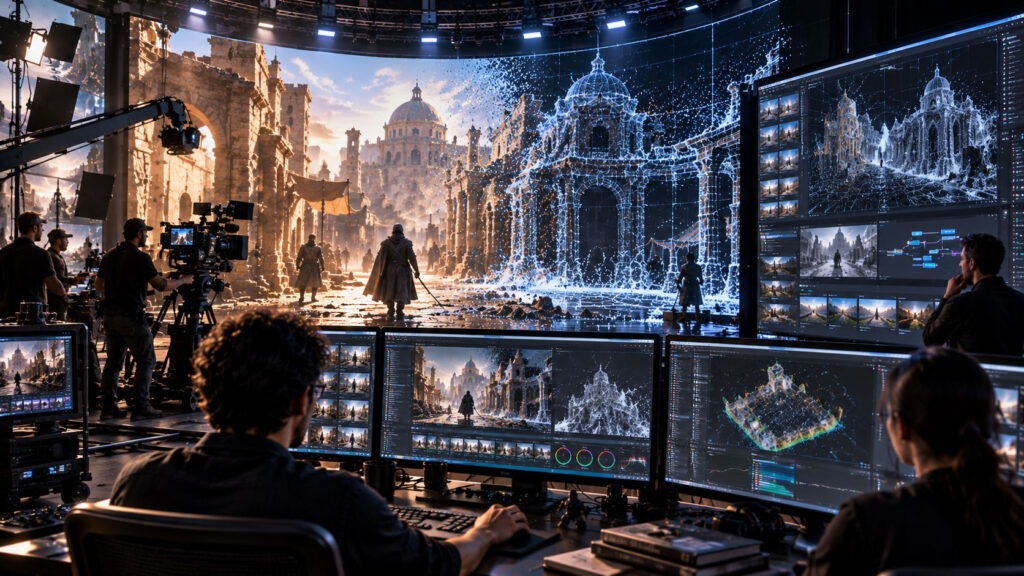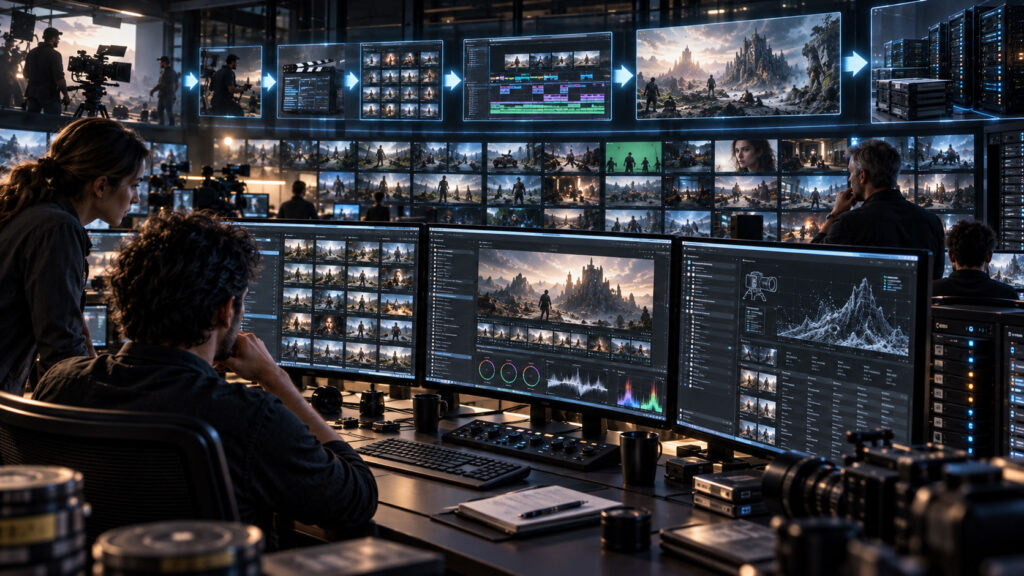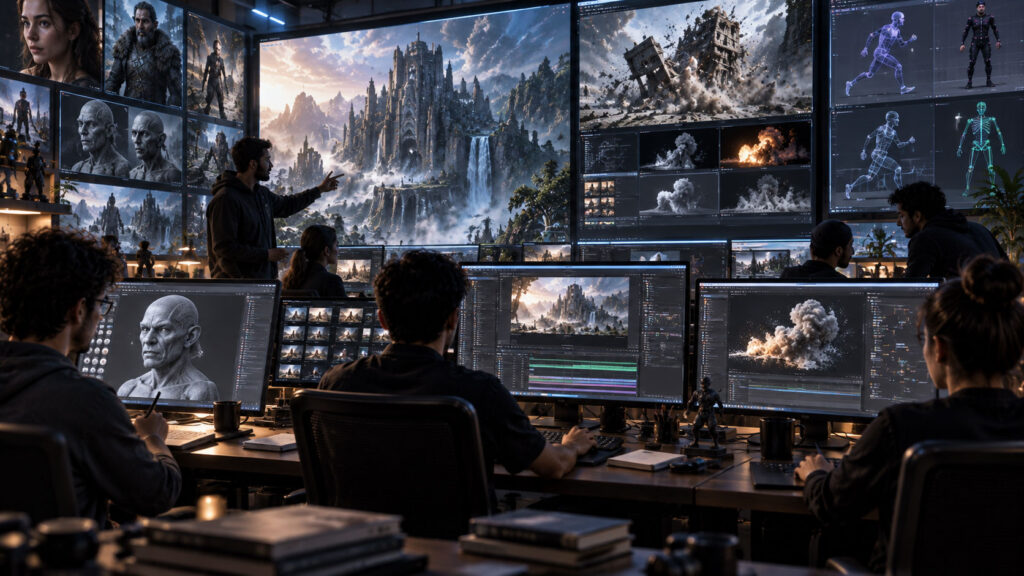
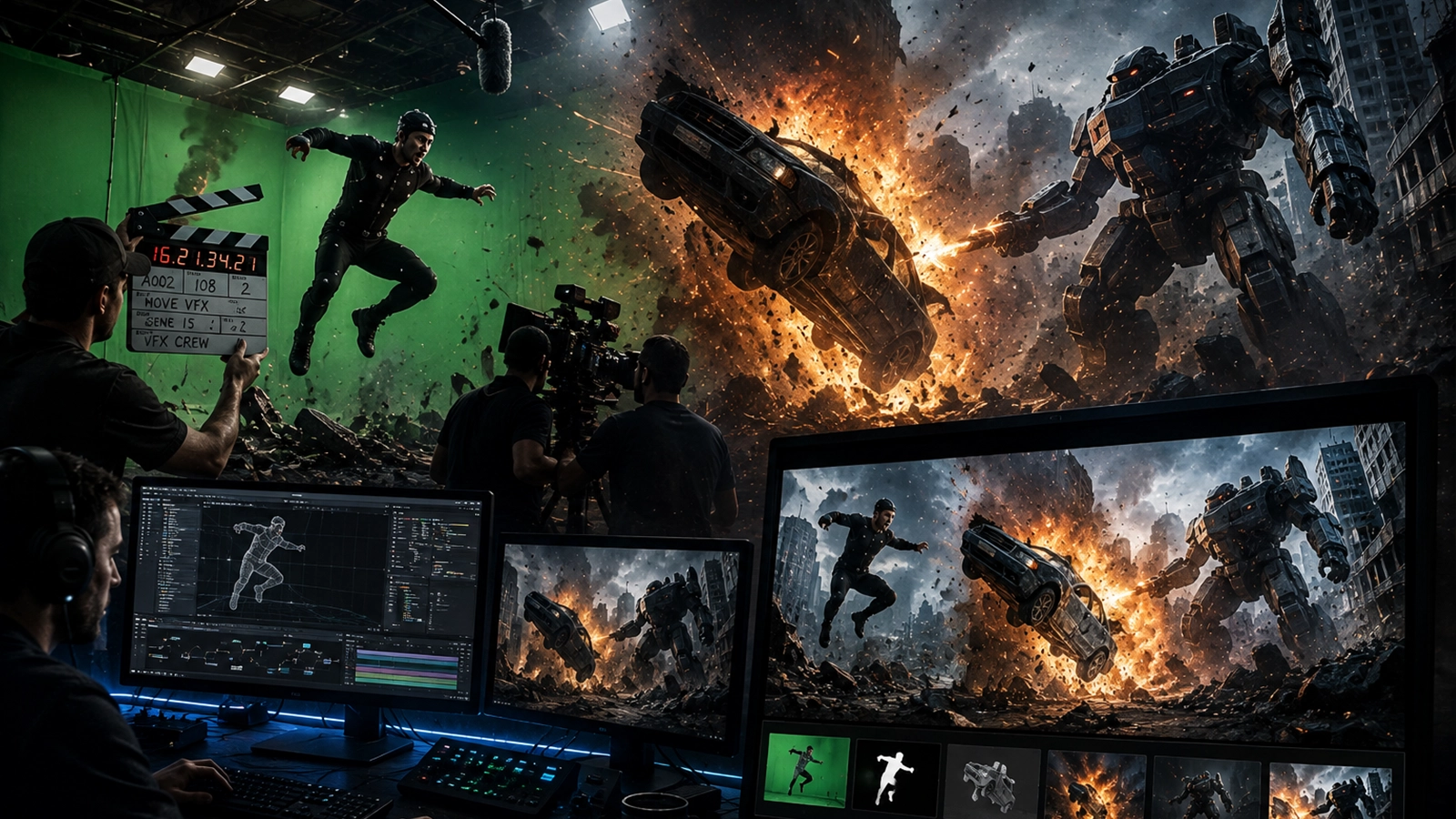
AI can accelerate cleanup, masking, object removal and image manipulation, but believable compositing still depends on tracking, light, color, depth and human judgement.
What is AI compositing?
Compositing is the process of combining visual elements into a single believable image. A typical VFX composite can contain live-action plates, mattes, CG renders, shadows, atmospheric effects, background replacements, paint fixes and color adjustments.
AI adds automation to selected parts of that process. Instead of replacing the composite itself, it can help create masks, remove objects, generate or repair pixels, analyze motion, and accelerate repetitive corrections.
The AI compositing pipeline
| Stage | AI can help with | Artist remains responsible for |
|---|---|---|
| Plate preparation | Cleanup and enhancement | Source quality and color management |
| Matting | Subject segmentation | Edge quality and temporal consistency |
| Tracking | Feature/object analysis | Camera/track validation |
| Cleanup | Object removal and pixel reconstruction | Reference quality and continuity |
| CG integration | Image manipulation and variations | Perspective, light and physical relationships |
| Final comp | Assisted corrections | Shot-wide consistency and approval |
1. AI masking and mattes
A clean matte is the foundation of many composites. Current AI-assisted workflows can identify subjects and propagate selections across frames. Our AI rotoscoping guide covers this in detail.
Fusion 21 also includes planar tracked roto, Bezier and B-spline masks, paint-based masks, Roto Assist and controllable motion blur.
The key principle is simple: a fast matte is useful only if it survives the whole shot.
2. AI object removal and cleanup
Object removal is one of the most useful AI-assisted compositing tasks. The goal is to remove an unwanted person, rig, logo, cable, tracking marker or other object while reconstructing believable background pixels.
Before using AI cleanup
- Check whether the object is moving.
- Look for clean background reference frames.
- Track the problem area if the camera moves.
- Check reflections and shadows left behind.
AI reconstruction can produce a convincing local patch, but it may not understand the physical continuity of a long shot. Always review the result over time.
3. Tracking and stabilization
Compositing becomes much easier when every inserted element follows the plate correctly. Tracking can provide motion data for masks, paint strokes, effects and CG.
Fusion’s current feature set includes fast motion tracking for matchmoving, stabilization and tracking roto points or paint strokes.
For AI-assisted camera solving, see our AI camera tracking guide.
4. AI relighting and image manipulation
AI image manipulation can help artists explore lighting changes, clean-up options and visual variations. But relighting a subject convincingly requires the new light to agree with highlights, shadows, reflections and the environment.
Do not treat generated pixels as final truth. If a change affects a hero element, compare it against the plate, CG lighting and surrounding pixels.
5. Integrating CG into live action
This is where compositing becomes more than placing one image over another. A CG object needs the correct camera perspective, scale, depth, lighting, shadow, reflection, motion blur and grain.
↓
CG MODEL → LIGHTING → RENDER PASSES
↓
MATTES / DEPTH / SHADOWS
↓
COMPOSITOR
↓
LIVE-ACTION PLATE → FINAL SHOT
Fusion supports true 3D compositing with models, cameras and lights, plus deep-pixel workflows using OpenEXR position information.
6. Color and exposure matching
Even a perfect matte and track can look fake if the inserted element has the wrong exposure or color. Match the CG or generated element to the plate before adding final stylization.
| Check | Question |
|---|---|
| Exposure | Is the CG brightness consistent with the plate? |
| White balance | Does the color temperature match? |
| Contrast | Are blacks and highlights behaving similarly? |
| Grain | Does the inserted element have the same texture? |
| Sharpness | Does it have the same lens/scale softness? |
Fusion includes color correction and color matching tools alongside its compositing workflow.
7. Depth, atmosphere and realism
One of the easiest ways to improve a composite is to reproduce the depth cues already present in the plate.
- Foreground elements should often be sharper or more contrasty.
- Distant elements may need atmospheric perspective.
- Shadows should respond to surfaces.
- Objects should inherit environmental color.
- Motion blur should match the camera movement.
- Lens effects should be applied consistently.
Fusion supports 3D compositing, particles, optical flow and deep-pixel workflows that can help construct these relationships.
8. AI compositing vs traditional compositing
| AI-assisted | Traditional | Best combined use |
|---|---|---|
| Fast mask generation | Precise roto | AI first pass + artist cleanup |
| Generative object removal | Paint/clone/patch | AI reconstruction + tracked cleanup |
| Rapid image variations | Controlled layers | AI exploration + final layered comp |
| Automated analysis | Manual tracking controls | AI solve + technical validation |
| Generated pixels | CG renders and passes | Use whichever gives better control |
Example: replacing a background
- Prepare the original plate.
- Create a clean subject matte.
- Track the camera if required.
- Prepare the replacement environment.
- Match perspective and scale.
- Place the subject in the new environment.
- Add contact shadows and atmosphere.
- Match exposure and color.
- Apply consistent grain and lens treatment.
- Review the entire sequence.
The AI tools can accelerate several steps, but the final composite is judged as one continuous shot.
Final AI compositing QC checklist
- Does the matte remain stable?
- Does the inserted element stay locked to the camera?
- Are edges free from halos?
- Are shadows physically believable?
- Do reflections agree with the environment?
- Is color and exposure matched?
- Does motion blur match?
- Is grain consistent?
- Are generated areas temporally stable?
- Does the composite still look correct at normal playback speed?
A composite is successful when the viewer stops noticing the layers. AI can make individual operations faster; the compositor’s job is to make the final image feel like it was photographed together.
How this fits the Zgian VFX cluster
AI TRACKING → Camera Tracking Guide
AI VFX → AI VFX Film Workflow
AI VS VFX → AI Video vs Traditional VFX
Frequently asked questions
What is AI compositing?
AI compositing is the use of machine-learning or generative tools to accelerate parts of the VFX compositing process, such as masking, cleanup, tracking, object removal and image manipulation.
Can AI replace a compositor?
AI can automate individual tasks, but final compositing still requires decisions about continuity, depth, color, lighting, edges and integration. A hybrid workflow is more practical for complex shots.
What is the best software for AI compositing?
There is no single best choice. After Effects provides AI-assisted workflows, while Fusion provides a broad node-based 2D/3D compositing environment with tracking, roto, keying, paint and 3D tools.
Is AI good for object removal?
It can be very effective for initial reconstruction, especially when clean background information is available. Long moving shots still need temporal review and manual correction.
Should I learn traditional compositing if I use AI?
Yes. Understanding masks, alpha, tracking, color, light, depth, blend modes and compositing structure makes AI-assisted results much easier to evaluate and fix.
Continue the Zgian VFX series
3D Generalist & VFX Professional · About the author →