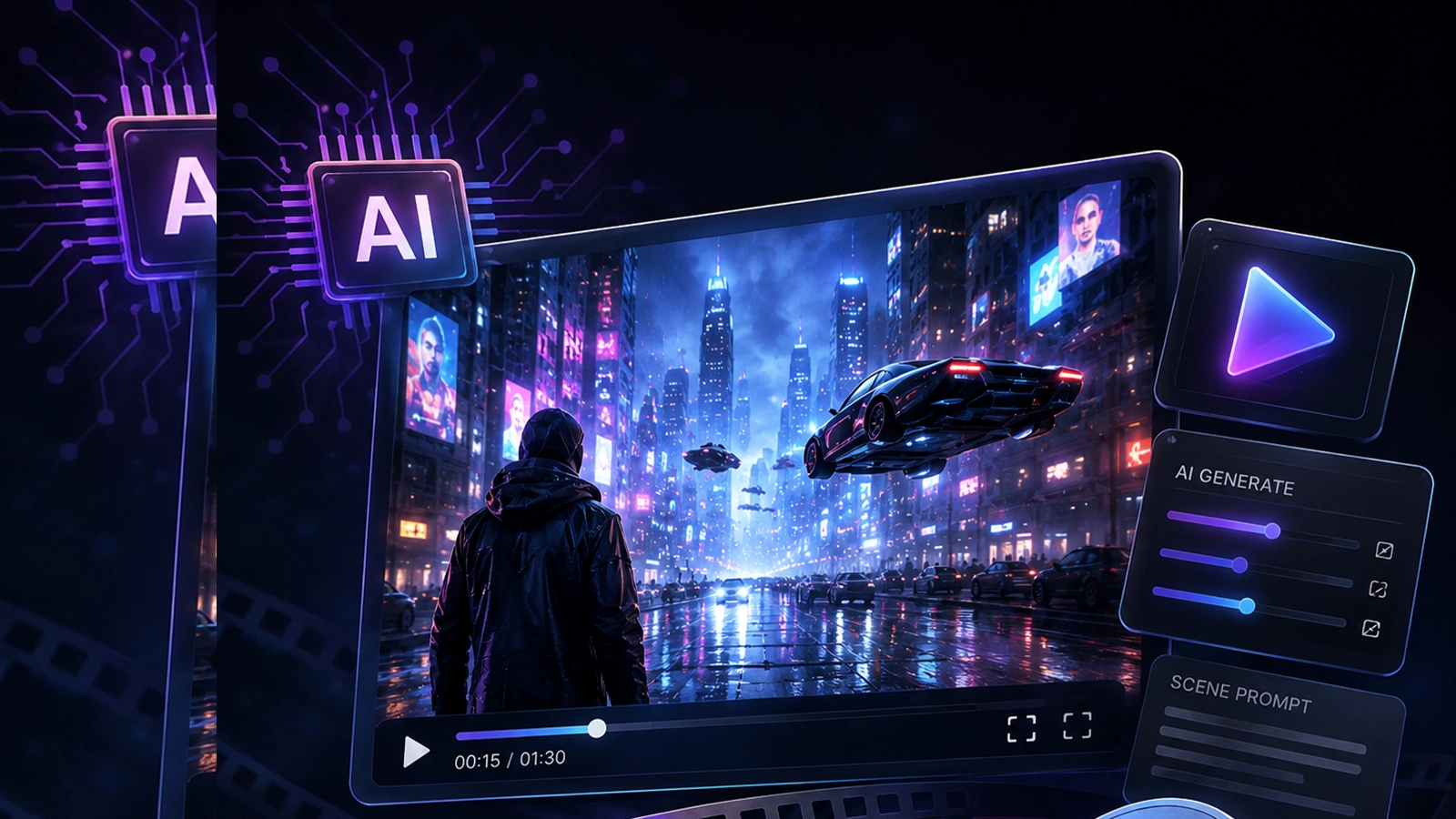

AI video is changing how VFX artists create, track, animate and composite shots—but it is not simply replacing the traditional pipeline. Here is where the real changes are happening.
The fundamental difference
Traditional VFX is built around controllable assets and repeatable operations. A compositor can adjust a mask, a 3D artist can change a model, an animator can change a pose, and a tracking artist can refine a camera solve.
Generative AI works differently. It can produce a plausible result extremely quickly, but the internal representation may not be as controllable unless the tool exposes editable masks, geometry, cameras, layers or motion data.
Speed is not the same as control. The future of VFX is likely to combine AI’s speed with the traditional pipeline’s editability.
AI video vs traditional VFX
| Task | AI-assisted workflow | Traditional workflow | Best approach |
|---|---|---|---|
| Rotoscoping | Fast subject segmentation and propagation | Precise manual masks and edge work | AI start + artist cleanup |
| Tracking | Fast automated feature/scene analysis | Manual tracks and solver control | AI solve + validation |
| Compositing | Generative cleanup and image manipulation | Layered, deterministic comp | Hybrid |
| 3D assets | Rapid model/concept generation | Designed, optimized production assets | AI base + artist refinement |
| Animation | Motion capture and generated motion | Keyframe/hand animation | Mocap + keyframe polish |
| Previs | Very rapid visual exploration | Slower but controllable scene building | AI previs → 3D scene |
| Final hero shots | Fast exploration but consistency risk | High control and repeatability | Traditional/hybrid |
1. Rotoscoping: one of AI’s clearest wins
Rotoscoping is repetitive because the artist may need to maintain a matte over hundreds or thousands of frames. AI segmentation can provide an initial mask and propagate it through the shot.
But difficult hair, motion blur, transparent objects, reflections, smoke and fast overlaps still require judgement and cleanup.
See our AI roto tools guide and VFX hub.
2. Tracking and matchmoving
AI-assisted tracking can identify visual features and estimate camera or object motion quickly. Current Flow Studio workflows include automatic camera tracking and live-action-to-CG scene reconstruction.
The important professional step is validation. A camera that looks approximately correct may still produce sliding CG if the lens, scale or solve is wrong.
Read our AI camera tracking guide for the full workflow.
3. Compositing: AI becomes an assistant
AI can accelerate cleanup, object removal, relighting, masking and image generation, but compositing remains fundamentally about controlling layers and relationships between elements.
↓
FINAL COMPOSITE
A useful workflow is to let AI perform the first pass, then bring the result into a traditional compositing environment for precise adjustments.
4. CGI and 3D: generation is not production
AI can create 3D models much faster than traditional modeling from scratch. But production assets also need sensible topology, UVs, textures, scale, rigging and predictable deformation.
Our CGI & 3D section explains the traditional pipeline, while our AI 3D tools guide covers the acceleration layer.
5. Animation and motion capture
AI-assisted markerless mocap has become particularly useful because artists can extract body, face and hand motion from video without traditional motion-capture hardware in many situations.
Flow Studio currently supports facial, body and hand capture, while its AI rigging workflow can turn generated characters into animation-ready assets.
But raw mocap still needs animation judgement. Foot contact, acting, timing, weight and hand interaction often benefit from manual correction.
Continue with our AI character animation workflow.
6. Virtual production: AI becomes a pipeline accelerator
Virtual production is an excellent example of why “AI vs traditional” is the wrong question. AI can accelerate characters, environments, previs and tracking, while real-time tools provide the controllable scene, camera and lighting.
↓
REAL-TIME SCENE → LIVE ACTION / LED → VFX FINISH
Flow Studio’s 2026 3D Editor + Canvas update is an example of this scene-first direction: characters, worlds, animations and cameras can be brought together into an editable scene.
Read our AI virtual production workflow and AI virtual production tools guide.
Why VFX artists still matter
Professional VFX is not simply the ability to produce a visually impressive frame. It is the ability to reproduce a creative decision across an entire sequence.
- Continuity: characters and environments must remain consistent.
- Art direction: the result must match the director’s intent.
- Technical control: cameras, mattes, geometry and passes must be editable.
- Shot integration: lighting, shadows, grain and motion blur must match.
- Problem solving: artists must know why an image is wrong, not just generate another one.
The hybrid AI + traditional VFX workflow
↓
2. AI PREVIS / EXPLORATION
↓
3. AI ROTO / TRACK / ASSET / MOCAP
↓
4. ARTIST VALIDATES + REBUILDS WHERE NEEDED
↓
5. TRADITIONAL 3D / ANIMATION / COMPOSITING
↓
6. AI ASSISTS WITH CLEANUP / VARIATIONS
↓
7. ARTIST FINAL QC
↓
8. DELIVERY
The new VFX skillset
| Old emphasis | New emphasis |
|---|---|
| Knowing one tool deeply | Understanding the entire pipeline and choosing the right AI tool for each stage |
| Manual repetition | Supervising automated first passes |
| Single software workflow | Interoperability and data movement |
| Only final image quality | Quality + consistency + editability |
What changes next?
The most important direction is the move from isolated AI generation toward controllable AI production systems.
Instead of asking an AI to make a finished shot, artists increasingly want to say:
- Keep this character.
- Keep this camera.
- Keep this environment.
- Change only the lighting.
- Change only the performance.
- Render another angle.
That is much closer to how professional VFX already works.
The biggest winners will not be “AI-only” artists or “traditional-only” artists. They will be artists who understand cinematography + 3D + VFX + AI + production constraints as one connected system.
What should filmmakers learn now?
- Understand the traditional VFX pipeline.
- Learn AI-assisted roto and tracking.
- Learn AI 3D generation and cleanup.
- Understand mocap and animation retargeting.
- Learn camera tracking and virtual production.
- Keep strong compositing skills.
- Learn how to evaluate AI output rather than blindly accept it.
Frequently asked questions
Is AI replacing traditional VFX?
AI is automating and accelerating parts of the VFX workflow, but it is not replacing the need for artists to control continuity, design, animation, compositing and final quality.
Will VFX artists lose their jobs because of AI?
The role is changing. Repetitive tasks may require less manual labor, while supervision, art direction, technical problem solving and AI-assisted workflows become more valuable.
Is AI video good enough for Hollywood VFX?
Some AI techniques are useful in professional pipelines, particularly for exploration, cleanup, tracking, roto, previs and asset generation. Final hero shots still benefit from controlled, editable production workflows.
Should I learn AI or traditional VFX first?
Learn the traditional fundamentals first, then use AI to accelerate them. Understanding cameras, light, animation, compositing and 3D makes it much easier to judge whether an AI result is actually correct.
What is the best future-proof VFX skill?
Pipeline thinking. The ability to move from a creative brief to camera, 3D, animation, AI assistance, compositing and final delivery is more durable than dependence on a single tool.
Continue the Zgian AI + VFX series
3D Generalist & VFX Professional · About the author →