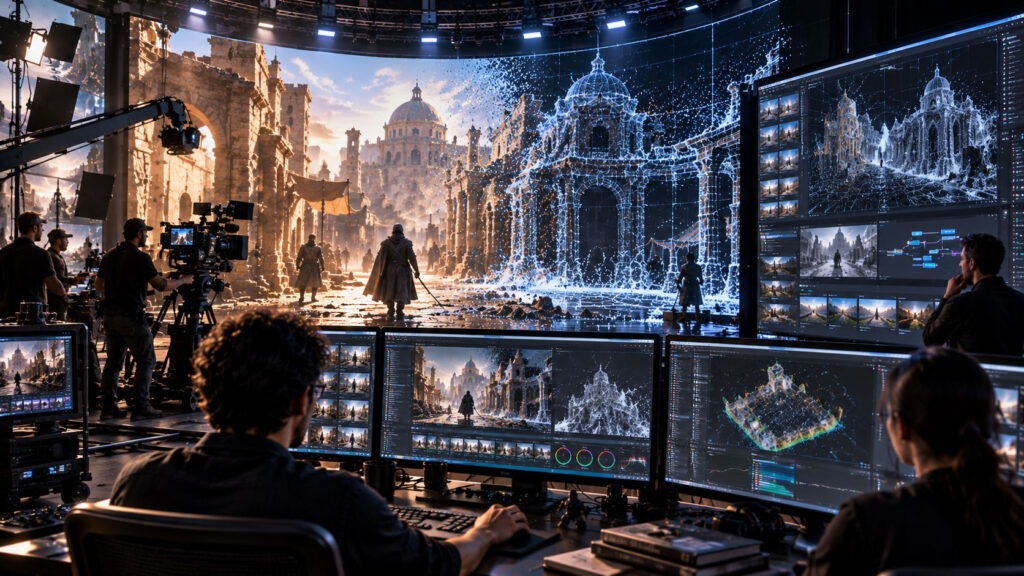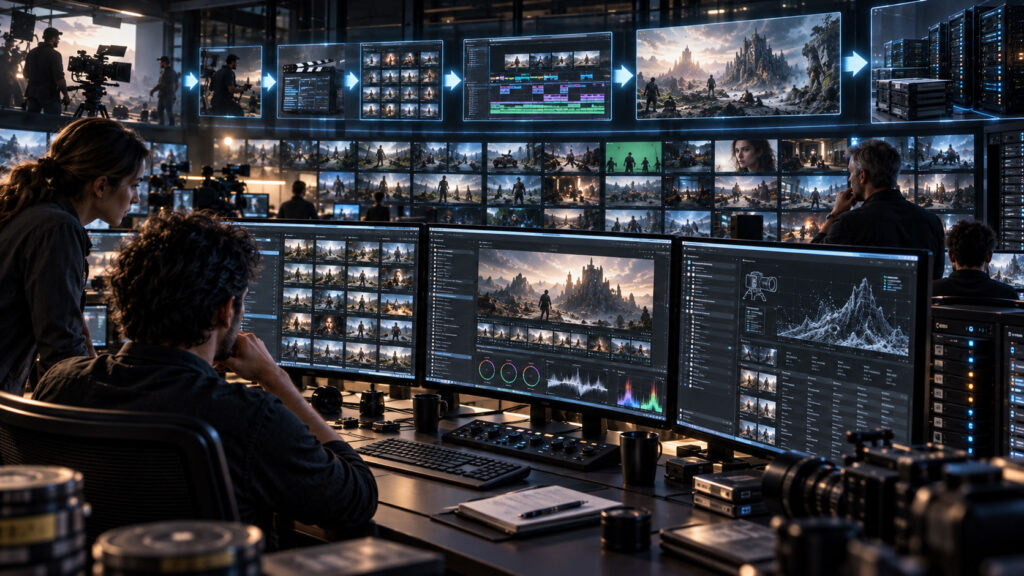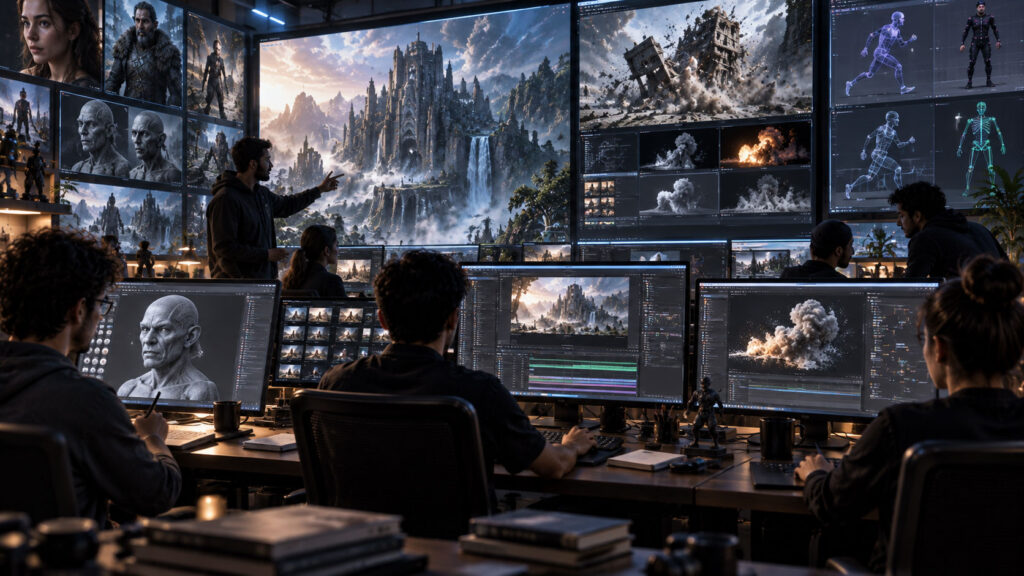
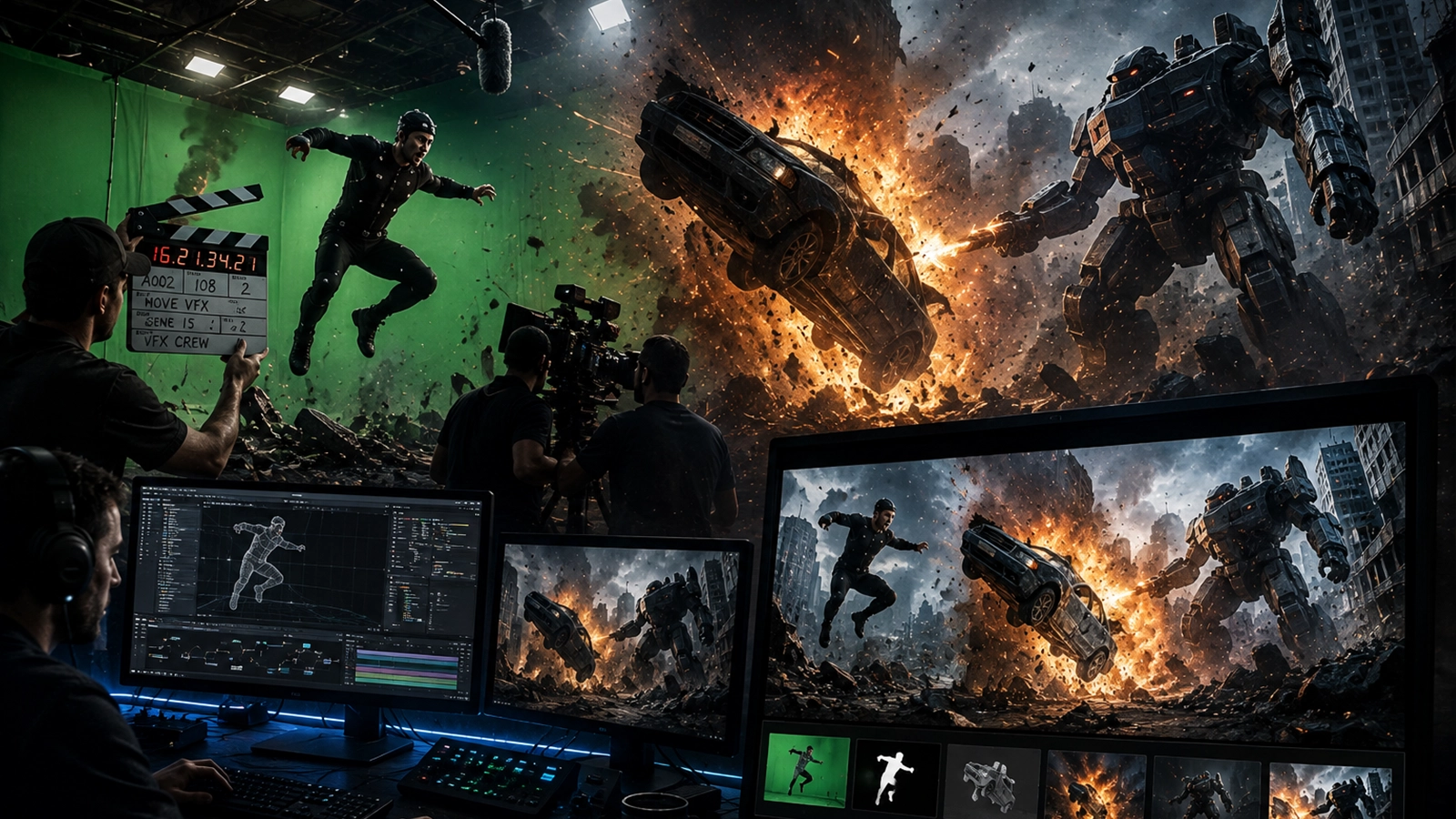
AI can generate impressive footage, but professional VFX is what gives difficult shots control: tracking, roto, keying, CG, compositing, cleanup, simulations and final integration.
- Why hybrid AI + VFX wins
- Decide what AI should do
- Build and prepare the plate
- Tracking and matchmove
- Rotoscoping and keying
- CG, effects and set extensions
- Compositing the shot
- AI-assisted cleanup
- Maintaining temporal consistency
- AI VFX tools and workflow choices
- Complete hybrid workflow
- Common mistakes
- Final VFX QC
- FAQ
1. Why hybrid AI + VFX wins
AI video is exceptionally useful for exploring ideas quickly, but a production shot often needs decisions that cannot be left to chance: exact camera movement, object placement, clean mattes, consistent lighting, interaction between CG and live elements, and repeatable revisions.
Traditional VFX pipelines remain built around tracking, rotoscoping, compositing, 3D, simulation and finishing. AI adds another generation and assistance layer to that pipeline. Current industry reporting increasingly describes AI as an augmentation tool inside established workflows rather than a universal replacement.
+
PROFESSIONAL TRACKING / ROTO / CG / COMP
+
HUMAN ART DIRECTION
=
CONTROLLED AI VFX
2. Decide what AI should do
| Task | AI is useful for | Keep professional control when |
|---|---|---|
| Concept exploration | Fast visual variations. | A final design must remain consistent. |
| Background generation | Environment ideas and plates. | Perspective and camera accuracy are critical. |
| Cleanup | Object removal and image repair. | Edges, reflections or critical hero details matter. |
| Roto | Initial mattes and segmentation. | Complex hair, motion blur or transparent edges require precision. |
| CG | Look development and reference. | Exact geometry, lighting and interaction are required. |
| Compositing | Masking, generative fill and local fixes. | Final integration must be technically reliable. |
3. Build and prepare the plate
Start with the best available source. If the plate is an AI-generated shot, preserve the highest-quality master and document the generation settings or references used to create it.
Plate preparation checklist
- Confirm resolution and frame rate.
- Check for AI artifacts before beginning VFX.
- Identify the intended camera movement.
- Mark important objects and interaction points.
- Identify areas that need roto or keying.
- Decide whether the shot should be stabilized or left in original motion.
- Create an original plate and a working copy.
4. Tracking and matchmove
Tracking tells the VFX system how the camera or object moves through the shot. AI can assist with point tracking, object tracking and segmentation, but a final matchmove must be judged against the actual plate.
| Tracking type | Use |
|---|---|
| 2D point tracking | Attach graphics or simple elements. |
| Planar tracking | Screen replacements, signs, surfaces. |
| 3D camera tracking | Insert CG into moving shots. |
| Object tracking | Follow a moving subject or prop. |
| AI-assisted tracking | Speed up initial analysis or difficult selections. |
Adobe’s current After Effects workflow includes AI-powered Object Matte for isolating objects and Adobe describes AI as part of its broader VFX workflow, while established compositing software still provides the precision needed for final tracking and integration.
5. Rotoscoping and keying
Roto creates mattes that separate foreground elements from the background. Keying performs a similar separation when a controlled color background is available.
AI segmentation can accelerate the first pass, especially for people and relatively clean objects. The professional artist still needs to inspect edges, hair, motion blur, transparency, shadows and contact areas.
| Edge issue | What to check |
|---|---|
| Hair | Fine strands, edge chatter and background contamination. |
| Motion blur | Whether the matte follows the true blurred silhouette. |
| Glass | Transparency, reflections and refraction. |
| Smoke | Soft alpha and density. |
| Fast action | Temporal stability and frame-to-frame edge changes. |
For a deeper foundation, continue with What Is Rotoscoping?.
6. CG, effects and set extensions
AI can provide excellent concept references, but production CG is still valuable when an element needs to obey exact perspective, camera motion, lighting and interaction.
| Element | AI contribution | Professional VFX contribution |
|---|---|---|
| Creature | Design exploration, texture ideas. | Rigging, animation, tracking, lighting and final integration. |
| Vehicle | Concept and look exploration. | Accurate geometry, camera-relative motion and reflections. |
| Environment | Concept/set-extension imagery. | Projection, 3D layout, perspective and depth. |
| Explosion | Reference or quick variations. | Controlled simulation, compositing and interaction. |
Use the least expensive technique that still provides the required control. A distant background may be solved with AI imagery; a hero creature interacting with a performer may require a full tracked CG/VFX pipeline.
7. Compositing the shot
Compositing is where all the pieces become one believable image. The basic order should remain understandable even when AI tools are involved.
→ TRACK / MATCHMOVE
→ ROTO / KEY
→ BACKGROUND
→ CG / FX
→ SHADOWS / REFLECTIONS
→ ATMOSPHERE
→ COLOR MATCH
→ GRAIN / FINISH
→ FINAL COMP
Use masks, mattes, premultiplication, edge treatment, depth cues, defocus and color relationships deliberately. Do not rely on a single AI “make it cinematic” pass to solve integration.
For the fundamentals, see What Is Compositing?.
8. AI-assisted cleanup
Cleanup is one of the areas where AI can save significant time. Typical jobs include unwanted-object removal, wire cleanup, background repair, beauty cleanup and patch generation.
| Situation | Recommended approach |
|---|---|
| Small artifact | Local AI cleanup + manual inspection. |
| Repeated temporal artifact | Track the problem and fix across frames. |
| Large background change | Consider plate replacement or set extension. |
| Critical hero detail | Use manual VFX control and reference frames. |
| Entire shot inconsistent | Regenerate from approved references rather than patch endlessly. |
9. Maintaining temporal consistency
One of the biggest differences between a still image and a film shot is time. A good AI frame can become a bad VFX shot when its texture, geometry, lighting or identity changes from frame to frame.
- Review shots at full speed.
- Inspect important elements frame by frame.
- Track masks rather than manually repainting every frame when possible.
- Use stable references for repeated characters and objects.
- Regenerate unstable source footage before building expensive downstream work.
- Keep VFX elements locked to the same camera and timing.
This is why our Zgian workflow uses AI Character Consistency and AI Previsualization before the VFX stage.
10. AI VFX tools and workflow choices
The best tool depends on the shot. Evaluate whether you need generation, tracking, segmentation, cleanup, compositing, 3D or finishing.
| Category | Examples / approach | Best use |
|---|---|---|
| Generative video | AI video models | Plates, concepts, variations and selected final shots. |
| AI segmentation | Object-aware matte tools | Fast roto/selection starting points. |
| Compositing | After Effects, Nuke and similar systems | Precise final integration. |
| 3D | Blender, Maya and similar systems | Accurate CG, cameras, environments and animation. |
| AI cleanup | Generative removal/inpainting | Local repair and plate cleanup. |
Adobe currently documents AI object isolation and other generative workflows in After Effects, while Foundry continues positioning Nuke as a node-based compositing environment used across film and television VFX.
11. Complete Zgian hybrid AI-VFX workflow
↓
STORYBOARD
↓
PREVIS
↓
AI VIDEO GENERATION
↓
EDIT
↓
PLATE QC
↓
TRACK / ROTO / KEY
↓
CG / FX / SET EXTENSION
↓
COMPOSITE
↓
AI-ASSISTED CLEANUP
↓
COLOR
↓
SOUND
↓
FINAL MASTER
- Start with approved previs.
- Generate only the shots that need final production.
- QC every AI plate.
- Track the camera and objects.
- Create accurate mattes.
- Build CG/FX only where needed.
- Composite with proper depth, light and interaction.
- Use AI for targeted cleanup.
- Check temporal stability.
- Color-match the shot to the film.
- Finish sound and deliver the master.
12. Common AI-VFX mistakes
| Mistake | Why it fails | Better approach |
|---|---|---|
| Using AI for every task | Loses precision where VFX needs control. | Choose the technique per shot. |
| Skipping tracking | Inserted elements float. | Track the plate accurately. |
| Trusting automatic roto | Edges chatter or disappear. | QC and refine mattes. |
| Ignoring contact shadows | CG looks pasted on. | Build interaction and grounding. |
| Generating final VFX before edit lock | Wasted work. | Use previs and editorial lock first. |
| Ignoring temporal artifacts | Shot looks fine as a still but fails in motion. | Review at full speed. |
| Overusing generative cleanup | Fine details can become synthetic. | Use local, controlled fixes. |
13. Final VFX QC
- Watch the complete shot at full speed.
- Check tracking and perspective.
- Check mattes and edges.
- Check shadows and reflections.
- Check motion blur and depth of field.
- Check grain/noise consistency.
- Check color and exposure against neighboring shots.
- Check AI-generated textures for temporal instability.
- Check all hero details frame by frame.
- Review the final exported master.
How this connects Zgian’s AI and VFX sections
CHARACTER → Character Consistency
STORYBOARD → AI Storyboarding
PREVIS → AI Previsualization
EDIT → AI Film Editing
SOUND → AI Film Sound Design
COLOR → AI Film Color Grading
VFX → this guide
Frequently asked questions
What is AI VFX?
AI VFX is a hybrid approach that combines AI generation or AI-assisted tasks with established visual-effects methods such as tracking, roto, keying, CG, compositing and finishing. It is better understood as a workflow than a single tool.
Can AI replace professional VFX?
AI can automate or accelerate parts of the process, but shots requiring precise tracking, complex mattes, controlled CG interaction and repeatable revisions still benefit from professional VFX techniques and artist supervision.
Can AI do rotoscoping?
AI-assisted segmentation can create useful starting mattes, especially for people and objects. Complex hair, transparency, motion blur and difficult edges still require careful review and refinement.
Should I generate the VFX shot entirely with AI?
Only when the shot’s required control is compatible with the model. For hero shots, complex interaction or exact camera/CG relationships, a hybrid workflow is often safer.
What is the biggest advantage of AI + VFX?
Speed of exploration combined with professional control. AI can help create or repair visual material quickly while tracking, roto, CG and compositing provide repeatable production accuracy.
Continue the Zgian VFX + AI series
3D Generalist & VFX Professional · About the author →
Related Zgian Coverage
- XGRIDS Brings 3D Gaussian Splatting Into Unreal Engine for Virtual Production
- Colorfront and Qumulo Make VFX Footage Searchable With AI
- Gnomon Best of Term Showcases the Next Generation of VFX and CG Artists
- IBC 2026 Shows How AI Agents Are Automating Media Localization at Scale
- Zerply Is Shutting Down: What VFX Artists Need to Do Before September 28
- Reuters Brings AI-Assisted Video Editing to Newsrooms With CuttingRoom
- Adobe Adds AI Video Generation and AI Assistant to Premiere Pro and After Effects
- How Milk VFX Used Unreal Engine to Build the Lost Worlds of Surviving Earth
- Prime Video Uses AI and VFX to Improve Lip-Sync for Dubbing