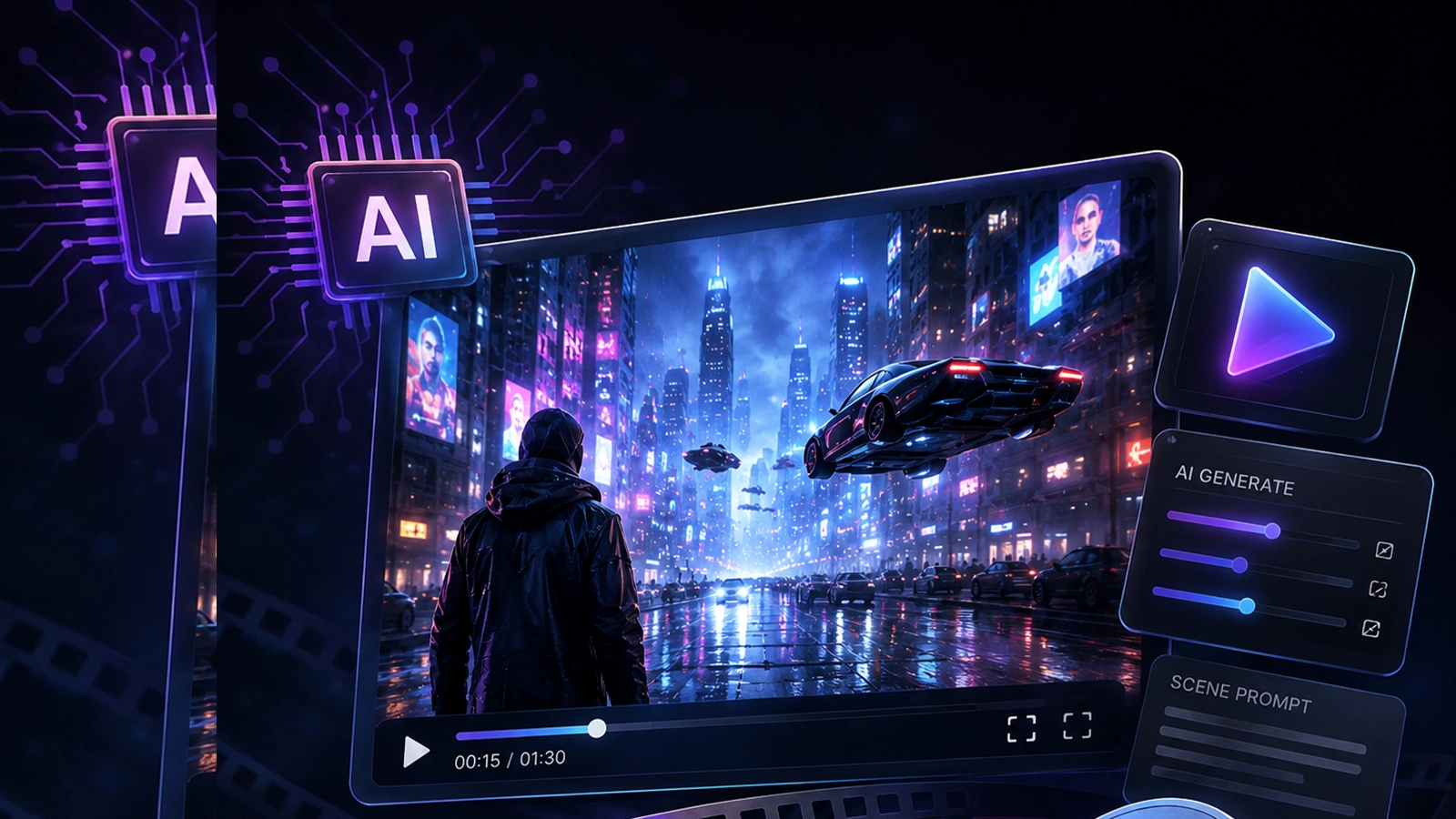

Turn visually inconsistent AI generations into a coherent film by balancing exposure, matching shots, protecting skin tones and building a controlled creative grade.
- Correction vs matching vs grading
- Why AI-generated footage needs grading
- The professional color pipeline
- Exposure and white balance
- Shot matching
- Skin tones and important colors
- Reference images and looks
- LUTs and AI looks
- AI color tools in 2026
- Building a cinematic look
- Complete Zgian workflow
- Common mistakes
- Final color QC
- FAQ
1. Correction vs matching vs grading
Color work becomes easier when you separate technical correction from creative styling.
| Stage | Question | Goal |
|---|---|---|
| Color correction / balance | Is this shot technically balanced? | Exposure, white balance, contrast and neutral color. |
| Shot matching | Does this shot belong beside the previous shot? | Consistent brightness, color, skin tones and contrast. |
| Creative grading | What should the scene feel like? | Mood, palette, density, contrast and film character. |
Practitioner comparisons in 2026 make the same distinction: AI tools are increasingly useful for balance and matching, while the final creative look remains a more subjective task.
2. Why AI-generated footage needs grading
AI video models can produce attractive individual shots while varying exposure, white balance, saturation, contrast, skin tone and perceived lens response from generation to generation. Even when the prompts are consistent, the footage may not behave like material captured by the same camera under the same lighting.
Color grading is therefore not merely a “cinematic filter.” It is the process that makes independently generated shots feel as though they belong to the same production.
→ TECHNICAL BALANCE
→ SCENE MATCH
→ CREATIVE LOOK
→ ONE VISUAL WORLD
3. The professional color pipeline
- Lock picture. Avoid grading shots that may be deleted.
- Identify the technical color space. Know what your footage and timeline represent.
- Balance. Fix exposure and white balance.
- Match. Choose a hero/reference shot and bring surrounding shots to it.
- Protect faces and important colors.
- Build the look. Establish contrast, palette and density.
- Apply shot-level refinements.
- Review the entire scene.
- Perform final QC and export.
Match first. Stylize second. A beautiful look applied to mismatched shots still looks inconsistent.
4. Exposure and white balance
Start with the fundamentals. If one shot is brighter or cooler than the next, the viewer notices the cut before noticing the “cinematic look.”
| Problem | First correction |
|---|---|
| Shot too dark | Raise exposure/offset while protecting highlights. |
| Highlights clipped | Recover where possible; avoid simply crushing the image. |
| Shot too warm | Correct temperature/tint before creative styling. |
| Shot too green/magenta | Neutralize tint before matching. |
| Low contrast | Set a controlled black/white range before the look. |
AI correction tools can accelerate this first pass by analyzing footage and applying automated balance, but results still depend on the source material and should be checked with scopes and by eye.
5. Shot matching: the most important AI color skill
Choose one strong “hero” shot for each scene. Match the other shots to that reference instead of independently grading every clip from scratch.
- Pick the hero shot.
- Match overall brightness.
- Match white balance.
- Match contrast and black level.
- Match skin tones.
- Match dominant environmental colors.
- Check the transition between every adjacent shot.
| Match target | What to compare |
|---|---|
| Luminance | Faces, midtones, highlights and blacks. |
| White balance | Neutral objects and overall temperature. |
| Skin | Hue, saturation and brightness. |
| Background | Sky, walls, foliage, practical lights. |
| Contrast | Black density and highlight roll-off. |
Current AI match tools can use a reference clip, still or saved look and apply a calculated match to other shots. MOVON, for example, currently describes frame-by-frame reference matching inside Premiere Pro and reports a private-beta workflow as of August 2026.
6. Protect skin tones and important colors
Faces are one of the strongest visual anchors in a scene. A grade can technically match two shots while still making the character’s skin feel different.
Check faces after every automated match
- Compare skin hue and brightness.
- Watch saturation in warm lighting.
- Check faces against the scene’s background color.
- Use targeted corrections when the global match damages the face.
- Do not force every skin tone toward one exact color; lighting and scene mood matter.
AI systems are increasingly capable of semantic analysis and targeted corrections, but colorists still need to decide what visual information should remain natural and what should be stylized.
7. Reference images and creative looks
For a narrative film, create a small reference library before grading the entire project. Useful references include a still from your own hero shot, production-design references, approved film frames and a few controlled palette examples.
| Reference | Use |
|---|---|
| Hero shot | Match exposure and scene continuity. |
| Film frame | Inspire palette, contrast and density. |
| Location still | Maintain environmental color identity. |
| Character reference | Protect wardrobe and skin relationships. |
| Approved grade | Maintain consistency across scenes. |
Reference-based matching is becoming a common feature of current AI color tools, including workflows where a still or graded clip becomes the target for an entire selection.
8. LUTs and AI looks
A LUT can be useful, but it should not be confused with a complete grade. A LUT is generally a transformation or look starting point; it does not understand every shot’s exposure, skin or local lighting problem.
→ SHOT MATCH
→ LUT / LOOK
→ MANUAL REFINEMENT
→ SCENE REVIEW
In a hybrid workflow, AI can perform the repetitive match while a LUT or look provides a controlled creative direction. Current 2026 guidance explicitly describes AI plus LUT workflows as a practical way to combine automation with creative control.
9. AI color tools in 2026
The tool landscape changes quickly, so evaluate tools by the actual job you need rather than by a generic “best AI color grader” ranking.
| Tool / approach | Useful for | Important note |
|---|---|---|
| DaVinci Resolve AI / Neural Engine | Professional finishing, masks, tracking and integrated color workflow. | Strong manual control; AI is an assistant, not the whole grade. |
| Colourlab.ai | Automated balance, matching and look development. | Designed for color-focused professional workflows. |
| Adobe Premiere Pro | Editors who want color assistance inside the NLE. | Convenient when the project already lives in Premiere. |
| MOVON Match | Reference matching inside Premiere. | Currently private beta as of August 2026. |
| AI reference-match tools generally | Fast first-pass consistency. | Always inspect faces, highlights and temporal stability. |
Current 2026 comparisons identify DaVinci Resolve, Colourlab.ai and Adobe workflows among the major AI-assisted options, while newer products such as MOVON are targeting fast reference matching directly in the editing timeline.
10. How to build a cinematic look
“Cinematic” is not one preset. A convincing look usually comes from a controlled relationship between contrast, color separation, saturation, highlight behavior and scene intent.
| Control | Creative question |
|---|---|
| Contrast | Should the scene feel soft, tense, harsh or graphic? |
| Color temperature | Should the world feel warm, cool or neutral? |
| Palette | Which colors dominate? |
| Saturation | Should colors feel natural, restrained or heightened? |
| Highlights | Should bright areas feel clean, soft or glowing? |
| Blacks | Should shadows feel deep or lifted? |
| Skin | How does the character sit inside the palette? |
Build the look on a representative hero shot, then distribute the look only after scene matching. This avoids using a creative grade to conceal technical inconsistencies.
11. Complete Zgian AI color workflow
↓
TECHNICAL SETUP
↓
BALANCE
↓
HERO SHOT
↓
AI SHOT MATCH
↓
SKIN / LOCAL CORRECTIONS
↓
CREATIVE LOOK
↓
SCENE-TO-SCENE MATCH
↓
FINAL QC
↓
MASTER
- Lock the edit.
- Set the project color management correctly.
- Balance each shot.
- Select a hero/reference shot for every scene.
- Use AI matching for the first pass.
- Manually fix faces, skies, practical lights and other important areas.
- Build the creative look.
- Check every cut.
- Compare scenes across the whole film.
- QC on scopes and multiple displays.
- Export the correct master and delivery versions.
12. Common AI color-grading mistakes
| Mistake | Why it fails | Better approach |
|---|---|---|
| Applying a LUT to everything | Does not fix shot-to-shot differences. | Balance and match first. |
| Trusting one-click AI | Faces and highlights can shift. | Inspect and refine. |
| Grading shots independently | The scene loses visual continuity. | Use hero-shot references. |
| Over-saturating | Creates an artificial digital look. | Use saturation selectively. |
| Crushing blacks | Removes texture and detail. | Protect shadow information. |
| Ignoring color management | Looks change between stages. | Define the working/delivery space first. |
| Judging only on one monitor | Display differences hide problems. | Use scopes and multiple real-world checks. |
13. Final color QC
- Watch the complete film without stopping.
- Check every scene transition.
- Check faces and skin tones.
- Check exposure jumps.
- Check white-balance shifts.
- Check skies, practical lights and saturated colors.
- Check blacks and highlights.
- Check for flicker or temporal color drift.
- Check the intended look survives the export.
- Review the actual exported master, not only the timeline.
How this fits the Zgian AI filmmaking pipeline
02 CAMERA → AI Video Camera Control
03 STORYBOARD → AI Storyboarding
04 PREVIS → AI Previsualization
05 GENERATION → AI Filmmaking Hub
06 EDITING → AI Film Editing
07 SOUND → AI Film Sound Design
08 COLOR → this guide
09 VFX / FINISHING → VFX Hub
Frequently asked questions
What is AI color grading?
AI color grading uses machine-learning assistance to analyze footage and automate parts of correction, shot matching or look development. It is best understood as an acceleration layer inside a broader color workflow.
Can AI match all my AI-generated shots?
AI can provide a strong first-pass match, but difficult differences in lighting, exposure or source quality may still require manual correction. Current practitioner comparisons describe balance and matching as the areas where AI is most useful, while creative grading still needs human judgment.
Should I use a LUT on AI video?
Yes, as a controlled creative starting point if it fits your color pipeline. Do not rely on a LUT to solve exposure and continuity problems first.
Which AI color tool should I use?
Choose based on your editing environment and task. DaVinci Resolve is strong for integrated professional color work; Colourlab.ai specializes in automated color workflows; Premiere is convenient for editors already in Adobe; newer tools such as MOVON focus on fast reference matching.
Does AI replace a professional colorist?
Not completely. AI can reduce repetitive technical work, but the final visual language, scene-to-scene judgment and creative intent still benefit from an experienced colorist or filmmaker.
Continue the Zgian AI Filmmaking series
3D Generalist & VFX Professional · About the author →