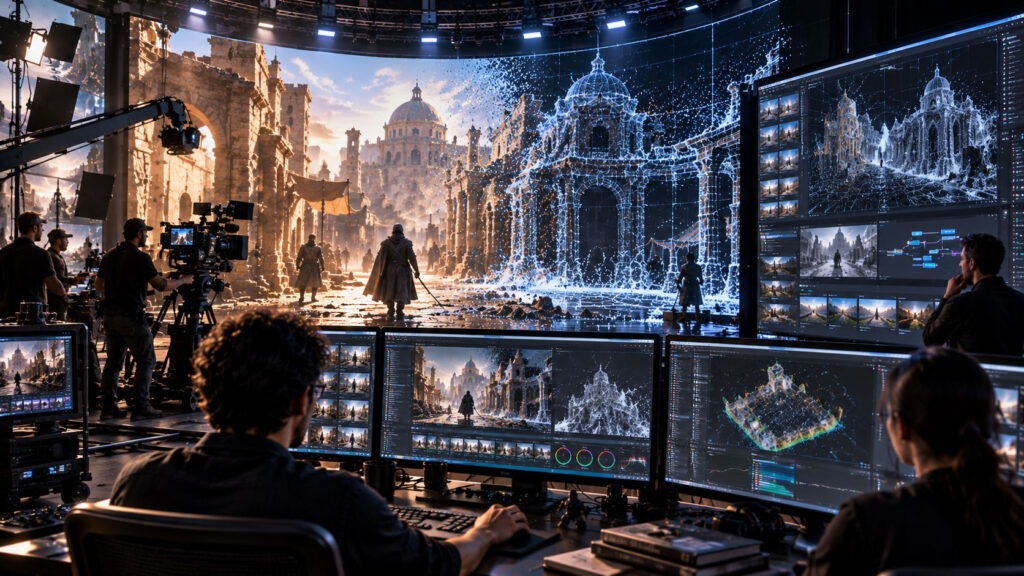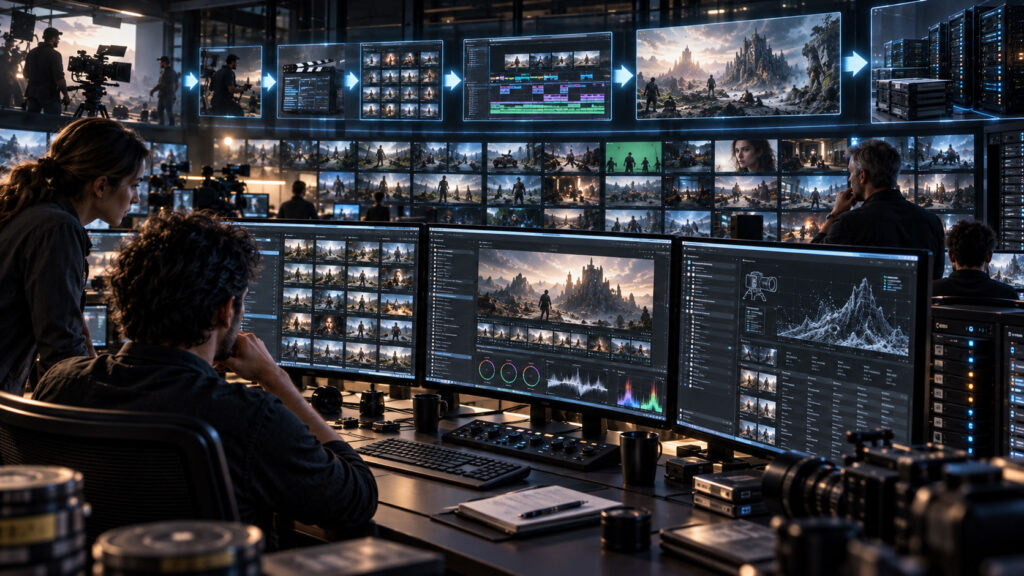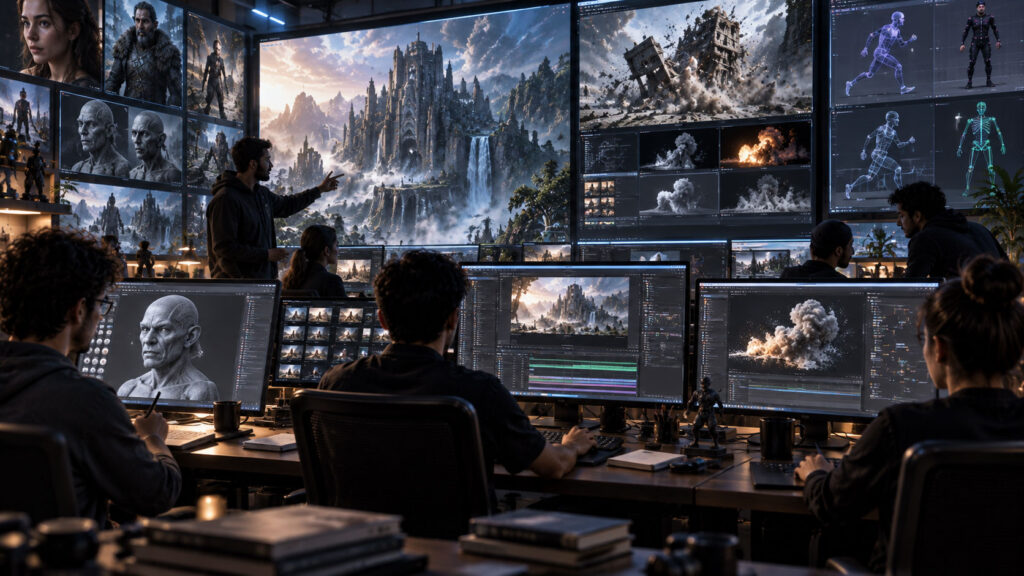
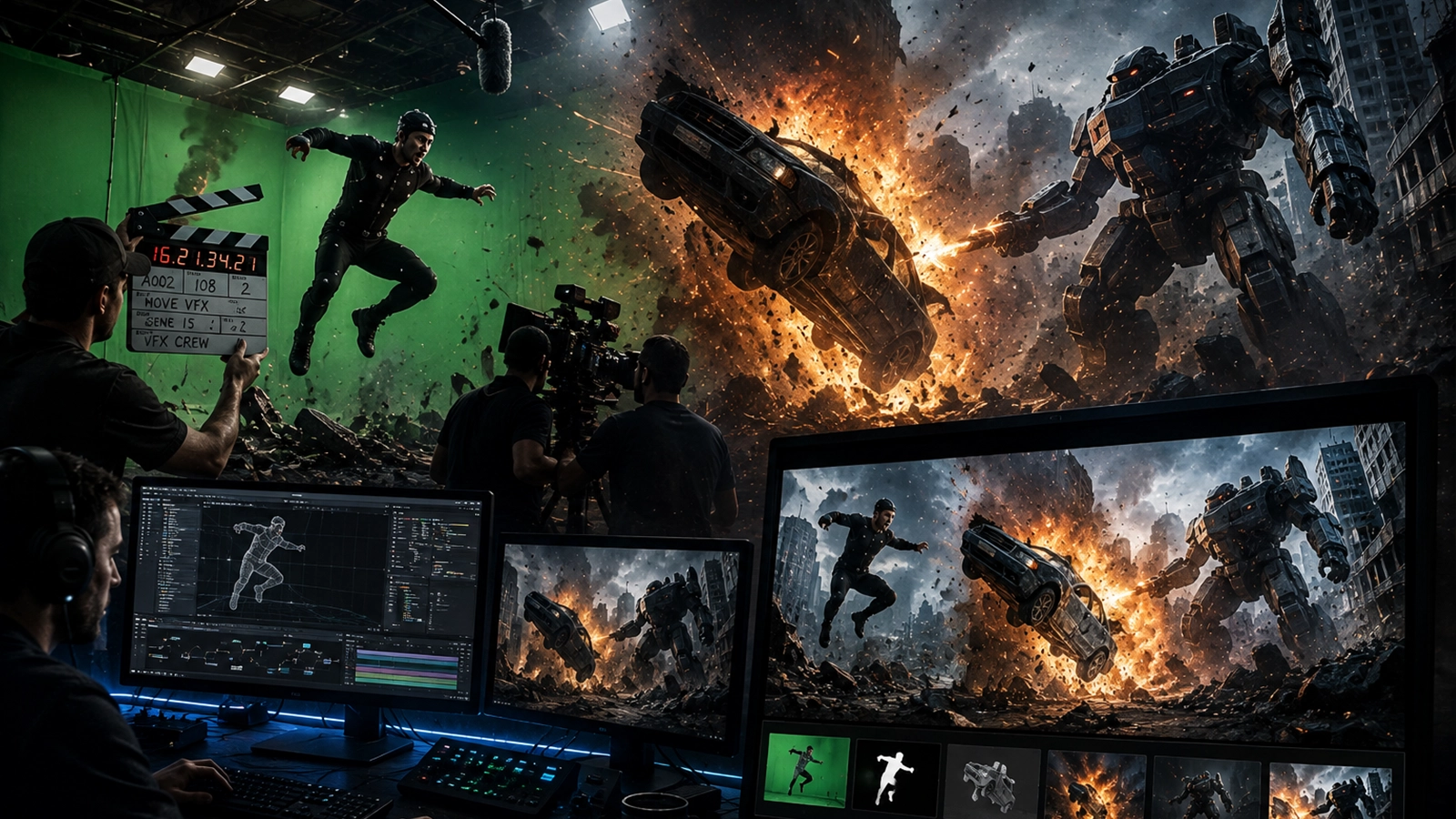
AI can create a powerful first matte in seconds. Professional rotoscoping begins where that automatic result stops: edges, hair, motion blur, transparency, temporal stability and production accuracy.
- What AI rotoscoping actually does
- Traditional roto vs AI-assisted roto
- The production workflow
- Creating the initial segmentation
- Tracking and propagation
- Edge refinement
- Hair, fur and fine detail
- Motion blur and fast movement
- Glass, smoke and transparency
- Temporal consistency
- AI roto tools in 2026
- Common mistakes
- Production matte delivery
- FAQ
1. What AI rotoscoping actually does
Rotoscoping is the process of creating animated mattes that separate an object or subject from its background. AI-assisted roto replaces some of the manual shape-drawing work with computer vision and segmentation.
Instead of drawing a Bezier shape around a person on every frame, an AI system can identify the subject from a click, mask, text or reference and then propagate that selection through the shot. The artist becomes the supervisor and refiner rather than the person drawing every frame from scratch.
→ AI SEGMENTATION
→ TRACK / PROPAGATE
→ MATTE REFINEMENT
→ TEMPORAL QC
→ PRODUCTION MATTE
2. Traditional roto vs AI-assisted roto
| Stage | Traditional approach | AI-assisted approach |
|---|---|---|
| Initial shape | Artist draws masks. | AI proposes a subject matte. |
| Frame propagation | Track and adjust masks. | Model tracks/propagates the segmentation. |
| Complex edge | Artist manually refines. | AI assists, artist refines. |
| Hair / transparency | Detailed matte work. | AI may provide a starting alpha, but requires close QC. |
| Final delivery | Artist verifies the sequence. | Artist still verifies the sequence. |
The major advantage is not “no roto artist.” It is less repetitive labor per shot. Current AI-assisted VFX tools are increasingly designed around this model.
3. The professional AI roto workflow
02 DEFINE SUBJECT
03 AI INITIAL MATTE
04 CHECK START / END
05 TRACK / PROPAGATE
06 REFINE EDGE
07 FIX DIFFICULT FRAMES
08 CHECK TEMPORAL STABILITY
09 QC AGAINST ORIGINAL
10 EXPORT MATTE
Do not start by trusting the AI result. Start by understanding the shot: what must be isolated, what is allowed to remain connected, and what downstream department will use the matte.
4. Creating the initial segmentation
The initial selection should clearly define the object or subject. If the system supports prompts, reference frames, clicks or scribbles, use the simplest input that gives a stable selection.
| Shot | Good initial strategy |
|---|---|
| Standing person | Select the full body and check both hands/feet. |
| Talking head | Include hair and ears; inspect shoulders and neck. |
| Vehicle | Separate the vehicle body from wheels, windows and reflections as required. |
| Prop | Use object-aware selection and verify similar background colors. |
| Creature | Use a strong reference frame and inspect limbs/tail frame by frame. |
Adobe’s current After Effects Object Matte workflow can use a simple click to identify objects and then propagate the matte through the footage, illustrating the direction of AI-assisted roto tools.
5. Tracking and propagation
AI segmentation is only useful if the matte remains attached to the correct subject. Propagation follows the selected object through time, but difficult shots can still cause identity swaps, edge drift or holes.
Always check these frames
- First frame
- First major movement
- Occlusion begins
- Occlusion ends
- Fastest movement
- Strongest motion blur
- Subject crosses a similar-colored background
- Last frame
Fix key frames at these moments rather than blindly accepting a long propagated result.
6. Edge refinement
A matte can be technically “correct” while still looking wrong in a composite. Edge quality is where professional roto judgment matters most.
| Edge problem | Typical symptom | Correction |
|---|---|---|
| Chatter | Edge vibrates from frame to frame. | Smooth and stabilize the matte. |
| Choke | Subject becomes unnaturally thin. | Expand/soften carefully. |
| Halo | Background color remains around subject. | Decontaminate or refine edge. |
| Hard edge | Composite looks cut out. | Match natural softness/motion blur. |
| Missing edge | Parts of subject disappear. | Restore with manual roto or additional segmentation. |
7. Hair, fur and fine detail
Hair is one of the classic stress tests for automatic roto. Individual strands may be semi-transparent, motion-blurred or similar in color to the background.
For hero shots, treat AI segmentation as the base matte, then create additional edge mattes or specialized hair mattes where necessary. In many cases, the final composite does not require every strand to be perfectly isolated; it requires the edge to behave naturally at the final viewing resolution.
8. Motion blur and fast movement
Fast movement creates a blurred silhouette rather than a clean geometric boundary. If an AI model snaps the matte to the sharp center of the object, the composite can look like a cut-out.
- Compare matte width to the original motion blur.
- Preserve natural softness where appropriate.
- Do not over-sharpen a matte.
- Check the matte against both the original and the intended background.
- For extreme motion, use dedicated manual shapes or specialized matte techniques.
9. Glass, smoke and transparency
Not every object should be treated as a simple binary foreground/background mask. Glass, smoke, hair, reflections and semi-transparent materials may require grayscale mattes, holdouts or separate compositing passes.
| Element | Preferred matte thinking |
|---|---|
| Solid person | Mostly binary alpha with soft natural edges. |
| Glass | Separate transparency/reflection treatment. |
| Smoke | Grayscale density rather than hard cutout. |
| Hair | Fine semi-transparent edge detail. |
| Shadow | Separate shadow matte/pass when needed. |
10. Temporal consistency
The biggest AI roto failure is often invisible when viewing a single frame. Play the matte at full speed and look for crawling, popping, edge expansion, disappearing fingers or changing silhouettes.
Freeze the matte on a difficult frame, inspect it closely, then play the shot. If it looks correct as a still but wrong in motion, it is not finished.
Temporal consistency is especially important when the matte feeds a replacement background, CG integration, beauty work or a keying/compositing operation. AI propagation must therefore be treated as an editable starting point rather than an automatic final.
11. AI roto tools in 2026
| Approach | Useful for | Best practice |
|---|---|---|
| Object-aware matte tools | People, props and obvious foreground objects. | Use as a fast first pass. |
| AI segmentation models | General subject isolation. | Review difficult edges and occlusions. |
| AI tracking/propagation | Long shots with moderate movement. | Correct key frames at failure points. |
| Manual spline roto | Hero and difficult shots. | Keep as the precision fallback. |
| Hybrid matte workflow | Complex production shots. | Combine AI base, manual shapes and edge mattes. |
Adobe’s current Object Matte feature is a prominent example of AI-assisted segmentation and propagation inside After Effects. Blackmagic Design also continues to integrate AI tools such as Magic Mask into DaVinci Resolve, making subject isolation part of a broader editing/VFX workflow.
12. Common AI rotoscoping mistakes
| Mistake | Why it fails | Better approach |
|---|---|---|
| Accepting the first matte | Small errors accumulate. | QC start, end and difficult frames. |
| Ignoring hair | Edges look synthetic. | Use dedicated edge refinement. |
| Ignoring motion blur | Subject looks cut out. | Preserve natural blur/softness. |
| Not checking occlusions | AI may switch to the wrong object. | Correct propagation around occlusions. |
| Using binary mattes for smoke/glass | Transparency becomes unnatural. | Use grayscale density and separate passes. |
| Checking only still frames | Temporal chatter survives. | Always watch the full shot. |
| Relying on AI for hero shots without cleanup | Small errors become obvious in final composites. | Finish hero mattes manually. |
13. Production matte delivery
The final matte should be delivered in the form required by the next department. Depending on the pipeline, that may be an alpha channel, grayscale matte, holdout, roto shape or compositing setup.
- Confirm frame range.
- Confirm resolution and frame rate.
- Confirm pixel aspect ratio where relevant.
- Check alpha interpretation.
- Check edge softness.
- Check frame handles.
- Check the matte against the original plate.
- Check the matte against a contrasting test background.
- Use clear naming and version numbers.
- Archive the original AI result and final refined matte.
How this fits the Zgian VFX + AI pipeline
AI VFX → AI VFX Workflow
ROTO FOUNDATION → What Is Rotoscoping?
AI ROTO → this guide
COMPOSITING → What Is Compositing?
COLOR → AI Film Color Grading
Frequently asked questions
What is AI rotoscoping?
AI rotoscoping uses computer-vision segmentation and tracking to create or propagate foreground mattes faster than fully manual frame-by-frame masking.
Can AI completely replace a roto artist?
Not reliably for difficult production shots. AI can greatly reduce repetitive work, but complex hair, motion blur, transparency, occlusion and hero shots still benefit from artist supervision and refinement.
Is AI roto good for hair?
It can provide a useful starting matte, but fine hair and semi-transparent edges should be checked carefully, especially on hero shots.
What is the biggest benefit of AI roto?
Speed. AI can create an initial segmentation and propagate it through many frames, allowing artists to spend more time on difficult frames and final edge quality.
Should I still learn manual rotoscoping?
Yes. Understanding manual roto, mattes, edge behavior and compositing remains valuable because AI tools are most powerful when an artist understands how to correct their output.
Continue the Zgian VFX + AI series
3D Generalist & VFX Professional · About the author →