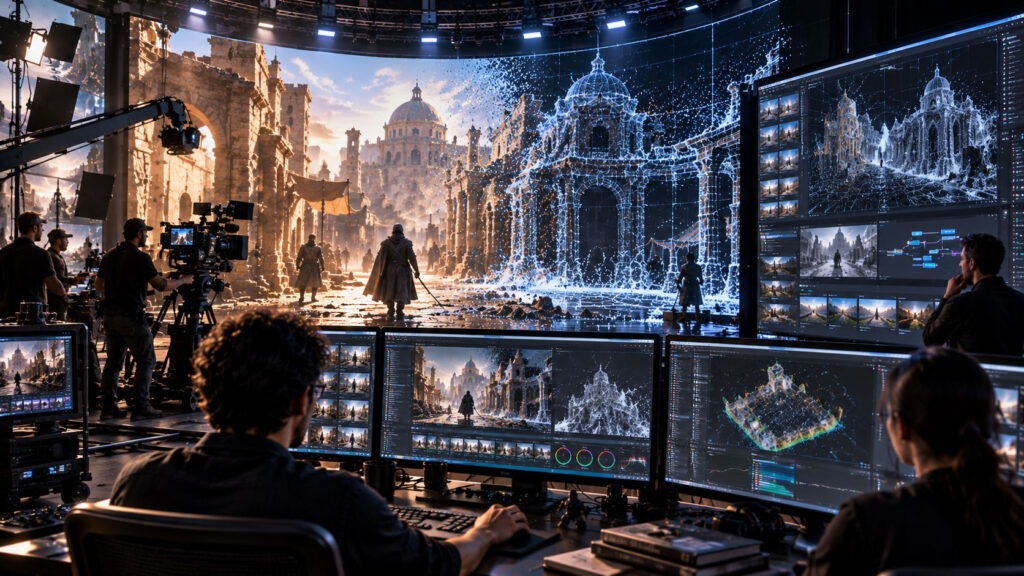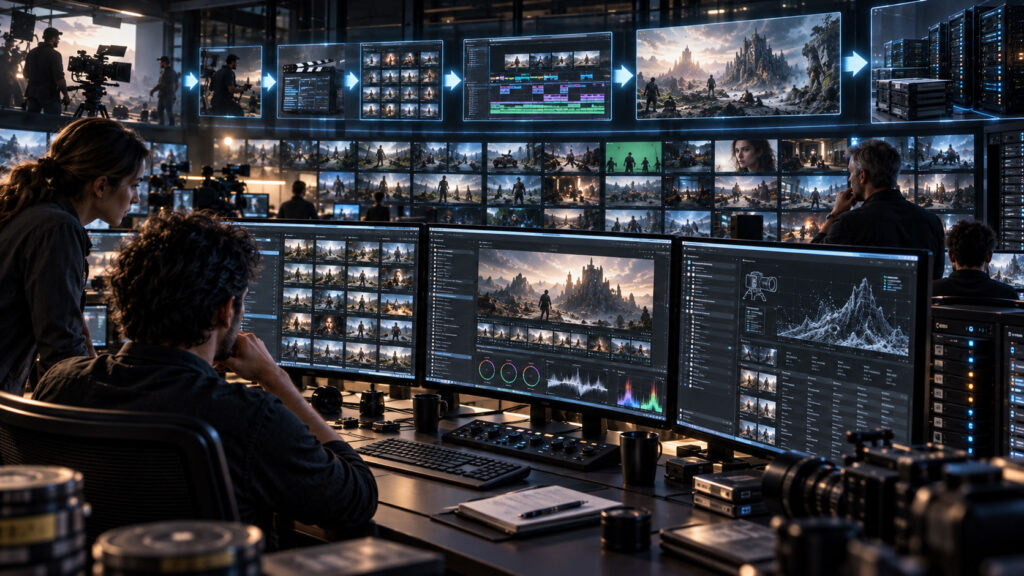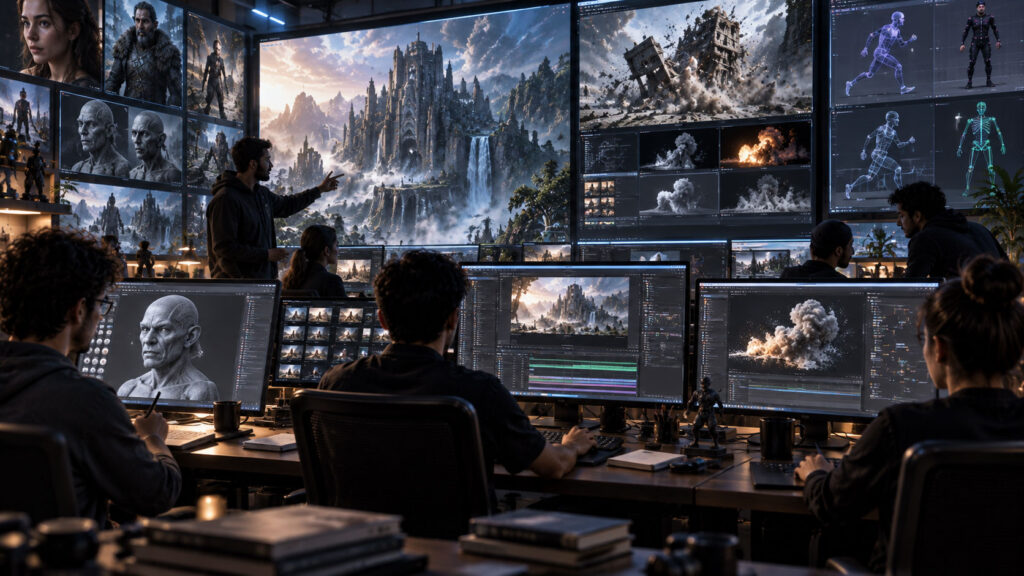
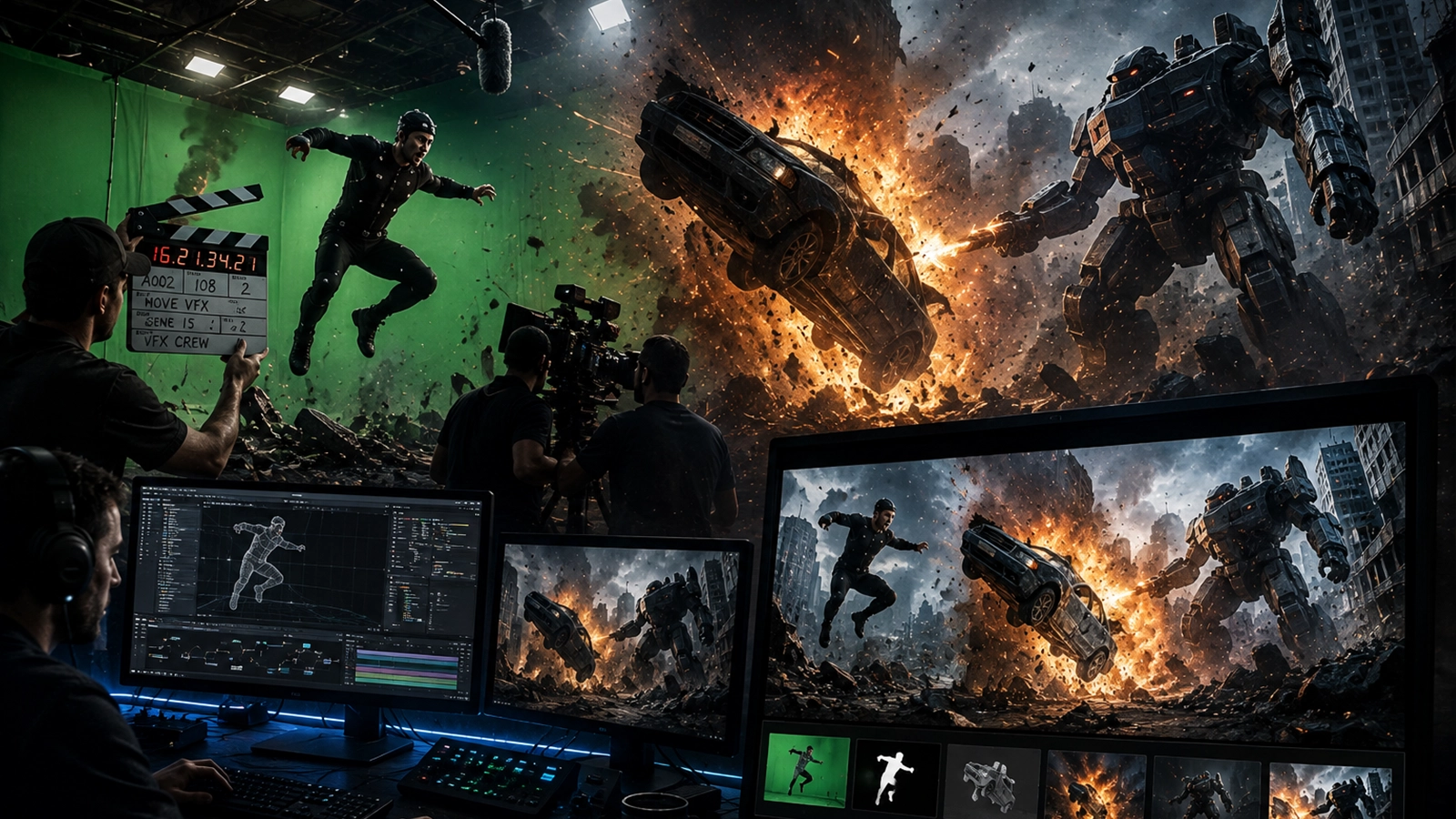
A digital environment becomes convincing when it moves with the same physical logic as the real world. Procedural motion, simulation and AI-assisted systems can animate vegetation, clouds, water, weather and destruction while keeping large scenes manageable.
- What environment animation controls
- Motion design and reference
- Wind systems
- Trees and vegetation
- Clouds
- Water and waves
- Rain
- Snow and ice
- Dust and sand
- Fire and heat
- Destruction
- Procedural motion
- AI environment simulation
- Dynamic weather
- Caching and optimization
- Common mistakes
- Complete workflow
- Final animation QC
- FAQ
1. What environment animation controls
Environment animation covers the motion of everything that makes a world feel alive: foliage, clouds, water, atmosphere, particles, weather, structures and secondary objects.
+
ENVIRONMENT RULES
+
MATERIAL BEHAVIOR
+
WEATHER STATE
↓
PROCEDURAL MOTION
↓
DYNAMIC DIGITAL WORLD
2. Motion design and reference
Start from real-world observation. Identify wind direction, movement frequency, inertia, scale, acceleration and interaction between environmental elements.
| Reference cue | Animation information |
|---|---|
| Wind direction | Shared motion vector. |
| Wind strength | Amplitude and frequency. |
| Mass | Acceleration and inertia. |
| Surface | Friction, sliding or deformation. |
| Weather | Changes across the whole environment. |
3. Wind systems
Wind is best treated as a field rather than independent animation. A shared wind system can influence trees, grass, flags, dust, smoke and loose objects at different strengths.
↓
TREE SWAY
+ GRASS MOTION
+ FLAGS
+ DUST
+ LOOSE OBJECTS
↓
COHERENT ENVIRONMENT MOTION
| Wind strength | Typical response |
|---|---|
| Light | Subtle leaf and grass movement. |
| Moderate | Branches, vegetation and loose props respond. |
| Strong | Large vegetation motion and airborne debris. |
| Extreme | Structural effects, debris and hazardous conditions. |
4. Trees and vegetation
Vegetation motion should vary by species, height, stiffness and wind exposure. A single identical sway curve across every tree immediately reveals the procedural system.
| Vegetation | Motion strategy |
|---|---|
| Grass | High-frequency low-amplitude motion. |
| Shrubs | Clustered wind response. |
| Young trees | More flexible trunk and branches. |
| Large trees | Slow trunk motion with layered branch movement. |
| Leaves | Small-scale high-frequency variation. |
5. Clouds
Cloud animation combines shape evolution, wind advection, lighting changes and atmospheric depth. For distant shots, 2D or volumetric approaches can be more efficient than detailed geometry.
| Cloud layer | Animation |
|---|---|
| Low clouds | Faster movement and stronger local depth. |
| Mid clouds | Moderate drift and shape evolution. |
| High clouds | Slow large-scale movement. |
| Storm clouds | Rapid density and lighting variation. |
6. Water and waves
Water motion should reflect scale. Small puddles need surface ripples; rivers need directional flow; oceans require layered waves and long-period movement.
| Water type | Primary motion |
|---|---|
| Puddle | Ripples and small disturbances. |
| River | Directional flow and surface variation. |
| Lake | Wind-driven waves and subtle currents. |
| Ocean | Multiple wave scales and long-period swell. |
| Waterfall | Downward flow, spray and mist. |
7. Rain
Rain is more than falling streaks. It changes surfaces, reflections, puddles, atmosphere, visibility and lighting. A convincing rain setup links all of these effects.
↓
DROPS
+
SPLASH
+
PUDDLES
+
WET SURFACES
+
MIST
+
ATMOSPHERIC DEPTH
↓
RAINING WORLD
8. Snow and ice
Snow should accumulate according to surface orientation, temperature, wind and exposure. Animation can include falling snow, sliding, settling and melting.
| Snow state | Visual behavior |
|---|---|
| Falling | Wind-driven particles with depth variation. |
| Accumulated | Surface-aware deposits. |
| Wind-blown | Drifts and airborne particles. |
| Melting | Wet surfaces and changing coverage. |
9. Dust and sand
Dust and sand need scale-aware particle motion. Ground-level dust follows terrain and wind while airborne particles respond to gusts and turbulence.
| Effect | Use |
|---|---|
| Ground dust | Vehicle and foot interaction. |
| Wind-blown dust | Environmental atmosphere. |
| Sand gust | Desert and storm conditions. |
| Dust haze | Large-scale depth reduction. |
10. Fire and heat
Fire can become an environmental animation system when flames, smoke, embers, heat distortion and lighting respond together.
| Fire layer | Role |
|---|---|
| Flame | Primary visible motion. |
| Smoke | Mass and direction. |
| Embers | Secondary particles. |
| Heat distortion | Optical response. |
| Fire light | Illumination on surrounding surfaces. |
11. Destruction
Procedural destruction should follow material and structural behavior. Concrete, glass, wood and metal do not break in the same way.
| Material | Typical behavior |
|---|---|
| Glass | Fracture and shard separation. |
| Concrete | Chunking, cracking and dust. |
| Wood | Splintering and bending. |
| Metal | Bending, tearing and deformation. |
Destruction should also create secondary effects such as dust, debris, impact sound cues and changing lighting conditions.
12. Procedural motion
Procedural animation creates motion from rules rather than keyframing every object. Noise, constraints, force fields, state machines and simulation caches can produce scalable environmental behavior.
↓
FORCES / CONSTRAINTS
↓
OBJECT RULES
↓
VARIATION
↓
SIMULATION / CACHE
↓
SHOT-SPECIFIC ART DIRECTION
13. AI environment simulation
AI can assist with motion reference analysis, simulation parameter suggestions, environment-state classification and generation of variations. The final animation still benefits from controllable procedural parameters.
| AI use | Benefit | Production control |
|---|---|---|
| Motion reference analysis | Identify movement patterns. | Convert observations into parameters. |
| Weather variation | Explore dynamic states. | Use reproducible state presets. |
| Simulation assistance | Suggest settings or variants. | Validate against physical behavior. |
| Animation cleanup | Reduce repetitive manual work. | Review timing and continuity. |
14. Dynamic weather
A dynamic weather system should coordinate clouds, sun intensity, atmosphere, precipitation, surface wetness and environmental motion. Weather becomes more believable when all departments respond to the same state.
| Weather state | Environment response |
|---|---|
| Clear | Strong sun, low haze and subtle wind. |
| Windy | Vegetation, dust and clouds accelerate. |
| Rain | Wet surfaces, puddles, mist and reduced contrast. |
| Storm | Dark sky, strong wind, rain and lightning. |
| Snow | Accumulation, cold atmosphere and reduced visibility. |
15. Caching and optimization
Dynamic environments can become expensive quickly. Cache simulations, instance repeated elements and use different simulation detail based on camera importance.
| Technique | Purpose |
|---|---|
| Simulation cache | Reuse expensive results. |
| LOD simulation | Reduce detail for distant elements. |
| Instancing | Reuse repeated animated assets. |
| Shot regions | Simulate only camera-relevant areas. |
| State presets | Keep weather consistent across shots. |
16. Common mistakes
| Mistake | Why it fails | Better approach |
|---|---|---|
| Every object moves identically | Procedural pattern becomes obvious. | Use species, mass and exposure variation. |
| Weather effects are isolated | World does not react consistently. | Drive all effects from a shared weather state. |
| Water ignores scale | Movement feels miniature. | Match wave frequency to environment scale. |
| Destruction ignores material | Breakup looks artificial. | Use material-specific fracture behavior. |
| No caching plan | Iteration becomes slow. | Design simulation and cache strategy early. |
17. Complete Zgian AI environment-animation workflow
↓
MOTION / WEATHER BRIEF
↓
GLOBAL FORCES
↓
WIND + VEGETATION
↓
CLOUDS + SKY
↓
WATER
↓
RAIN / SNOW / DUST
↓
FIRE / DESTRUCTION
↓
AI / PROCEDURAL VARIATION
↓
WEATHER STATE
↓
CACHE + OPTIMIZATION
↓
FINAL ANIMATION QC
- Define the environmental motion and weather brief.
- Establish global forces and shared states.
- Animate vegetation and wind response.
- Animate clouds and atmospheric motion.
- Build water and surface interaction.
- Add precipitation and particulate effects.
- Add fire or destruction where required.
- Introduce controlled AI/procedural variation.
- Cache and optimize simulations.
- Review the complete environment in final playback.
18. Final animation QC
- Check global motion direction.
- Check timing and scale.
- Check vegetation variation.
- Check cloud movement and continuity.
- Check water behavior.
- Check precipitation and atmospheric interaction.
- Check fire, smoke and destruction relationships.
- Check weather continuity across shots.
- Check simulation caches and playback performance.
- Review final shots at normal speed and frame-by-frame when necessary.
How this fits the Zgian VFX + AI pipeline
AI ARCHITECTURE → Digital Architecture 2.0
AI MATERIALS → Environment Materials 2.0
AI LIGHTING → Environment Lighting 2.0
AI ANIMATION → this guide
AI SET EXTENSION → Environment & Set Extension 2.0
Frequently asked questions
What is environment animation?
It is the animation of natural and built-world elements such as vegetation, clouds, water, weather, particles and destruction so a digital environment behaves like a living world.
How do I animate large numbers of trees?
Use shared wind fields, procedural variation, instancing and distance-based simulation detail instead of individually keyframing every tree.
How can weather stay consistent across shots?
Use shared weather-state presets that drive lighting, atmosphere, precipitation, wind and surface conditions.
Should destruction be fully simulated?
Only when the camera or interaction requires it. For many shots, a combination of simulation, pre-baked caches and art-directed effects is more efficient.
Where does AI help most?
AI is useful for reference analysis, variation and setup assistance, while procedural systems and simulations provide the repeatable control required for production.
Continue the Zgian VFX + AI series
3D Generalist & VFX Professional · About the author →