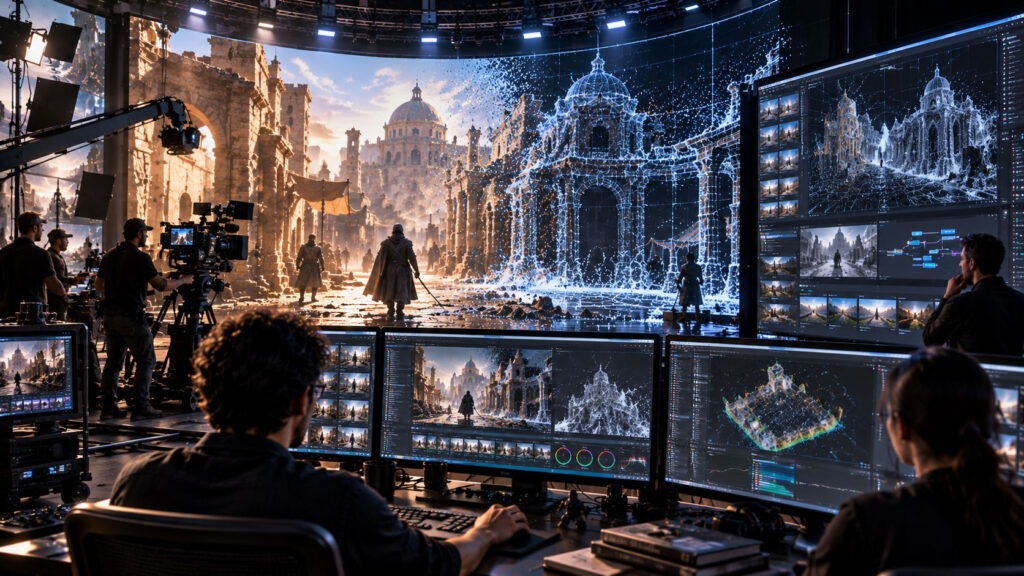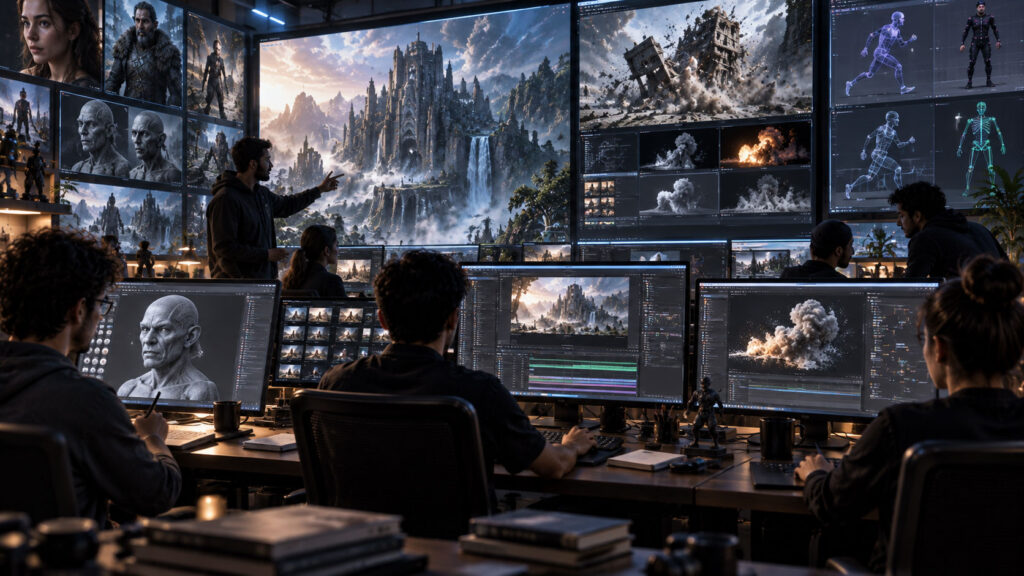
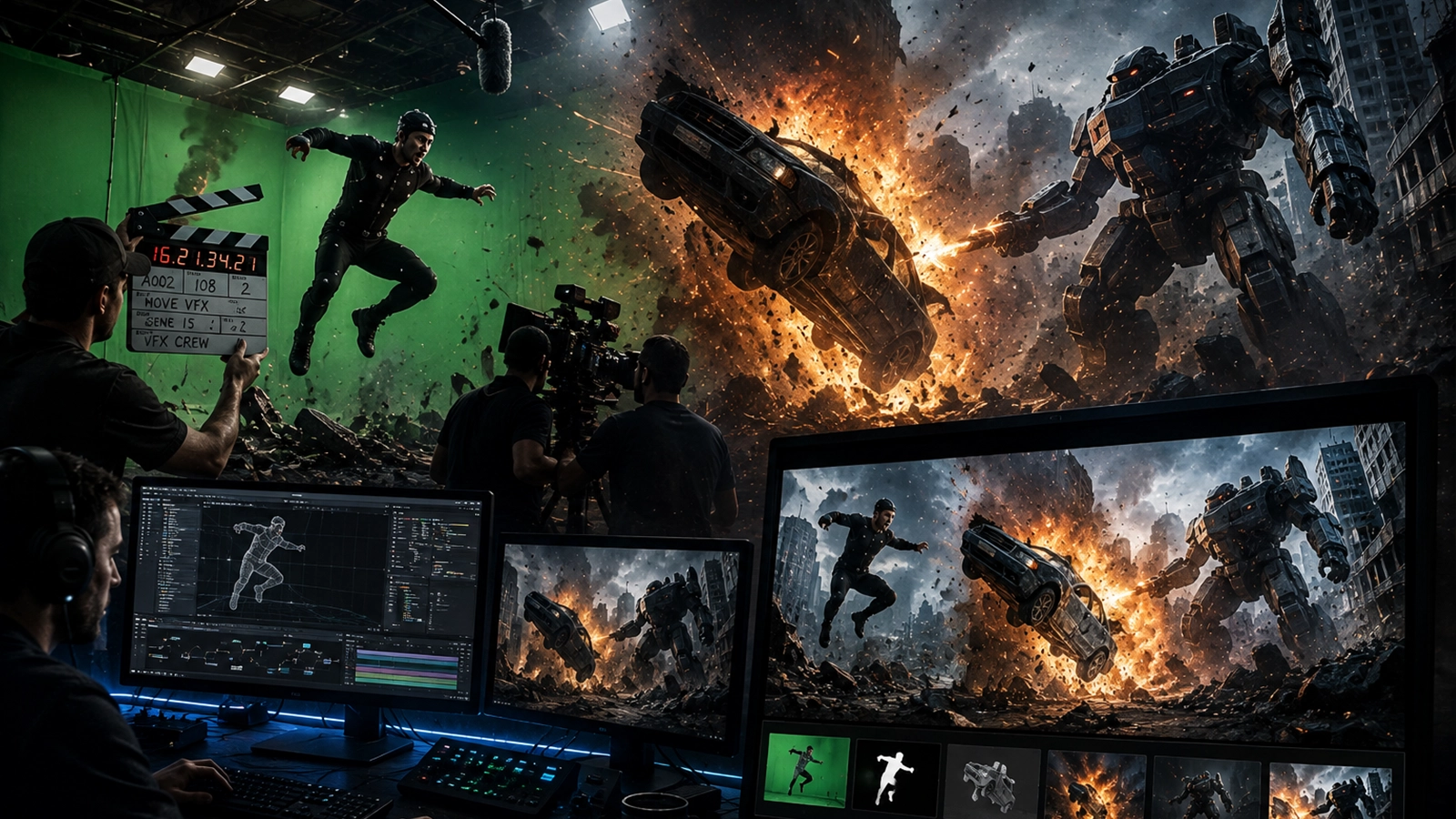
Environment FX brings a digital world to life through physically informed fire, smoke, fluids, debris and destruction. AI can accelerate reference analysis, setup and variation, while simulation gives the final shot controllable motion and believable interaction.
1. What environment FX includes
Environment FX covers dynamic effects that interact with the world: flames, smoke, explosions, particles, dust, fluids, collapsing structures and material-driven debris.
↓
FORCES + MATERIAL RESPONSE
↓
SECONDARY FX
↓
LIGHT / ATMOSPHERE
↓
ENVIRONMENT INTERACTION
↓
FINAL VFX SHOT
2. FX brief and reference analysis
Before simulating, define the event’s scale, duration, force direction, material behavior, camera needs and environmental conditions. Good reference analysis prevents expensive simulations that have to be rebuilt later.
| Reference cue | Production decision |
|---|---|
| Scale | Particle size, fluid resolution and debris dimensions. |
| Force | Velocity, acceleration and direction. |
| Material | Fracture, deformation or fragmentation behavior. |
| Environment | Collision surfaces, wind and atmosphere. |
| Camera | Required detail and simulation region. |
3. Fire
Fire is a coupled system of temperature, fuel, velocity, smoke and light. The visible flame shape should respond to airflow and the surrounding environment.
| Fire layer | Production role |
|---|---|
| Fuel | Defines where combustion can occur. |
| Temperature | Drives buoyancy and visible heat. |
| Velocity | Shapes flames and smoke movement. |
| Emission | Creates the visible flame response. |
| Light | Illuminates nearby surfaces. |
4. Smoke
Smoke communicates scale and motion. Its density, turbulence and lighting response should reflect the event and environment.
↓
HOT VELOCITY
↓
BUOYANCY
↓
TURBULENCE
↓
DENSITY EXPANSION
↓
DISSIPATION
| Smoke state | Visual behavior |
|---|---|
| Fresh | Dense, hot and strongly directional. |
| Rising | Expands and loses density. |
| Cooling | Becomes more diffuse. |
| Wind-driven | Stretches and advects through the environment. |
5. Explosions
An explosion is usually a layered event rather than one simulation. Combine a fast pressure-driven core with fire, smoke, debris, dust, sparks and lighting changes.
| Layer | Purpose |
|---|---|
| Flash | Immediate high-energy visual cue. |
| Fireball | Primary hot volume. |
| Shock / pressure | Drives surrounding motion. |
| Smoke | Longer-duration volume. |
| Debris | Communicates environmental impact. |
| Dust | Connects the event to the ground. |
6. Sparks and embers
Sparks provide fast secondary detail. Their size, trajectory, lifetime and brightness should be tied to the event rather than randomly scattered.
| Element | Variation |
|---|---|
| Initial velocity | Direction and speed. |
| Lifetime | Short, medium or long-lived particles. |
| Gravity | Controls trajectory. |
| Wind | Creates environmental interaction. |
7. Debris
Debris should inherit the force of the event and reflect the material being broken. Large hero fragments need more simulation detail than distant pieces.
| Debris type | Behavior |
|---|---|
| Large chunks | Rigid-body motion and collision. |
| Small fragments | Particle or instanced rigid-body approach. |
| Glass | Shard-like breakup. |
| Dust fragments | Volume or particle response. |
8. Dust
Dust connects debris and ground interaction. It should be influenced by impact energy, wind and surface conditions.
↓
GROUND DISTURBANCE
↓
DUST SOURCE
↓
UPDRAFT + WIND
↓
DIFFUSION
↓
ATMOSPHERIC FADE
9. Fluid simulation
Fluid systems are useful for rivers, floods, spills, splashes, waterfalls and destruction shots. The correct simulation method depends on scale, viscosity and camera requirements.
| Fluid type | Important behavior |
|---|---|
| Water | Low viscosity, waves, splashes and surface tension. |
| Oil | Higher viscosity and slower flow. |
| Flood | Large-scale terrain interaction. |
| Foam | Secondary surface detail. |
| Spray | Fine particles from impacts and turbulence. |
10. Rigid bodies
Rigid-body systems are suited to objects that maintain their shape while moving and colliding. Constraints can define how structures hold together before failure.
| Control | Effect |
|---|---|
| Mass | Changes acceleration and collision response. |
| Friction | Controls sliding and contact. |
| Restitution | Controls bounce. |
| Constraints | Defines structural relationships. |
11. Soft bodies
Soft-body behavior is useful when objects deform rather than fracture or remain rigid. Cloth, flexible materials, vegetation and selected organic effects can use deformation-based simulation.
| Property | Purpose |
|---|---|
| Elasticity | Controls recovery after deformation. |
| Stiffness | Controls resistance to bending. |
| Damping | Controls oscillation. |
| Collision | Controls interaction with the environment. |
12. Destruction
Destruction should be designed around structure and material. A building does not simply explode into random fragments; stress, constraints and impact determine how it fails.
↓
STRESS / IMPACT
↓
CONSTRAINT FAILURE
↓
PRIMARY FRACTURE
↓
SECONDARY DEBRIS
↓
DUST + SMOKE
↓
SETTLEMENT
| Material | Typical breakup |
|---|---|
| Concrete | Chunks, cracks and dust. |
| Glass | Fragments and sharp shards. |
| Wood | Splinters and bending. |
| Metal | Bending, tearing and deformation. |
13. Secondary FX
Secondary effects often sell the scale of the primary event. Add only effects that have a physical or cinematic reason to exist.
| Secondary effect | Source |
|---|---|
| Sparks | Electrical or metal interaction. |
| Dust | Ground and structural impact. |
| Smoke | Combustion and hot material. |
| Fragments | Fracture and collision. |
| Heat distortion | Hot gases and fire. |
| Lighting flicker | Fire or electrical source. |
14. AI-assisted simulation
AI can assist with reference classification, parameter exploration, simulation variation and procedural setup. The strongest production workflow keeps the final controls explicit so artists can reproduce and art-direct results.
| AI task | Benefit | Production control |
|---|---|---|
| Reference analysis | Identify motion and scale cues. | Translate observations into parameters. |
| Parameter suggestions | Faster simulation exploration. | Validate against reference. |
| Variation generation | Create alternate takes. | Keep seed and settings recorded. |
| Cleanup assistance | Reduce repetitive work. | Perform final artist review. |
15. Caching and optimization
Simulation is often the expensive part of an FX pipeline. Cache stable stages, use proxy simulations during look development and allocate resolution according to camera importance.
| Technique | Purpose |
|---|---|
| Low-res preview | Fast iteration. |
| Final cache | Stable high-quality result. |
| Camera-based resolution | Spend detail where visible. |
| Instancing | Efficient repeated debris and particles. |
| Layered caching | Allow secondary FX to be revised independently. |
16. Common mistakes
| Mistake | Why it fails | Better approach |
|---|---|---|
| One simulation for everything | Hard to art-direct and optimize. | Separate primary and secondary layers. |
| Wrong scale | Motion feels miniature or enormous. | Use real-world dimensions and timing. |
| Random debris | No relationship to impact. | Drive debris from force and material. |
| Over-detailed simulation | Iteration becomes slow. | Match resolution to camera need. |
| Ignoring lighting | FX looks pasted onto the environment. | Integrate emission, shadows, reflections and atmosphere. |
17. Complete Zgian AI environment-FX workflow
↓
REFERENCE + SCALE
↓
PRIMARY SIMULATION
↓
FIRE / SMOKE / FLUID / DESTRUCTION
↓
DEBRIS + PARTICLES
↓
DUST / SPARKS / SECONDARY FX
↓
LIGHT + ATMOSPHERE
↓
AI / PROCEDURAL VARIATION
↓
CACHE
↓
COMPOSITE
↓
FINAL FX QC
- Define the event and camera requirements.
- Analyze physical reference and establish scale.
- Build the primary simulation.
- Add material-specific debris and interaction.
- Layer secondary particles, dust, sparks and smoke.
- Integrate lighting and atmospheric response.
- Use AI-assisted variations where useful.
- Cache simulation layers.
- Composite and grade the complete effect.
- Review the final shot at normal speed and frame-by-frame.
18. Final FX QC
- Check physical scale.
- Check timing and velocity.
- Check interaction with the environment.
- Check fire and smoke continuity.
- Check debris and material behavior.
- Check fluid boundaries and collisions.
- Check secondary FX density.
- Check lighting and shadows.
- Check cache integrity and playback.
- Review final composite at delivery resolution.
How this fits the Zgian VFX + AI pipeline
AI ARCHITECTURE → Digital Architecture 2.0
AI MATERIALS → Environment Materials 2.0
AI LIGHTING → Environment Lighting 2.0
AI ANIMATION → Environment Animation 2.0
AI ENVIRONMENT FX → this guide
Frequently asked questions
What is environment FX?
It is the simulation and compositing of dynamic effects that occur within or interact with a digital environment, including fire, smoke, debris, fluids and destruction.
Does AI replace FX simulation?
Not necessarily. AI can assist with analysis, setup and variation, while simulation remains valuable when physical interaction and art direction matter.
How should explosions be built?
Layer the event into flash, fire, pressure or shock response, smoke, debris, dust and secondary effects rather than relying on one generic effect.
How can FX simulations be optimized?
Use low-resolution previews, camera-based detail, layered caches, instancing and separate simulation stages that can be revised independently.
Why is material behavior important in destruction?
Different materials fracture, bend and deform differently. Material-specific behavior makes the event believable.
Continue the Zgian VFX + AI series
3D Generalist & VFX Professional · About the author →